
07.05.1931–03.11.2016
Misha Brusilovsky
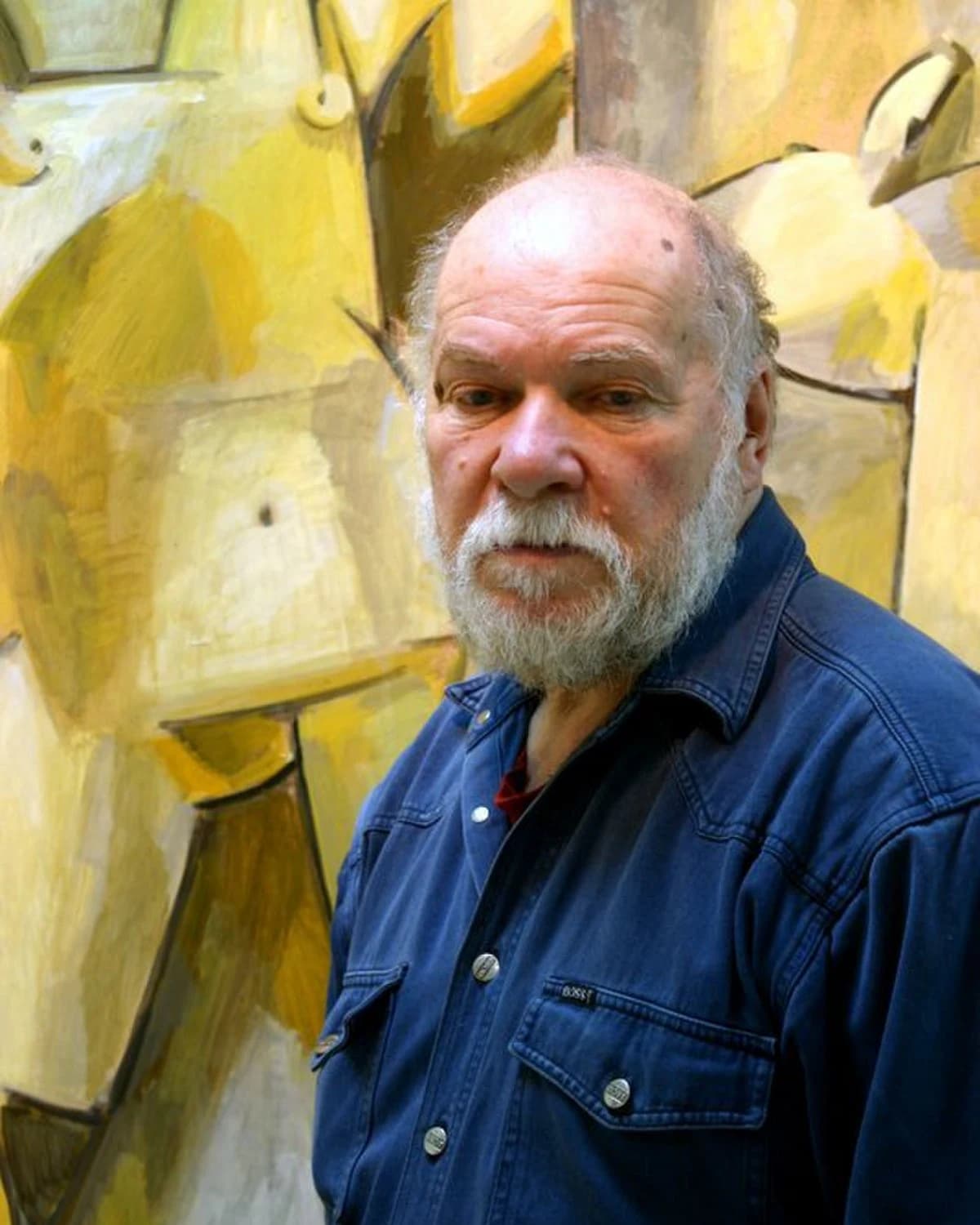
Misha Brusilovsky (1931–2016) entered a boarding school for gifted children in Kyiv at thirteen, and in 1959, after the Repin Institute in Leningrad, was assigned to Sverdlovsk. There, with Gennady Mosin, he painted “1918”, and for many years afterwards worked outside the official line. In 1989 he had a retrospective in Paris. He lived and died in Yekaterinburg.
Biography
In 1944 a boy from Kyiv got into a boarding school for gifted children because of a portrait drawn in coloured pencils. Misha Brusilovsky was thirteen, shining shoes on the square in front of the railway station, and he gave the drawing to a grown-up lad nicknamed Kot (Tomcat), who took most of the boys’ earnings. Kot drove him to the school himself. That is how the artist’s biography tells the story.
He was born on 7 May 1931 in Kyiv. His father, Shaya Shevelevich, was a military engineer and was killed in the war in 1943; his mother, Frida Abramovna, worked in trade; he had a younger brother, Vsevolod. In 1938 his father was sent on a long assignment to the Far East and the family went with him: they lived at In station, in Birakan and in Birobidzhan. At the beginning of 1941 they returned to Kyiv, and in June the war began. Misha and his brother were taken to Troitsk in the Southern Urals, to their aunt Raya, their father’s sister, a doctor; when she was mobilised in 1943, he travelled with her on a hospital train, helped the doctors and the wounded, and during long stops walked to the villages to exchange salt for food.
In 1945 he entered the Shevchenko Art School in Kyiv and graduated in 1952. The Kyiv Art Institute turned him down: admissions, as the sources put it, were strictly regulated by ethnicity. He painted copies of pictures by well-known Soviet artists for palaces of culture and other institutions. In 1953 he went to Moscow and worked for a time as a designer at the All-Union Agricultural Exhibition, then moved on to Leningrad and entered the graphic arts department of the Repin Institute of Painting, Sculpture and Architecture. Ostap Shrub and Minas Avetisyan studied alongside him. He defended his diploma in 1959 (his supervisor was Alexei Pakhomov) and was assigned to Sverdlovsk.
In Sverdlovsk he taught drawing at the Shadr Art College and illustrated books for the Central Ural Publishing House. He met Vitaly Volovich, Herman Metelev, Andrei Antonov and Anatoly Kalashnikov, and with Gennady Mosin, a friend from the institute, he began work on easel paintings. The chairman of the regional Union of Artists, Alexander Vyaznikov, who was waging a campaign against “formalism” (the label then used against art that departed from official Socialist Realism), and some officials of the regional Communist Party committee received his work with hostility. In May 1961, after an exhibition marking his thirtieth birthday, the newspaper “Uralsky rabochy” (The Ural Worker) printed a note, “An Unnecessary Enterprise”, signed by a certain “office worker Efimov”, which criticised every work on show.
In 1962 he and Mosin began the painting “1918”. The idea was a challenge to Vladimir Serov, first secretary of the board of the Union of Artists of the RSFSR, a specialist in historical and revolutionary painting and in portraits of Lenin. In 1963 the art council of the exhibition committee for “Socialist Ural” approved the sketch, and a contract was signed with the authors. When the canvas was almost finished, they rolled it up and painted another version: their Lenin is a resolute man, ready to do anything to reach his goal, not the quiet and modest figure usually painted. Serov tried to ban the picture while it was still in progress; it was helped by Belashova, a secretary of the Union of Artists of the USSR, who used it in her struggle against Serov. The painting was shown at major exhibitions in Moscow, received a special diploma from the Ministry of Defence, was reproduced in “Tvorchestvo”, “Ogonyok” and “Iskusstvo”, and in 1966 represented Soviet art at the Venice Biennale; in 1967 it was seen in Berlin, in the German Democratic Republic. It is now in the Volgograd Museum of Fine Arts. Brusilovsky completed the first version in the late 1980s and gave it to the Yekaterinburg Museum of Fine Arts; the 1963 sketch is in the Perm State Art Gallery. Nationwide fame did not help him with the regional party committee: his name was entered on the “black” lists of formalists, and the publishing house officially forbade him to work.
Without commissions, he worked a great deal in his studio, which other artists visited. He painted “The General” and “García Lorca”, “Leda”, “Venus in the Grotto”, “The Rape of Europa”, subjects from folk tales, “Football” and “Once in Sverdlovsk”. In 1968 he was admitted to the Union of Artists of the USSR. “Civil War Red Commanders in the Urals” (1969, again with Mosin) caused arguments: its style had nothing to do with Socialist Realism. The painting “Arkady Raikin’s Theatre” (1972) was judged anti-Soviet, and Tatiana Nabrosova, who had bought it for the Sverdlovsk House of Art Workers and later became the artist’s wife, was summoned to the KGB. In 1976 he joined a team of 28 artists at Uralmash, the heavy-engineering plant; in 1977 he painted a group portrait of a team of smiths at the Uralmash works. The painting “Golubovsky State Farm” (1984) caused another scandal: Boris Yeltsin, then first secretary of the regional party committee, publicly called it harmful to Soviet art.
In 1986 the ban was lifted. In 1989 the Paris collector and gallery owner Garik Basmadjan proposed an exhibition, and in April Brusilovsky arrived in Paris. The canvases came rolled up. “Aggression” (1975) was chosen for the posters. In July Basmadjan travelled to the USSR and on 29 July disappeared in Moscow; it is considered one of the most mysterious crimes of perestroika-era Russia. The retrospective of fifty works ran from 18 November 1989 to 18 January 1990, and the French press named him alongside Ilya Kabakov, Erik Bulatov and Vladimir Yankilevsky. The gallery stopped its joint projects, and Brusilovsky returned home, leaving most of his works in Paris.
In 1991 he received the Mosin Prize. In 1992 he spent a year in the United States, in Columbus and New York, and painted about a hundred pictures. After France and America his colour changed, and he began to repaint his earlier subjects. In 1993–1997 he made miniatures for the Autograph gallery according to the laws of abstraction, and in 1999 the Sverdlovsk Philharmonic showed “Biblical Subjects” from the collection of Yevgeny Roizman. Eleven interior canvases for a private client, made in 1990 together with Kalashnikov, were never collected by the client, and the public saw them only in 2013.
In 2002 he was awarded the Governor of Sverdlovsk Region Prize, in 2011 the title of Honoured Artist of the Russian Federation, in 2013 he received the mantle of an honorary member of the Russian Academy of Arts, and on 1 June 2016 he became an Honorary Citizen of Sverdlovsk Region. His works are held in museums in Yekaterinburg, Perm, Chelyabinsk, Orenburg and Irbit, and in private collections in several countries. In 2008 a sculptural group by Andrei Antonov, “City Dwellers. Conversation”, showing Brusilovsky, Volovich and Metelev, was installed in Yekaterinburg.
Brusilovsky died on 3 November 2016 in Yekaterinburg and was buried in the Shirokorechenskoye cemetery. The museum named after him opened on 7 May 2017.
Profile notes
Profile and sources
Image
Artist image
Марина Голомидова; Wikimedia Commons; CC BY-SA 3.0.
