
1510–1572
Mir Sayyid Ali
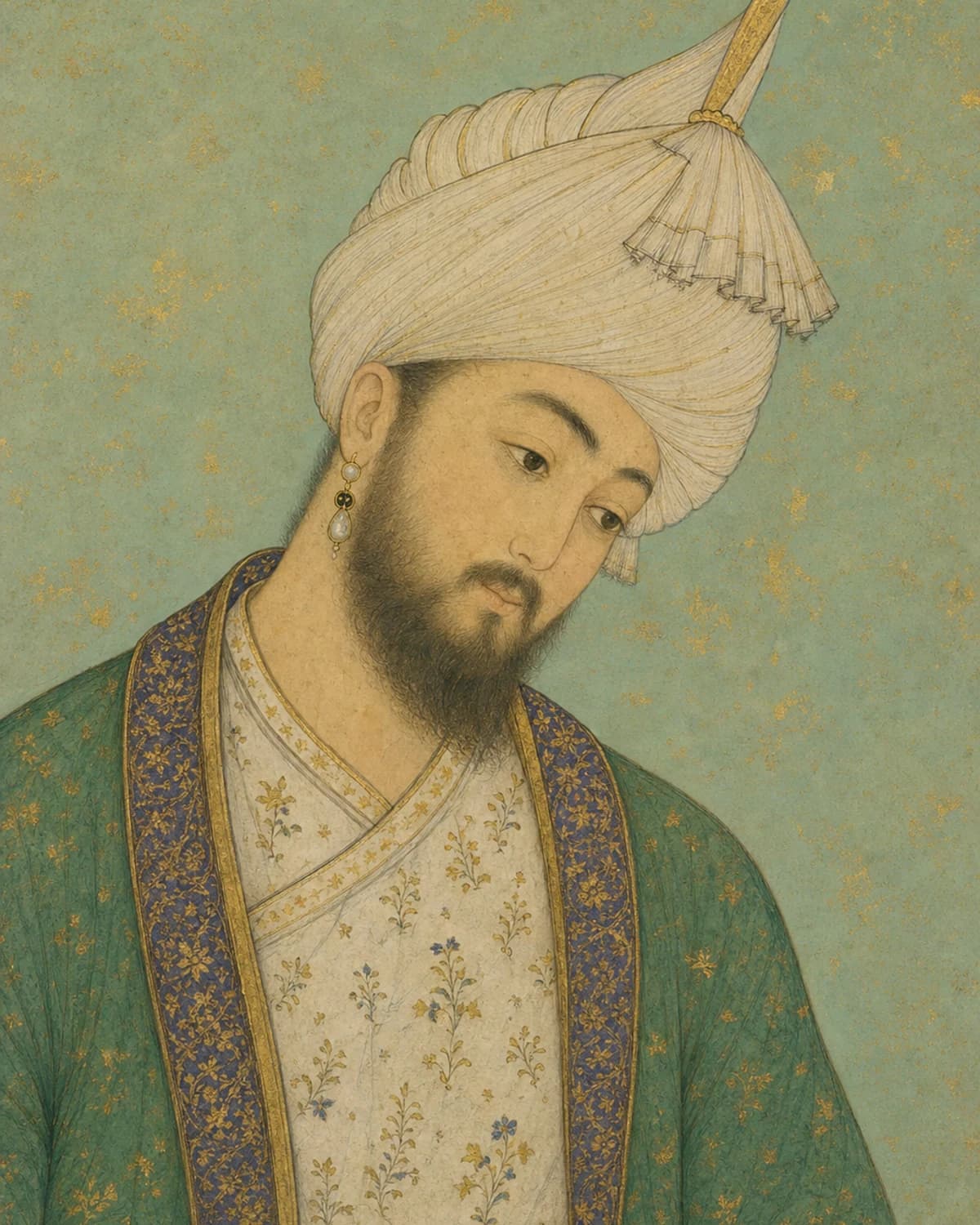
Mir Sayyid Ali, son of the Tabriz painter Mir Musavvir, began at the court of Shah Tahmasp working on the “Shahnameh” and Nizami’s “Khamsa”, and in the mid-1540s entered the service of the exiled Mughal emperor Humayun. Together with Abd al-Samad he stood at the origins of Mughal miniature painting, and under Akbar he began the huge manuscript of the “Hamzanama”.
Biography
Abu’l-Fazl, vizier to the emperor Akbar, listed more than a hundred court painters in his chronicle. First on the list is Mir Sayyid Ali of Tabriz. He learned his art from his father, the chronicler writes, and from the moment he came to the palace “the ray of royal favour shone” on him. Akbar’s father, the emperor Humayun, gave him the honorary title Nadir al-Mulk, “Wonder of the Realm”.
Mir Musavvir was himself a well-known painter, and the family belonged to the sayyids, descendants of the Prophet Muhammad. The chronicler Qazi Ahmad thought the son more gifted than the father, although Mir Musavvir’s influence is visible in his work. Mir Sayyid Ali was born, probably in the 1510s, in Tabriz; according to another version, in Badakhshan. He also wrote poetry, under the pen name Juda’i.
He began in the years when the shah’s workshop was led by Behzad. Scholars believe that as a very young man he worked on the “Shahnameh” made for Shah Tahmasp I from 1525 onwards; the manuscript was later unbound, and its leaves dispersed among museums. Two miniatures in this book are attributed to him, along with a share in leaves painted jointly with Sultan Muhammad and Aqa Mirak. Next came the “Khamsa” of Nizami of 1539–1543, now in the British Library: of its fourteen miniatures four are given to him, and the scene in which an old woman brings Majnun to the encampment bears his signature. To the 1540s belongs a drawing of an elegant youth holding an open letter (Freer Gallery, Washington), in which a self-portrait is sometimes seen. A double frontispiece to the “Khamsa” was made at the same time: “Nomad Encampment” on one leaf and “Night-time in a Palace” on the other, both now in the Harvard Art Museums. Today only the palace scene is left to him.
His career at court was cut short by a change in the shah himself. From the 1540s Tahmasp grew ever stricter in his faith, lost interest in book painting and in the end banned secular images throughout the country. The artists dispersed, many finding refuge with his nephew Ibrahim Mirza. At this time the Mughal emperor Humayun, who had lost his throne after defeats by Sher Shah, came to Iran; in 1543 the shah received him with honour. In Tabriz Humayun saw the work of the court painters and invited two of them to join him, Abd al-Samad and Mir Musavvir. Why the son went instead of the father is not known. Mir Sayyid Ali entered Humayun’s service around 1544–1545.
Humayun took a long time to win back his lands, and for several years his court was based in Kabul. Mir Sayyid Ali arrived there in 1549 and stayed until the summer of 1555, when Humayun’s army defeated Sikandar Shah Suri and opened the road to Delhi. Little survives from the Kabul years; among the few works is the “Portrait of a Young Scribe” (around 1550, Los Angeles County Museum of Art), in which the museum sees a possible self-portrait. Persian portraiture was more conventional and idealised than Mughal, but this leaf is counted among the finest Persian portrait miniatures.
Humayun died in January 1556, half a year after returning to Delhi, after a fall from the stairs of his library. His heir, Akbar, had learned drawing as a child from Mir Sayyid Ali and Abd al-Samad. Mir Sayyid Ali became head of the imperial kitabkhana, the library and workshop, and in 1562 began its largest undertaking, the “Hamzanama”, the story of Amir Hamza, the Prophet’s uncle. Fourteen volumes of a hundred large illustrations each were planned, about 1,400 leaves; about 140 survive. He himself, like Abd al-Samad, directed more than he painted; the leaf “The Prophet Elijah Rescues the Drowning Nur ad-Dahr” (British Museum) is attributed to him. His late manner is also shown by the portrait of his father (1565–1570) and the drawing “A Sage Reflecting on a Book”, both in the Musée Guimet in Paris. In India he kept to the Persian manner, although the influence of local painting is visible in his landscapes. Work on the book went slowly: after seven years only four volumes were ready. Around 1569 Mir Sayyid Ali left the court and set out as a pilgrim to Mecca, and the “Hamzanama” was completed by 1577 under Abd al-Samad’s direction.
What became of him afterwards is not known. Some believe he died during the hajj, and then the year usually given is 1572; others think he returned to Akbar’s court and died later, in the 1580s.
Related context
Associations
Works connected through artistic movements, cultural context and period. Priced works available in this market appear first.
Profile notes
Profile and sources
Image
Artist image
На основе открытого изображения: Mir Sayyid Ali; Wikimedia Commons; Public domain.
