
1450–1555
Mir Musavvir
Mir Musavvir worked in the royal book workshop of Shah Tahmasp I at Tabriz and took part in illustrating the Shahnameh of Ferdowsi commissioned by the shah. His signature appears on the miniature “Manuchihr Enthroned”, and the portrait of the table-steward Sarkhan Beg bears an inscription pointing to his authorship. He most likely spent the end of his life at the court of Humayun, where his son Mir Sayyid Ali had gone before him.
Biography
Few signatures by Mir Musavvir survive, and one of them is hidden: his name is written on a courtier’s turban in the miniature “Manuchihr Enthroned” from the Shahnameh of Shah Tahmasp. The rest of what we know has to be gathered from small details like this, from a handful of leaves attributed to him, and from the accounts of his contemporaries.
Nothing is known of his youth. He was born in the late fifteenth century, according to some accounts in Badakhshan, according to others in Termez; the dates given in reference books (1450–1555) are not confirmed by documents in that form, and only his death, around 1555, is reliably known. The word “Mir” in his name is a shortening of “emir”: he was a sayyid, a descendant of the Prophet Muhammad, and this gave him a special standing. “Musavvir” means “painter”. He is said to have studied under Bihzad and to have been a contemporary of Sultan Muhammad; I have not seen direct documents for this.
From his native region he moved to Tabriz, the Safavid capital, and entered the workshop of Shah Tahmasp I, where he was soon among the painters most often called on. Dust Muhammad, the author of a treatise on calligraphers and painters written in 1544, calls him and Aqa Mirak two incomparable sayyids in the service of the royal library. According to him, they painted the walls of the palace of the shah’s brother, Sam Mirza (scholars mention a hall of mirrors there, where Jalal al-Din Mirak joined them), and worked on manuscripts of the Shahnameh and the Khamsa of Nizami. Dust Muhammad compares him to Mani and claims that Mani would have thrown away his brush on seeing Mir Musavvir’s work.
His largest project was the Shahnameh of Tahmasp, commissioned around 1525–1535: 742 pages measuring 47 by 31.8 centimetres, with 258 full-page miniatures. Many are attributed to him, often in collaboration with other painters. Some scholars, relying on signatures and attributions, regard him as one of the chief contributors and name eight miniatures, among them “Zahhak’s Nightmare”, the most complex composition in the manuscript. His early works of the 1520s, for example “Ardashir and the Slave Girl Gulnar” (1527–1528), are carefully constructed, with close attention to architecture, lamps, bowls and ewers. By the 1530s, in the observation of specialists, his pages became broader in conception and more dramatic, with fewer small details. For albums he also made single-page paintings, such as the portrait of Sarkhan Beg, the steward of the royal table (about 1530–1540, British Museum). The paint on the face is badly lost, but the drawing of the turban is rendered with great fineness.
The third signed work is “Nushirwan and the Owls” from the Khamsa of Nizami made for the shah in 1539–1543. A verse couplet in the iwan depicted in the miniature names the painter and dates the page to 1539–1540.
Later, according to the chroniclers, Mir Musavvir fell out of favour; perhaps the shah had simply lost interest in patronizing artists. In 1544 the exiled Mughal emperor Humayun was a guest in Tabriz and invited the best masters to join him “if he regained his throne”. His son, Mir Sayyid Ali, went first; the chronicler Qadi Ahmad thought him more gifted than his father and added that he “hastened to India”. Mir Musavvir himself followed later, possibly together with Dust Muhammad. By November 1549 both had left Iran and were at the court in Kabul.
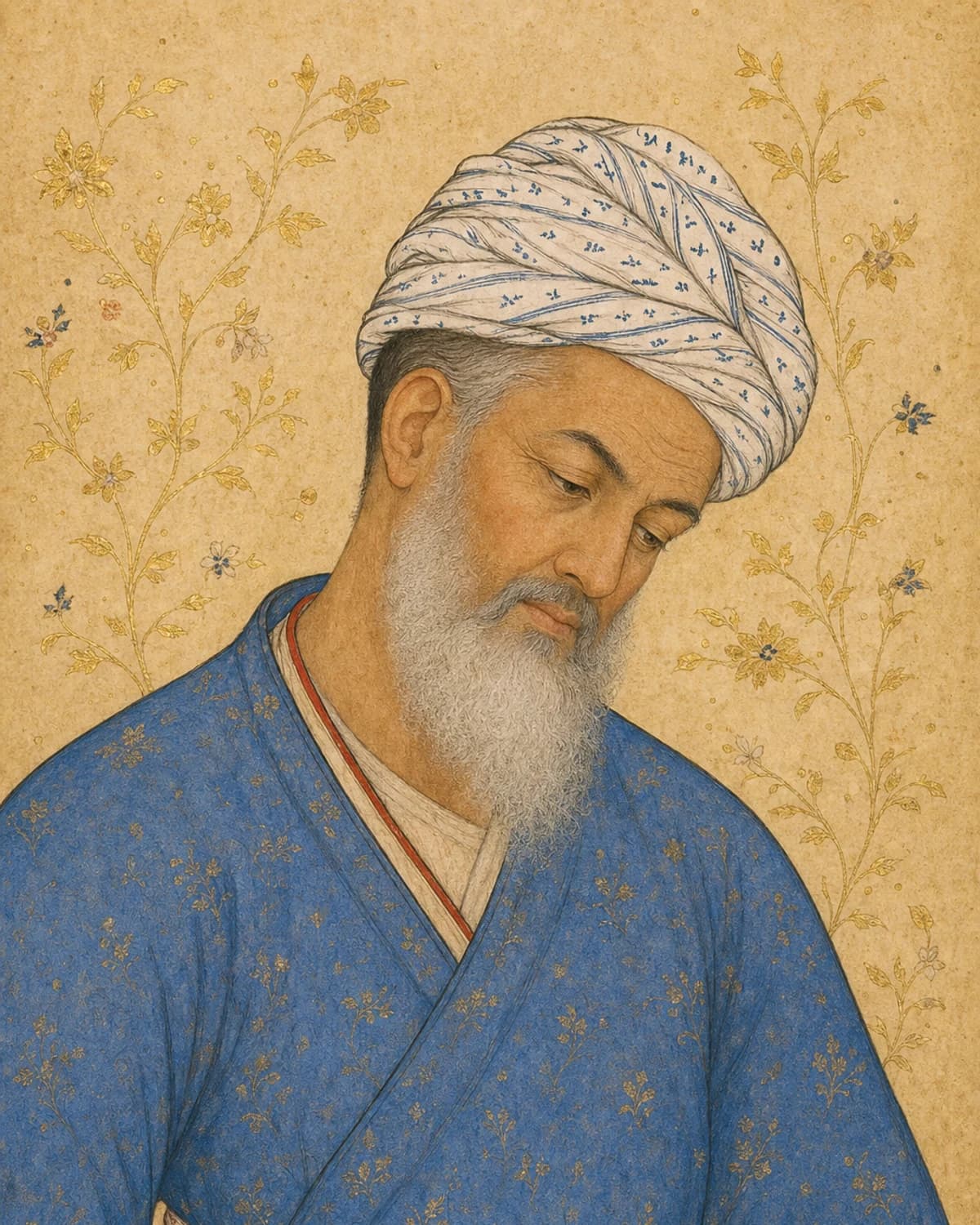
A Khamsa of Nizami (Ahmedabad, private collection) was made for Humayun in the 1550s, one of the few manuscripts surviving from his time. Two or three miniatures in it are attributed to Mir Musavvir. A portrait of 1555, either his own or his son’s, shows him in an Indian turban: he had probably already joined his compatriots in the Punjab. He died around 1555, according to most accounts in India. No undisputed works by him have yet been found among the output of the Mughal workshop, but his son became the teacher of Prince Akbar and directed the making of the Hamzanama.
Related context
Associations
Works connected through artistic movements, cultural context and period. Priced works available in this market appear first.
Profile notes
Profile and sources
Image
Artist image
На основе открытого изображения: Attributed to Lal / Attributed to Mir Mossavvir; Wikimedia Commons; Public domain.
