
18.11.1852–10.07.1913
Mikoláš Aleš
Mikoláš Aleš (1852–1913), together with František Ženíšek, won the commission to paint the interiors of the National Theatre in Prague, for which he made the cycle “Homeland”. In his lifetime he was known chiefly as a graphic artist: he illustrated fairy tales, songbooks and historical works, drew for magazines and designed sixty marionettes. His oil paintings became widely known only after his death.
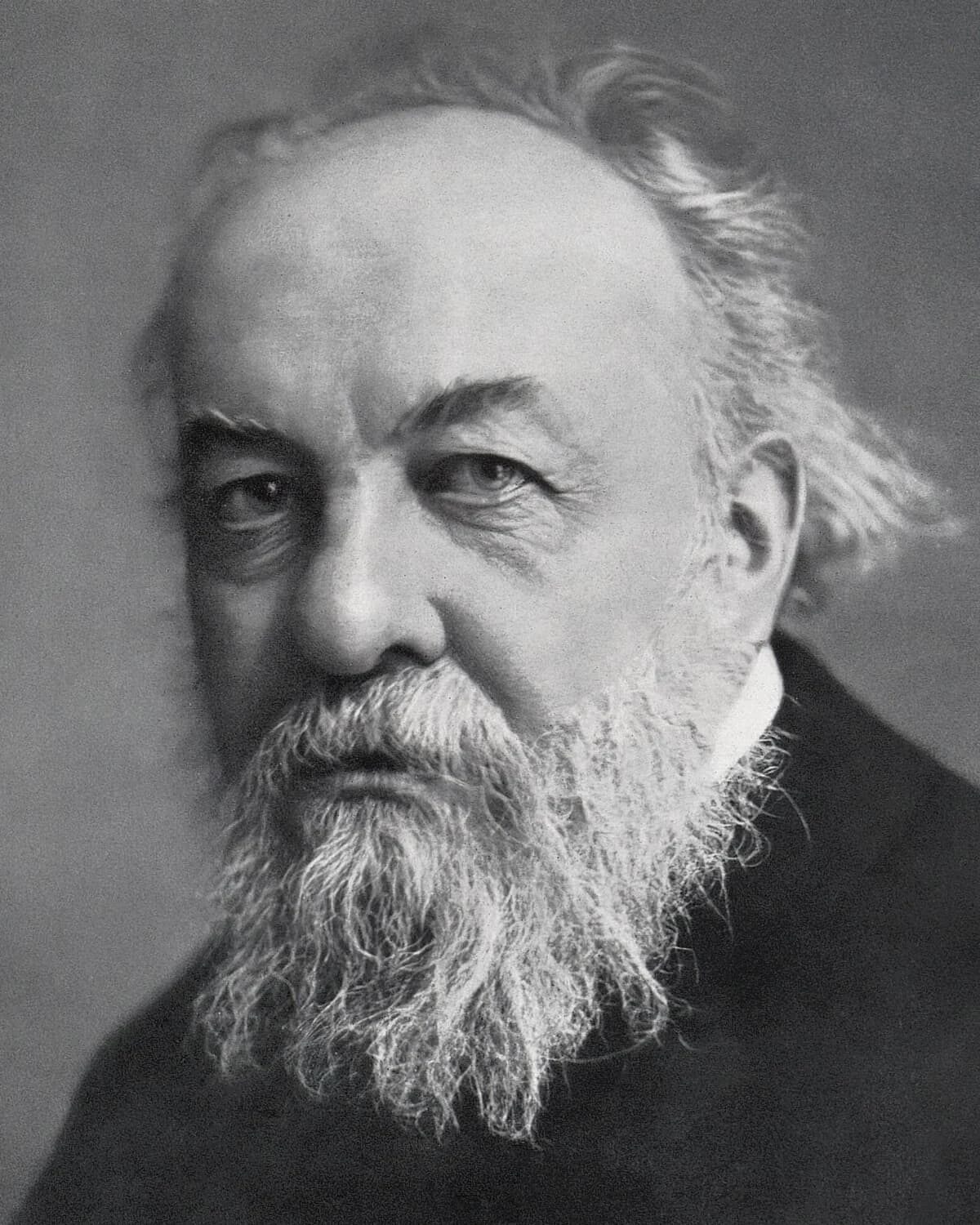
Biography
In 1876 a student at the Academy of Fine Arts in Prague was arrested for taking part in a protest against Professor Alfred Woltmann. After the arrest he was expelled from the academy.
Aleš was born on 18 November 1852 in Mirotice, near Písek, the son of an official. The family was not well off and moved often because of money troubles: in 1856 to Písek, then to Prague, and in 1859 back to Mirotice. He began to draw at the age of four. In 1865 he entered the gymnasium, in 1867 he moved to the Realschule, a secondary school with a practical curriculum, and after examinations in 1869 he went to Prague, to the Academy of Fine Arts. While studying he was already earning a living from drawings and book illustrations. Sources give different dates for the end of his time at the academy: by some accounts he finished in 1875, by others he was expelled in 1876.
His first notable series, “The Senses”, dates from 1876. The next year came “Homeland”, made with Ženíšek for the National Theatre. Aleš’s early works are Romantic, with a visible influence from Josef Mánes; later the aesthetics of Art Nouveau were added to this. He was interested in the Czech people and their history, and I would call that the constant theme of all his work. In 1879 Aleš, with Ženíšek and Bohumír Roubalík, won the competition to decorate the interior rooms of the National Theatre in Prague. In the same year he married and went to study in Italy. After his return, in 1880–1881, he worked on fourteen large panels for the theatre and at the same time drew for the magazine Šotek. For the Prague puppet theatre he designed sixty marionettes.
“The Senses” and “Homeland” were followed by “The Elements” (1881) and “Prague” (1882), then by the cycle “The Life of the Ancient Slavs” (1891). In 1889 a cycle of illustrations to Czech folk songs appeared, and in the same year he painted watercolour landscapes. He drew for the magazines Květy, Světozor, Zlatá Praha and Šotek. There also survive many graphic sheets showing the streets and buildings of Prague, Plzeň and other Czech towns, as well as cartoons for fresco decoration on houses. The total number of his published drawings is estimated at more than five thousand; by other counts he made about eight thousand pen drawings alone. I have not checked either figure against documents.
Aleš also illustrated songs of other peoples. Among his Ukrainian works a drawing for the song “Vorony koniu, zahrai pidi mnoiu…” (1904) is mentioned, and among Russian subjects the cartoon “Polky Ihorevi” (1902) and the cycle “The Russian Bogatyr” (1912).
In 1895 an exhibition of his work was held in Prague. For his sixtieth birthday he was made an honorary citizen of Prague and given the title “Inspector of Painting and Adviser on the Visual Arts”.
Aleš died on 10 July 1913 in Prague; the last series of his illustrations dates from that same year. His oil paintings became widely known only after his death. In 1952 the director Václav Krška made a biographical film about him, with Karel Höger in the title role.
Related context
Associations
Works connected through artistic movements, cultural context and period. Priced works available in this market appear first.








Profile notes
Profile and sources
Image
Artist image
Jan Schumpeter; Wikimedia Commons; Public domain.
