
10.02.1810–12.02.1898
Miklós Barabás
Miklós Barabás (1810–1898) grew up in Transylvania, studied in Vienna, learned lithography in Cluj and painted portraits in Bucharest, and went on to become the leading portraitist of the Hungarian Reform Age. His sitters included Franz Liszt, Lajos Kossuth, Sándor Petőfi and János Arany. In 1859 he became one of the founders of the Art Society in Pest and headed it from 1862 until his death.
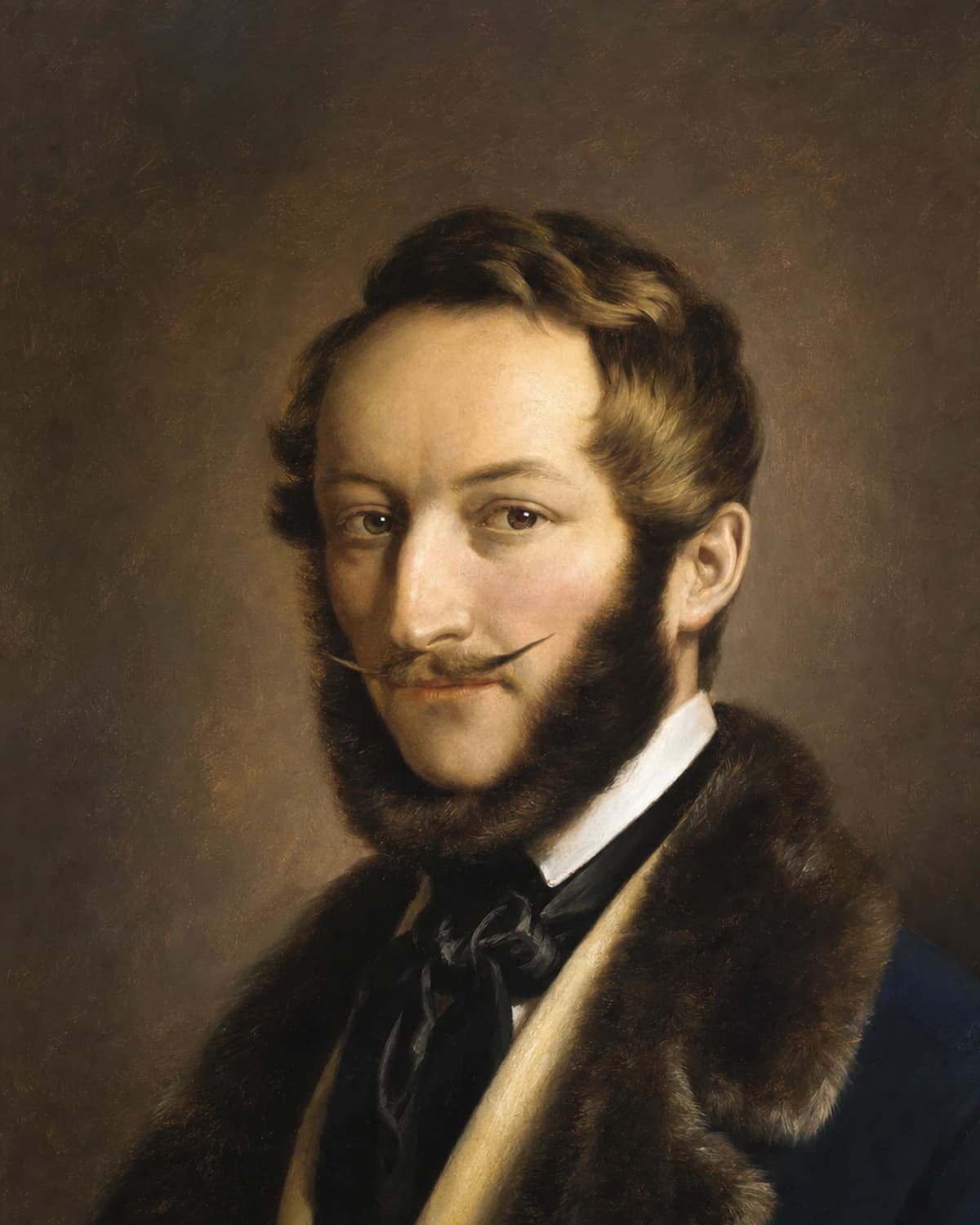
Biography
The portrait of the young Franz Liszt, painted in 1847, is perhaps still Barabás’s best-known work. Six years later he painted Emperor Franz Joseph I, and in 1884, when he was past seventy, the poet János Arany.
He was born in Mărcuşa (the Hungarian name is Márkosfalva), in Háromszék County in Transylvania, into a Hungarian family. Sources disagree on the date of birth: 10 or 22 February 1810. He received his secondary education at the Protestant college of Nagyenyed (today Aiud), where his uncle Miklós Gaal taught.
In 1829 he went to Vienna, to the Academy of Fine Arts, and for a time studied with Johann Ender; in 1830 he returned to Kolozsvár (today Cluj-Napoca) and learned lithography from Gábor Barra. In 1831 he moved to Bucharest. He worked there for two years as a portraitist, and I think it was these commissions that gave him his first serious experience. In 1834–1835 he travelled in Italy. There he met the Scotsman William Leighton Leitch, who was six years his senior. Leitch taught him watercolour, they became friends and painted together in the Lake Maggiore region. Leitch’s influence can be seen in his later work. In 1836–1838 Barabás continued his studies in Budapest and after 1840 finally settled in Pest; by other accounts this happened in 1855, so I would not like to name the exact date.
He painted politicians, musicians, writers, clergymen, army officers and members of high society in Hungary, Austria and Romania. His sitters included Lajos Kossuth and Sándor Petőfi. There were also documentary portraits of historical heroes of Hungary, Transylvania and Croatia. His portraits, often small in format, bear the stamp of Biedermeier and of the tastes that prevailed in Vienna. He also painted scenes of rural life and portraits of peasant families.
One such work, “Romanian Family Going to the Fair” (1844), was a success at the exhibition of the Vienna Art Association in 1844 and then in Pest. It was regarded as the finest folk genre painting of its time, and the beginnings of Hungarian genre painting are linked with Barabás’s name.
During the years of absolutism commissions grew scarce, and for a time he had to take photographs and paint altarpieces. Out of these difficulties grew the Art Society, founded in 1859; from 1862 until the end of his life Barabás was its president.
In 1867 he was elected a member of the Hungarian parliament for Pest.
He died in Budapest on 12 February 1898. He is buried in the Kerepesi Cemetery, under a monument by Eduard Telcs.
Related context
Associations
Works connected through artistic movements, cultural context and period. Priced works available in this market appear first.








Profile notes
Profile and sources
Image
Artist image
На основе открытого изображения: Miklós Barabás; Wikimedia Commons; Public domain.
