
05.03.1856–01.04.1910
Mikhail Vrubel
Mikhail Vrubel worked in almost every field of art: church murals and icons in Kiev, majolica and fireplaces at Abramtsevo, stage sets, panels for Moscow mansions, illustrations to Lermontov. Critics long refused to accept his “Demons”, “The Swan Princess” and “Pan”; in 1896 the Academy jury had his panels removed from the Nizhny Novgorod exhibition. He was elected an academician in 1905, when he could hardly work any more.
Biography
On 25 April 1896 a telegram went from Nizhny Novgorod to St Petersburg: “Vrubel's panels monstrous, must be removed, awaiting jury.” It concerned two huge canvases, “Mikula Selyaninovich” and “The Princess of Dreams”, which Savva Mamontov had commissioned from Vrubel for the empty walls of the art section of the All-Russian Exhibition. A commission of the Academy of Arts ruled that they could not be shown, and on 22 May the panels were carried out of the pavilion. Mamontov bought them, had Polenov and Korovin finish “Mikula”, and put up a separate pavilion nearby with a sign: “Exhibition of decorative panels by the artist M. A. Vrubel, rejected by the jury of the Imperial Academy of Arts.” Everything after his name soon had to be painted over.
Later, if Korovin is to be believed, Nicholas II praised Vrubel's “Lilacs” at Diaghilev's exhibition and asked whether this was the artist who had been “executed in Nizhny”.
Vrubel was born on 5 (17) March 1856 in Omsk, where his father, an army officer from a noble family of Polish origin, was serving; in Polish the surname means “sparrow”. His mother died when the boy was three. The family moved wherever the father was posted: Astrakhan, Kharkov, Saratov, St Petersburg, Odessa. In Saratov the boy saw a copy of Michelangelo's “Last Judgement” and, according to his sister, reproduced it from memory in every detail. He graduated from the Richelieu Gymnasium in Odessa with a gold medal, and in the holidays he copied Aivazovsky's “Sunset at Sea” in oils. Then came the law faculty of St Petersburg University. He studied, it seems, without much zeal, had to repeat a year, lived as a tutor with the wealthy Papmel family, was taken with Kant's philosophy and went to the evening classes at the Academy.
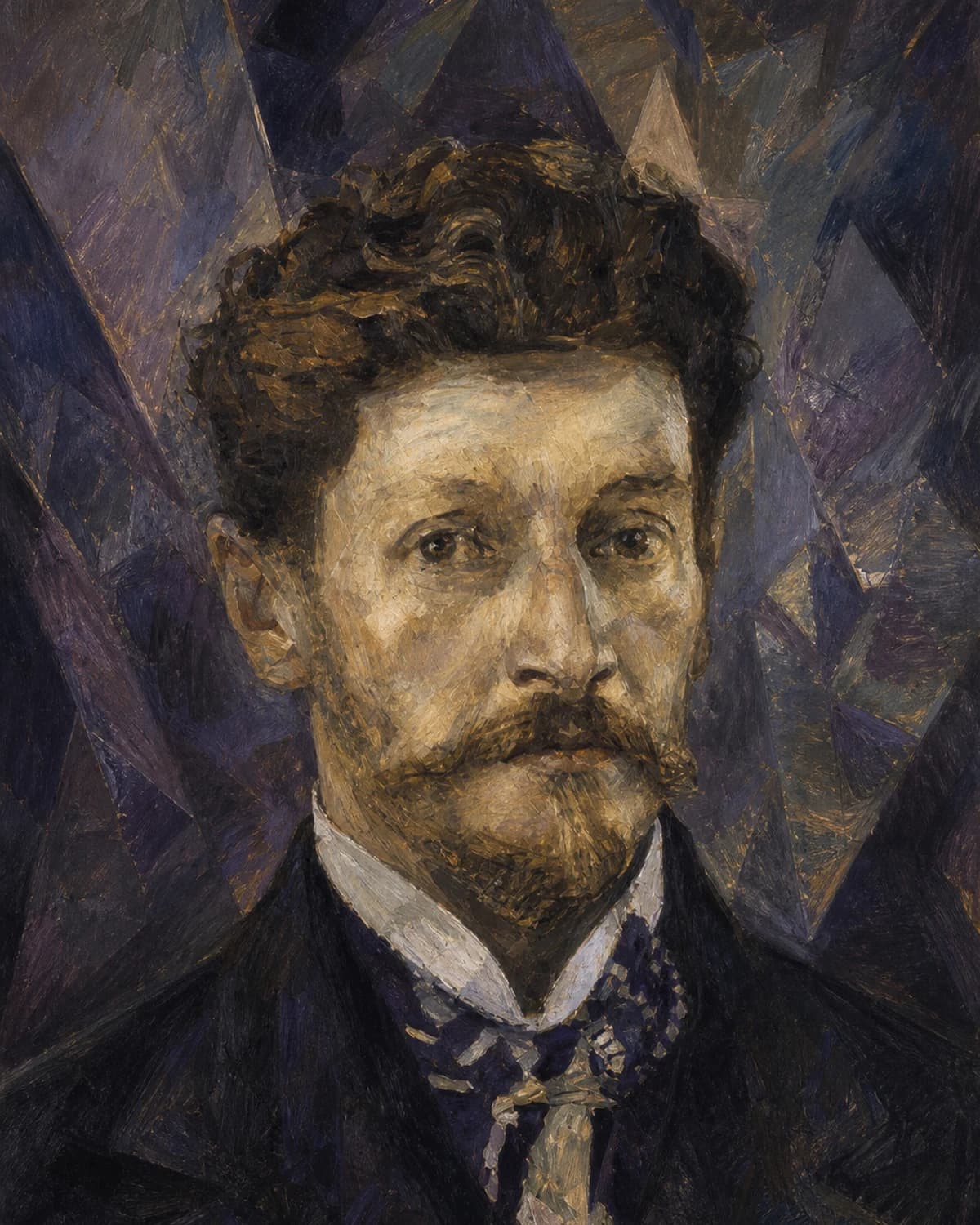
In 1880, at twenty-four, he became an auditor at the Academy of Arts and joined Pavel Chistyakov's class. He later called his years with Chistyakov the brightest of his artistic life. There he became friends with Serov, and there he developed his way of building form out of small facets, almost like a crystal. In 1883 “The Betrothal of Mary and Joseph” won a silver medal, but he never finished the course: that autumn Adrian Prakhov, on Chistyakov's recommendation, invited him to Kiev to restore the twelfth-century murals of St Cyril's Church.
The five years in Kiev gave him more than the Academy had. In St Cyril's Church he painted “The Descent of the Holy Spirit on the Apostles” himself, directly on the wall, without cartoons, and among the apostles one can recognise acquaintances from Kiev and Prakhov himself. He traced some hundred and fifty figures for the restorers and restored the angel in the dome of St Sophia's Cathedral. He painted three icons for St Cyril's in the winter of 1884/85 in Venice, on zinc panels, while studying the mosaics of Torcello and San Marco, Carpaccio and Giovanni Bellini. His sketches for St Vladimir's Cathedral, several versions of the “Lamentation”, were turned down by Prakhov: they stood out too sharply from the ensemble. I think it was an honest decision, though a painful one for Vrubel. The first “Demon”, painted in Kiev, he destroyed after his father had seen it. The only finished picture of those years is “Girl against a Persian Carpet”.
In September 1889 he went to Moscow to see friends and stayed there for some fifteen years.
At first Vrubel lived in Konstantin Korovin's studio, then at Mamontov's on Sadovaya-Spasskaya Street. For the 1891 jubilee edition of Lermontov he made illustrations to “The Demon” in black watercolour, and the press abused them for “crudeness” and “caricature”. At the same time came “The Demon Seated”: in a letter to his sister in May 1890 he described it as “a half-naked, winged, young, mournfully pensive figure sitting with its arms around its knees against a sunset”. From the summer of 1890 he ran the ceramics workshop at Abramtsevo, made majolica, stoves, fireplaces and architectural designs, and worked with Fyodor Schechtel on the Morozov mansions. The panels “The Judgement of Paris” and “Venice” were refused by the clients, the Dunkers, and bought by the collector K. D. Artsybushev, in whose house Vrubel later lived for long periods; he painted Artsybushev's portrait as well.
Early in 1896, at a rehearsal of “Hansel and Gretel” in St Petersburg, he heard the singer Nadezhda Zabela and proposed to her practically on the day they met. They were married in Geneva on 28 July 1896. The best works of the Moscow years were painted beside her and beside Rimsky-Korsakov's operas: “Pan” (painted in a single day at Talashkino over a portrait of his wife he had begun), “Bogatyr”, “The Swan Princess” (1900). At the 1900 Exposition Universelle in Paris his majolica fireplace “Volga Svyatoslavich and Mikula Selyaninovich” won a gold medal. On 1 September 1901 their son Savva was born.
Vrubel worked on “The Demon Downcast” in the winter of 1901/02 for fourteen hours a day and could not stop: after the exhibition in Moscow in February 1902 he went on repainting it in St Petersburg. In the spring of 1902 the artist fell gravely ill and spent the following years mostly in clinics, with short returns to work. In November 1902 Benois and Diaghilev organised an exhibition of thirty-six of his works, with three “Demons”, and attitudes towards him changed. In the clinics he drew doctors, patients, a discarded dress, a rumpled bed, a carafe, a rose in a glass. In 1905 he showed “The Pearl Shell”, on 28 November of that year he was elected an academician “for prominence in the artistic field”, and at the turn of 1905–1906 he drew a portrait of Valery Bryusov. Soon afterwards he went blind. His sister Anna read Turgenev and Chekhov's “The Steppe” aloud to him.
Vrubel died in St Petersburg on 1 (14) April 1910. He was buried on 3 April in the cemetery of the Novodevichy Convent in St Petersburg. The only speech over the grave was given by Alexander Blok, who called him a “herald of other worlds”.
Related context
Associations
Works connected through artistic movements, cultural context and period. Priced works available in this market appear first.








Profile notes
Profile and sources
Image
Artist image
На основе открытого изображения: Mikhail Vrubel; Wikimedia Commons; Public domain.
