
19.05.1862–18.10.1942
Mikhail Nesterov
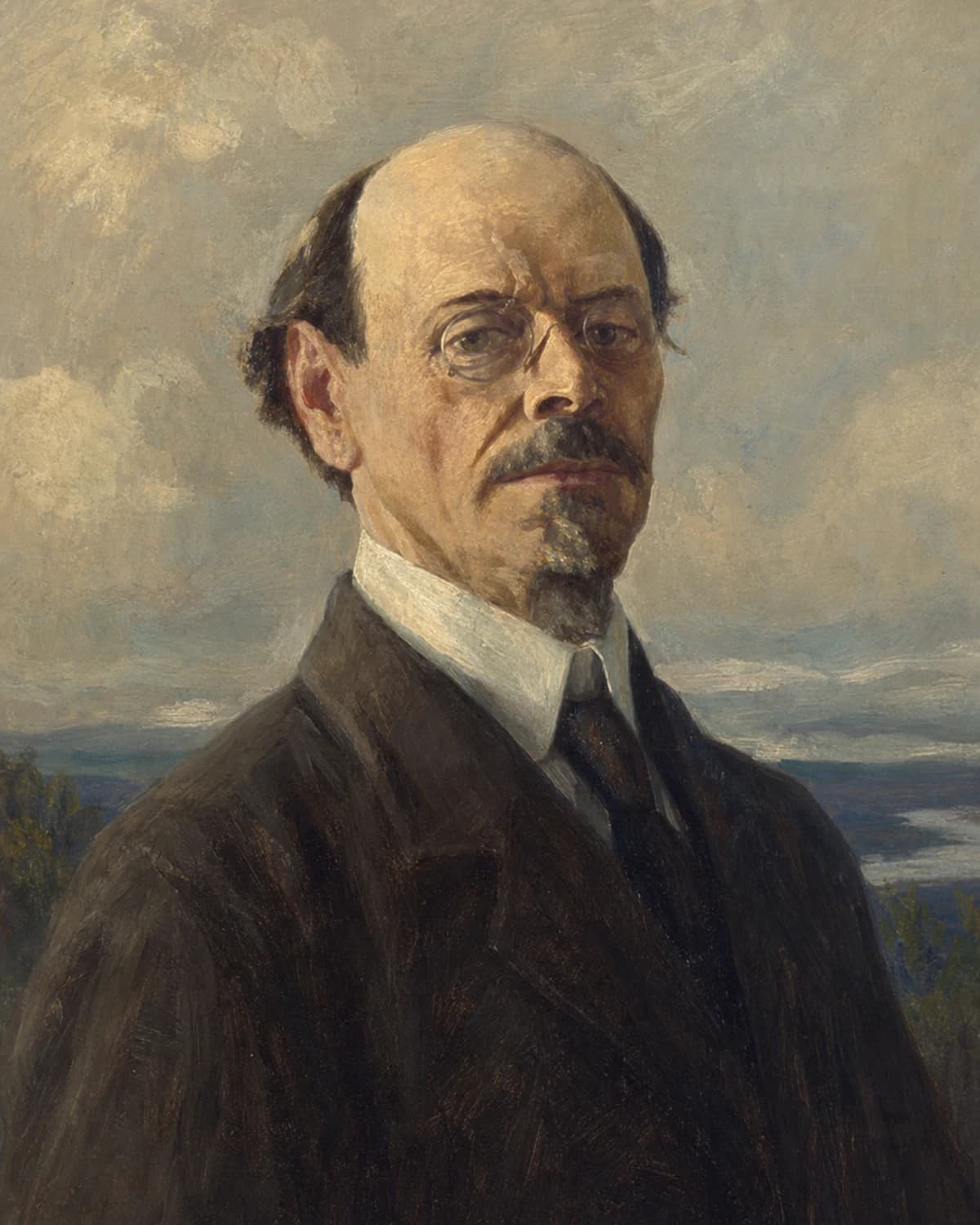
Mikhail Nesterov (1862–1942) made his name with “The Vision to the Youth Bartholomew”, which opened his half-century cycle on St Sergius of Radonezh. For more than twenty years he painted churches, from St Vladimir’s Cathedral in Kiev to the Marfo-Mariinsky Convent in Moscow, and after the revolution he became a portraitist: his portrait of the physiologist Ivan Pavlov won him a Stalin Prize in 1941.
Biography
In 1877 a fifteen-year-old pupil of a Moscow secondary school went to the Fifth Itinerant Exhibition and stopped in front of Kuindzhi’s “Ukrainian Night”. He was overwhelmed, as he later wrote, “to the point of languor”. That autumn Mikhail Nesterov entered the Moscow School of Painting, Sculpture and Architecture.
He was born on 19 (31) May 1862 in Ufa, the son of a merchant who traded in cloth but cared more for history and books. In 1874 the boy was sent to Moscow to enter a technical college; he failed the examinations and ended up at Voskresensky’s secondary school, whose director persuaded his father not to stand in the way of his son’s study of painting.
At the School of Painting Nesterov studied under Pavel Sorokin, Illarion Pryanishnikov and Vasily Perov, his favourite teacher. In 1881 he left for St Petersburg, to the Academy of Arts and Pavel Chistyakov, but the Academy disappointed him and a year later he came back. By then Perov was dying, and his pupil managed to paint a portrait of the fading teacher. Then came the classes of Alexei Savrasov and Vladimir Makovsky, subjects from pre-Petrine Russia and a living earned by drawings for magazines and books. In 1885 “The Calling of Mikhail Fyodorovich Romanov to the Throne” earned him the title of Free Artist, and that summer, against his parents’ wishes, he married Maria Martynovskaya, whom he had met in Ufa. In May 1886 their daughter Olga was born and his wife died. Her features can later be recognised in the three versions of “The Tsarevna” (1887) and in “The Bride of Christ”.
His first major success was “The Hermit” (1888–1889): an old monk in bast shoes wanders along a river in late autumn, past a thin fir tree and the last red sprig of rowan. The painting was shown at the Seventeenth Itinerant Exhibition and bought by Pavel Tretyakov, and in the spring of 1889 Nesterov used the money to travel to Austria, Italy, France and Germany, without knowing a single foreign language. In Venice he was moved most of all by Carpaccio and his “childlike faith”, and in Paris he saw Bastien-Lepage’s “Joan of Arc”, which, in the view of art historians, had a decisive influence on his next painting.
“The Vision to the Youth Bartholomew” (1889–1890) is based on the life of St Sergius of Radonezh written by Epiphanius the Wise; Nesterov painted the landscape near the Trinity Lavra of St Sergius, staying in the village of Komyakino near Khotkovo. At the Eighteenth Itinerant Exhibition the canvas provoked arguments and it, too, went to Tretyakov. The artist considered it his best work to the end and in old age liked to repeat: “It is not I who will live. ‘The Youth Bartholomew’ will live.” Over half a century he painted fifteen large works about Sergius, among them “The Youth of St Sergius” and the triptych “The Labours of St Sergius”.
In 1890 the painting was seen by Adrian Prakhov, who was in charge of the murals of St Vladimir’s Cathedral in Kiev, and he invited its author to join him. Nesterov hesitated, then went to study Byzantine models in Rome, Palermo, Constantinople and Ravenna, and until 1895 worked in the cathedral alongside Viktor Vasnetsov, placing his saints against a background of living nature. He gave more than twenty-two years to church murals and icons: Abastumani, where Grand Duke George Alexandrovich invited him in 1898, the mosaics of the Church of the Resurrection of Christ in St Petersburg, the Marfo-Mariinsky Convent, the cathedral in Sumy. He judged this work harshly himself, most gently the Marfo-Mariinsky Convent, where he painted “The Way to Christ” with ordinary people in place of saints and ascetics.
Alongside these came paintings about the fate of women, inspired by Melnikov-Pechersky’s novels about the Old Believers beyond the Volga: “On the Hills” (1896), “The Great Tonsure” (1897–1898), which made him an academician, and “Meditations”. The painting “To the Sound of the Bell” (1895) brought him membership of the Society of Itinerant Art Exhibitions. After a trip to the Solovetsky Monastery in 1901 came “Silence” and “Quiet Life”. In the spring of 1902 he showed the still unfinished “Holy Rus” in Kiev, and one of the visitors, Ekaterina Vasilyeva, soon became his second wife. Her portrait of 1905 he considered the first portrait he was satisfied with.
He placed the painting “In Rus. The Soul of the People” (1915–1916) beside “The Youth”: “At the beginning of life, ‘The Youth Bartholomew’; towards the end, ‘The Soul of the People’.” Along the Volga walks a crowd of people of every class and every age, and far ahead strides a peasant boy, painted from his son Alyosha. In 1917 came “The Philosophers”, a double portrait of Pavel Florensky and Sergei Bulgakov.
After the revolution the family left for the Caucasus; in Armavir in 1918 Nesterov fell seriously ill, and he did not return to Moscow until 1920.
Religious subjects had become impossible. In 1925 he was briefly arrested and released thanks to the efforts of Alexei Shchusev; in 1938 he spent two weeks in Butyrka prison, his son-in-law was shot that same year, and his daughter Olga was sent to a camp.
Portraiture became his main genre. Nesterov took no commissions and painted those he chose himself: the Korin brothers (1930), the sculptor Shadr (1934), the surgeon Sergei Yudin, Vera Mukhina (1940), Ivan Pavlov in 1930 and 1935. Durylin recalled his conviction that everything in a picture moves outward from the human face; in the late portraits this shows best of all, to my mind. For the second portrait of Pavlov he received a Stalin Prize of the first degree in 1941, and on 1 June 1942 he was made an Honoured Art Worker of the RSFSR. The same year saw the publication of his memoirs, “Bygone Days”.
He refused to leave Moscow during the war. In the autumn of 1942 he painted “Autumn in the Village”, recalling Pushkin’s line “The sky already breathed of autumn…”. In October friends arranged a concert for him in the flat of the pianist Konstantin Igumnov; Nadezhda Obukhova sang twelve old romances, and in gratitude Nesterov painted a watercolour for her. He died on 18 October 1942 in the Botkin Hospital and was buried in the Novodevichy Cemetery.
Related context
Associations
Works connected through artistic movements, cultural context and period. Priced works available in this market appear first.








Profile notes
Profile and sources
Image
Artist image
На основе открытого изображения: Mikhail Nesterov; Wikimedia Commons; Public domain.
