
03.06.1881–10.05.1964
Mikhail Larionov
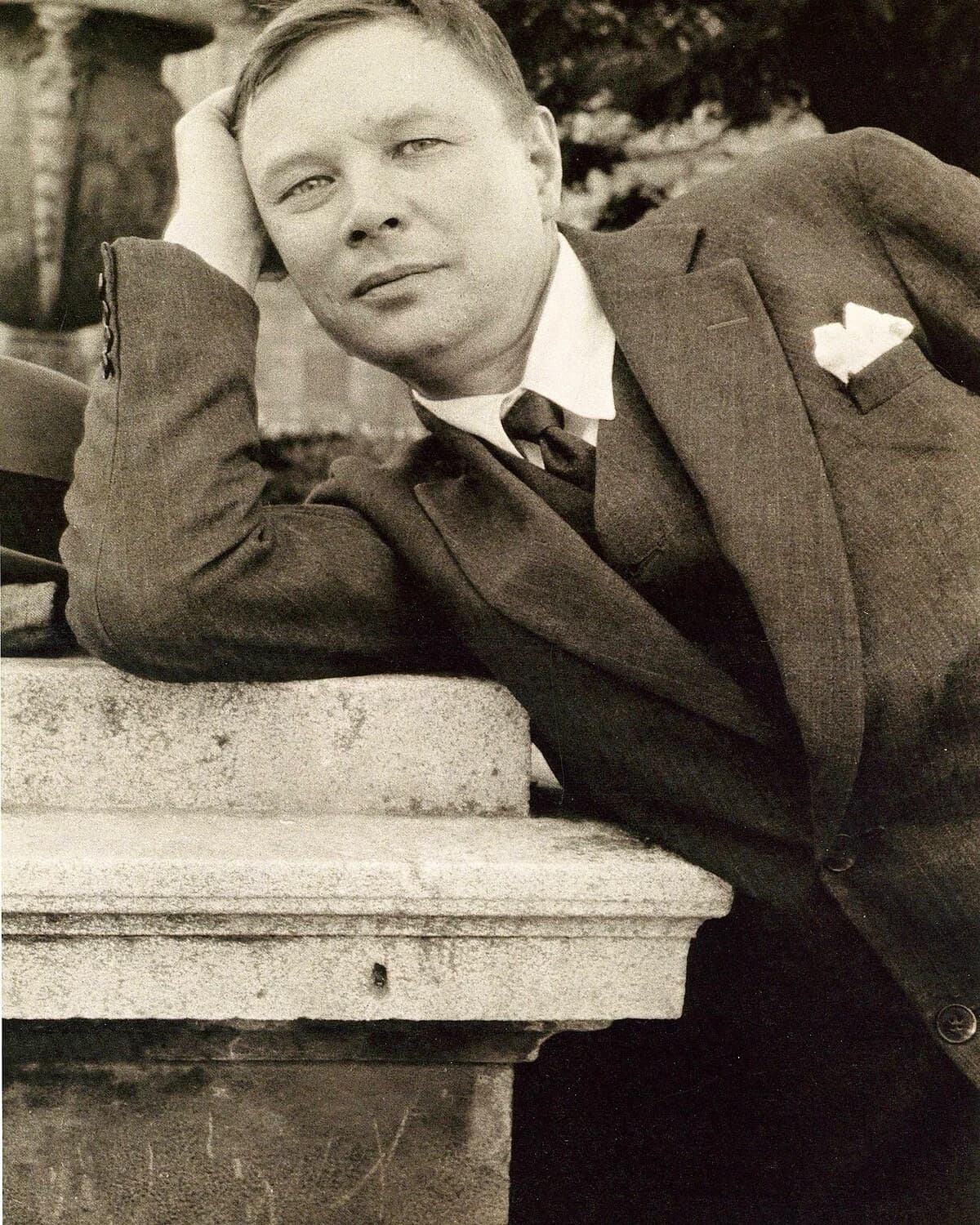
Mikhail Larionov (1881–1964), a native of Tiraspol, was the chief ringleader of the Moscow avant-garde of the 1910s: he gave the Knave of Diamonds and the Donkey’s Tail their names, staged the Target exhibition and invented Rayonism together with Natalia Goncharova. From 1915 he lived in France and designed productions for Diaghilev’s Ballets Russes; he never returned to Russia.
Biography
In 1913 a slim book entitled “Rayonism” came out in Moscow: 21 pages of text, six plates of illustrations, an edition of a thousand copies. In it Mikhail Larionov explained a new kind of painting. The object all but disappears, and forms arise where rays reflected from different things intersect. Rayonism is considered one of the first experiments in non-objective art in Russia, and Larionov and Natalia Goncharova devised it together.
That same year his exhibition “Target” opened. Around the same time Larionov staged street performances in Moscow in which the participants appeared with painted faces and in eccentric costumes, and the film “Drama in the Futurists’ Cabaret No. 13” grew out of these escapades.
He was born on 22 May (3 June) 1881 in Tiraspol, Kherson province, into the family of an army medical assistant. His childhood was spent in the south, and for many years afterwards he went back to Tiraspol to paint summer studies. In 1891 the Larionovs moved to Moscow; Mikhail entered Voskresensky’s real school, and in 1898 the Moscow School of Painting, Sculpture and Architecture, where he studied under Valentin Serov, Isaac Levitan and Konstantin Korovin. His studies dragged on until 1910; according to some accounts, he was suspended from classes three times for his radical views. At the School he met Natalia Goncharova. She became his companion and ally for life, though they registered their marriage only in 1955.
He first saw French painting in Sergei Shchukin’s collection in Moscow. Larionov himself was a passionate collector of prints, Japanese woodcuts and lubok. In 1902–1906 he painted in a late Impressionist manner (“Lilac Bush in Bloom”), and in 1906, at Diaghilev’s invitation, he took part in the Russian section of the Paris Salon d’Automne. From 1907, under the impression of Fauvism and naive art, and partly of Russian shop signs, he turned to Primitivism: rich colour, sharp line, pointed subjects, as in “Resting Soldier” or “Spring”. Larionov was among the founders of the group Wreath–Stephanos (1907) and took part in the Golden Fleece and in Izdebsky’s salons. After that he invented and organised exhibitions himself: “Knave of Diamonds” (1910), “Donkey’s Tail” (1912), “Target” (1913), “No. 4: Futurists, Rayonists and Primitive” (1914). He was friends with Vladimir Tatlin and took him under his wing until Tatlin broke with him in 1912. It seems to me that these four exhibitions show well how he worked: first gather people together, give the group a cheeky name, and then move on before anyone else.
In 1914 he was called up into the army. In the fighting in East Prussia Larionov was wounded and shell-shocked, and in December 1914 he was discharged. In the summer of 1915 Diaghilev invited him to Lausanne to work on the sets for new ballets. So began his life in France.
From 1915 to 1929 Larionov and Goncharova designed productions for the Ballets Russes: “Midnight Sun” (1915) and “Kikimora” (1916) to music by Rimsky-Korsakov and Lyadov, “Russian Tales” (1917), Prokofiev’s “Chout” (1921), for which he also worked as choreographer together with Tadeusz Slavinsky, and Stravinsky’s “Renard” (1922). In his easel painting he returned to a figurative manner, to intimate subjects and still life. After the revolution he never went back to Russia, although in 1928 he helped to organise the exhibition “Contemporary French Art” in Moscow. In Paris Larionov illustrated books, among them the French edition of Blok’s “The Twelve” (1920).
Goncharova died in 1962. Some time later Larionov married A. K. Tomilina, who became the heir of both artists.
He died on 10 May 1964 at Fontenay-aux-Roses near Paris and is buried in the cemetery at Ivry-sur-Seine. In 1989 A. K. Tomilina-Larionova gave his paintings to the Tretyakov Gallery.
Related context
Associations
Works connected through artistic movements, cultural context and period. Priced works available in this market appear first.








Profile notes
Profile and sources
Image
Artist image
Unknown author Unknown author; Wikimedia Commons; Public domain.
