
30.12.1832–16.05.1902
Mikhail Clodt von Jürgensburg
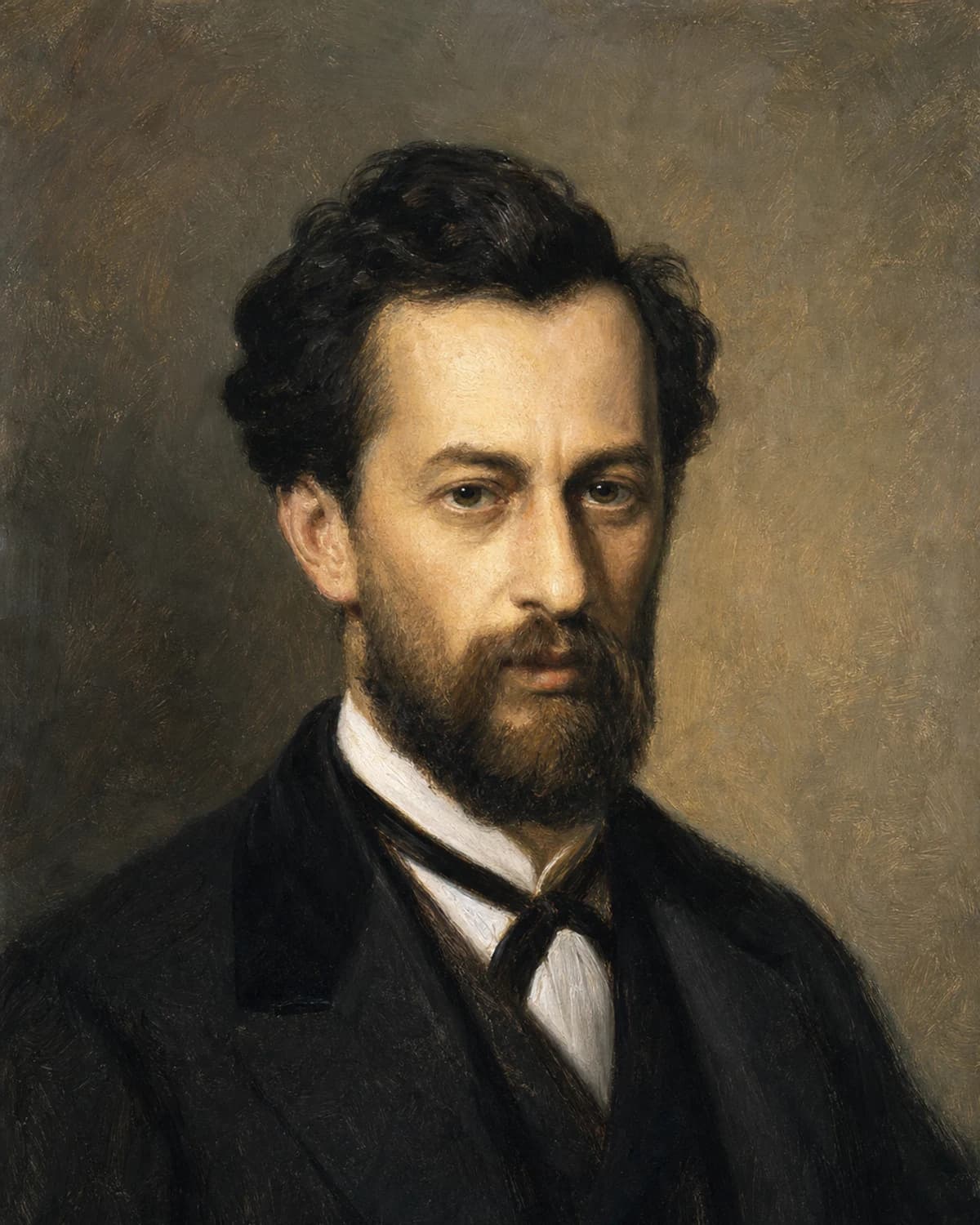
Baron Mikhail Clodt (1832–1902), nephew of the sculptor Peter Clodt, studied at the Academy of Arts under Maxim Vorobyov and became one of the founders of the Association of Travelling Art Exhibitions. Tretyakov bought his “On the Ploughland” straight from the second Peredvizhniki exhibition. He taught the Academy’s landscape class from the 1870s, and left the Association after a newspaper article he wrote against Kuindzhi.
Biography
In 1879, after a Peredvizhniki exhibition had closed, an article signed “An Amateur” appeared in the newspaper Molva. The author denied Arkhip Kuindzhi any real talent: all his painting, in the Amateur’s view, rested on a special lighting effect, which the artist overused wherever he could. It soon came out that the article had been written by Baron Mikhail Konstantinovich Clodt, one of the founders of the Association of Travelling Art Exhibitions.
Kuindzhi demanded his expulsion from the Association and, when he failed to get it, left himself.
Clodt was born on 30 December 1832 (11 January 1833) in Saint Petersburg, into the Baltic German family of Clodt von Jürgensburg, in which many practised the arts. His father, Konstantin Clodt, a major general of artillery, was a keen wood engraver; his uncle, Peter Clodt, was one of the finest sculptors in Russia. He was first sent to the Corps of Mining Engineers, but mining did not interest him, and the only thing he enjoyed was the drawing lessons of Ivan Khrutsky. In 1851, at eighteen, he entered the Academy of Arts, in Maxim Vorobyov’s landscape class. In 1853 he won a second-class silver medal and a scholarship from the Society for the Encouragement of Artists, but, according to the family chronicler Georgy Clodt, gave it up in favour of those in greater need. Then came a large silver medal (1855), a small gold medal for “View on the Island of Valaam” (1857) and, on graduating in 1858, a large gold medal for “View on the Zagezal Estate near Riga”, with the right to three years’ travel abroad at government expense.
In May 1858 he settled in a small hotel on Lake Geneva, but the Swiss landscape did not inspire him and the work would not come. In Paris he met Théodore Rousseau, Daubigny and Corot, ran into his cousin Mikhail Petrovich Clodt and travelled with him to Brittany and Normandy. French and Swiss painting struck him as “untidy and unfinished”. Having sent the Academy his report pictures, “Barges on the Shore at Low Tide. Brittany” (1859) and “View in Normandy” (1860), he asked permission to finish his travels at home. Clodt returned in January 1861, and the Academy allowed him to travel around Russia and even extended his pension.
For the works he brought back from the trip he received the title of academician. In the summer of 1863 he and his wife stayed with relatives in Mtsensk district, Oryol province, travelled through the Tula and Smolensk provinces, and found his motifs there. “Highway in Autumn” (1863), a low sky with heavy rain clouds, a black, sodden road and a peasant cart stuck in it, made his name. For “View in Oryol Province” he became a professor in 1864, although at the time there was no salaried post for him at the Academy.
He worked slowly and sometimes repainted a picture several times: the foreground is drawn down to the smallest detail, while the distances, the sky and the clouds are generalised. He was reproached for dryness and pettiness, but Stasov, reviewing the Academy exhibition of 1867, came to his defence: Clodt, he wrote, sought only to capture Russian nature “in all its homeliness”. He did not know how to sell his pictures to advantage, and he was always short of money.
In December 1870 he joined the first board of the Association of Travelling Art Exhibitions. At the first exhibition, which opened on 29 November 1871 in the Academy building, he showed “Midday” and “View in Kiev, from the Garden of Mr Muravyov”; his portrait by Ivan Kramskoi hung there too, and critics named Savrasov’s “The Rooks Have Come Back” and Clodt’s pictures as the best landscapes in the show. At the second exhibition came “On the Ploughland” (1872): a sultry noon and a peasant woman who has looked up from her work for a moment to watch a carriage on the road. Pavel Tretyakov bought it straight from the exhibition, and Clodt painted replicas in 1873, 1879 and 1881.
From 1871 he taught at the Academy as a supernumerary without pay, and in 1873 he was given a professor’s salary. With Alexei Bogolyubov and Sokrat Vorobyov he set up the landscape class and sat on the Academy council; among his pupils were Nikolai Dubovskoy, Julius Klever and the marine painter Alexander Beggrov. In the dispute over Vasily Vereshchagin he did not side with the professors, and he was never fully regarded as one of their own either at the Academy or in the Association. Every year he travelled around the country: “Peasant Woman by a Broken Cart with Flax” (1873), “Evening View in Oryol Province” (1874), “Rye” (1877), “Cows at Watering” (1879). Stasov called him “a painter of poetic rural moods”, yet in “Cows at Watering” he also saw a petty, slavish following of nature.
On 21 March 1879 the general meeting of the Association elected him and Kuindzhi to the audit committee, and soon afterwards the article in Molva appeared. Nikolai Yaroshenko, a member of the board, wrote to Clodt that the article had been dictated not by love of art but by petty vanity and envy. On 3 January 1880 Clodt applied to leave the Association, yet he went on showing at the Peredvizhniki exhibitions as a non-member exhibitor. I think this is the whole man: he left, but would not part with his public. In the midst of all this his father died.
After leaving the Association he went on travelling around Russia; among his late works are “The Volga near Simbirsk” (1881) and “The Shore” (1885). His sight was failing. In 1886 he was taken off the Academy’s staff, and in 1894 he was finally dismissed with a small pension. He had to give up his official apartment, and with his son Boris he rented a small flat on Kolomenskaya Street; his son died in 1899. Clodt’s name is last mentioned in 1897, in connection with the Peredvizhniki jubilee exhibition. Almost nothing is known of his last years; what survives are court extracts and writs of execution, which show that he lived in poverty and borrowed money.
Mikhail Clodt died on 16 (29) May 1902 in Saint Petersburg and was buried on 22 May in the Smolensky Lutheran Cemetery.
Related context
Associations
Works connected through artistic movements, cultural context and period. Priced works available in this market appear first.








Profile notes
Profile and sources
Image
Artist image
На основе открытого изображения: Ivan Kramskoi; Wikimedia Commons; Public domain.
