
06.09.1882–14.04.1954
Mikhail Avilov
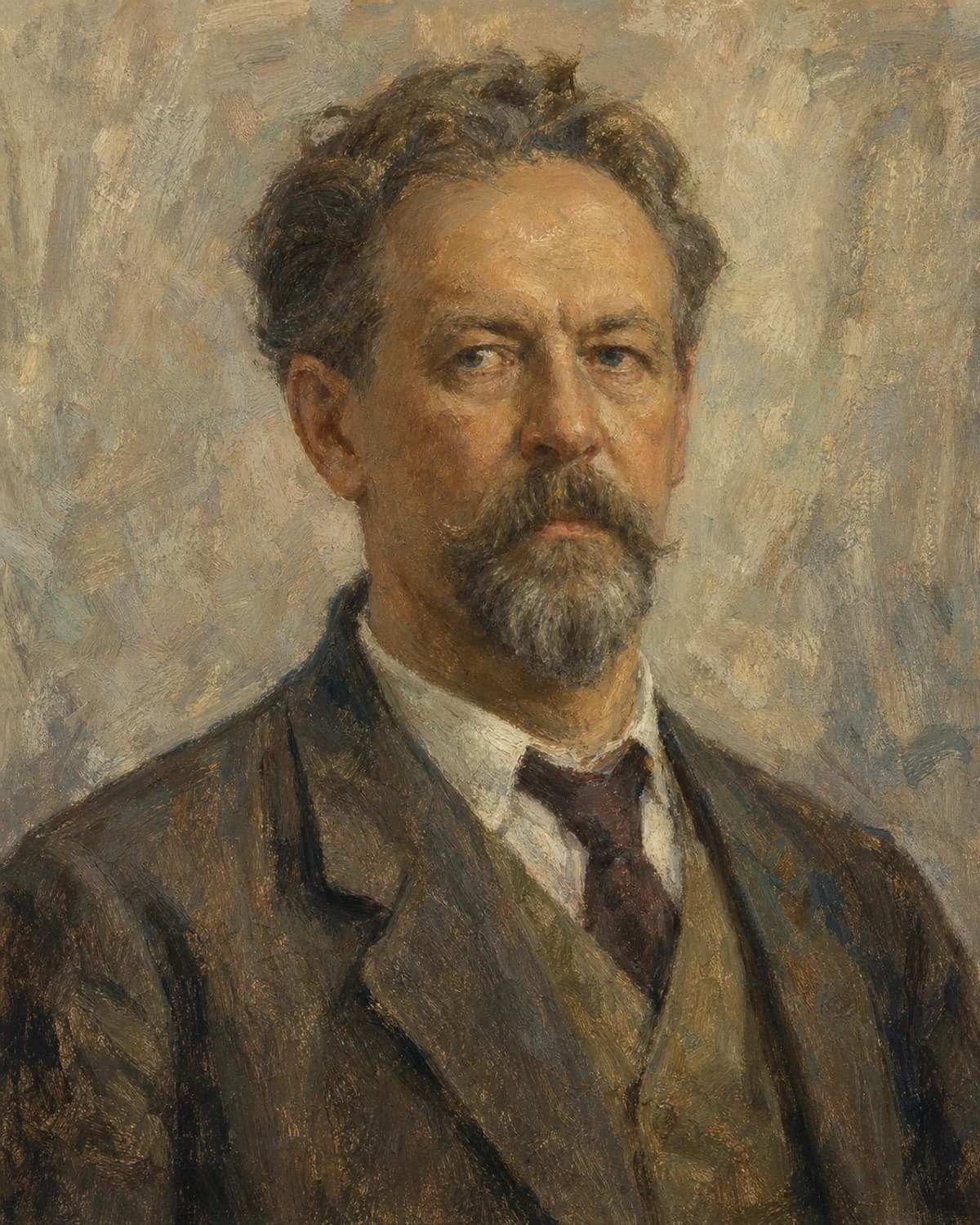
Mikhail Avilov (1882–1954) studied under the battle painters Franz Roubaud and Nikolai Samokish, volunteered for the army in the First World War and published front-line sketches in the magazine Niva. He won a Stalin Prize, first degree, for “The Duel of Peresvet and Chelubey on the Kulikovo Field”. He taught in Leningrad for more than twenty years and from 1947 gave classes at the Repin Institute.
Biography
The Stalin Prize, first degree, was awarded to Avilov in 1946, but the picture it was given for had been finished in 1943: “The Duel of Peresvet and Chelubey on the Kulikovo Field”. A subject from medieval history, painted in the middle of the war, brought him the highest honour of his career.
He was born on 18 September 1882 (6 September, Old Style) in Saint Petersburg. From 1893 he studied at the Drawing School of the Society for the Encouragement of the Arts, and in 1903 he spent a short time in the studio of Leon Dmitriev-Kavkazsky. By some accounts this lasted until 1904, and etching did not appeal to him. From 1904 he was an auditor at the Higher Art School of the Academy of Arts, in the studio of the battle painter Franz Roubaud, and from 1910 he moved to Nikolai Samokish. He had been exhibiting since 1908, including at Academy shows and those of the Kuindzhi Society. He received the title of artist on 14 November 1913 for “The Tsarevich on a Walk”, a picture with other titles as well: “Tsarevich Ivan the Terrible and His Boyar Tutors”. In 1916 the Society for the Encouragement of the Arts gave first prize to his “Oprichniki”.
In the First World War he joined the army as a volunteer. His front-line sketches were printed in the Petrograd magazines Niva and Solntse Rossii.
After the revolution he went to Siberia. In 1918 he worked in Tyumen, Irkutsk and Barnaul: he made posters and illustrations for local publishers, designed stage productions and taught in art schools. In 1921 he returned to Petrograd and began teaching, first at the school of the Society for the Encouragement of the Arts and then at the Academy of Arts. From 1922 to 1930 he taught at the Leningrad Art and Industrial College. In 1923 he joined the Association of Artists of Revolutionary Russia, a group of realist painters committed to Soviet subjects, which by some accounts he left in 1928. Posters survive from the 1920s, along with a series of lubok-style prints, “The Life of the Red Army”, and drawings for Nikolai Nekrasov’s poem “Orina, the Soldier’s Mother”. From 1934 to 1940 he worked with other artists on the panorama “The Storming of Perekop”; reports of his share in it are thin, and I cannot say more precisely.
A large part of his work consists of many-figured battle scenes on subjects from Russian and Soviet military history. But his output includes pieces of another kind: “The Bridge”, “The Horseman”, “A Moscow Troika”, “A Horse Harnessed to a Sled”, “A Perm Peasant Woman”. It seems to me that they show he was a battle painter by training, not by narrow specialisation: horses and landscape came as easily to him as a line of cavalry.
In 1935 and 1940 he had solo exhibitions in Leningrad. In May 1941 he was awarded the Order of the Red Banner of Labour. Until December 1941 he worked in besieged Leningrad, then was evacuated to Central Asia and Moscow. He received the prize for the picture of Peresvet and Chelubey, and had held the title of Honoured Art Worker of the Russian Federation since 1944. In 1947 a solo exhibition was held in Moscow, and the Academy of Arts of the USSR elected him a full member. From the same year he taught at the Repin Institute of Painting, Sculpture and Architecture in Leningrad, as a professor from 1948, and stayed there until his death. In 1948 the almanac “Fine Art of Leningrad” published his article on how he had worked on “The Duel”. His pupils included Ivan Godlevsky, Maria Dobrina, Vladimir Zakharin, Alexander Romanychev, Yury Skorikov, Viktor Teterin, Yevgeny Charsky and Efim Rubin, as well as Kanafiya Telzhanov and Sabur Mambeyev, later artists of Kazakhstan and Kyrgyzstan. In 1953 he was named People’s Artist of the Russian Federation.
He died in Leningrad on 14 April 1954 and was buried in the Tikhvin Cemetery, in the Necropolis of Masters of Art. In 1955 a monument by Nikolai Dydykin was set up over the grave: a bronze bust of the artist on a grey granite pedestal, with a palette in his left hand and a brush in his right. His paintings are held by the Russian Museum, the Tretyakov Gallery, the Perm Art Gallery, the Irkutsk Art Museum and the Yavornytsky Historical Museum in Dnipro. A street in Kryvyi Rih is named after him.
Related context
Associations
Works connected through artistic movements, cultural context and period. Priced works available in this market appear first.








Profile notes
Profile and sources
Image
Artist image
На основе открытого изображения: Qwe2014; Wikimedia Commons; CC BY-SA 4.0.
