
19.12.1921–21.08.2002
Mikayil Abdullayev
Mikayil Abdullayev (1921–2002) studied in Baku under Sadykh Bakhlulzade, then in Moscow under Sergey Gerasimov, and graduated from the Surikov Institute in 1949. He painted portraits of Azerbaijani poets and composers, brought back from his travels in India the cycle “Through India”, for which he received the Nehru Award, and made a mosaic with scenes from Nizami for the Baku metro.
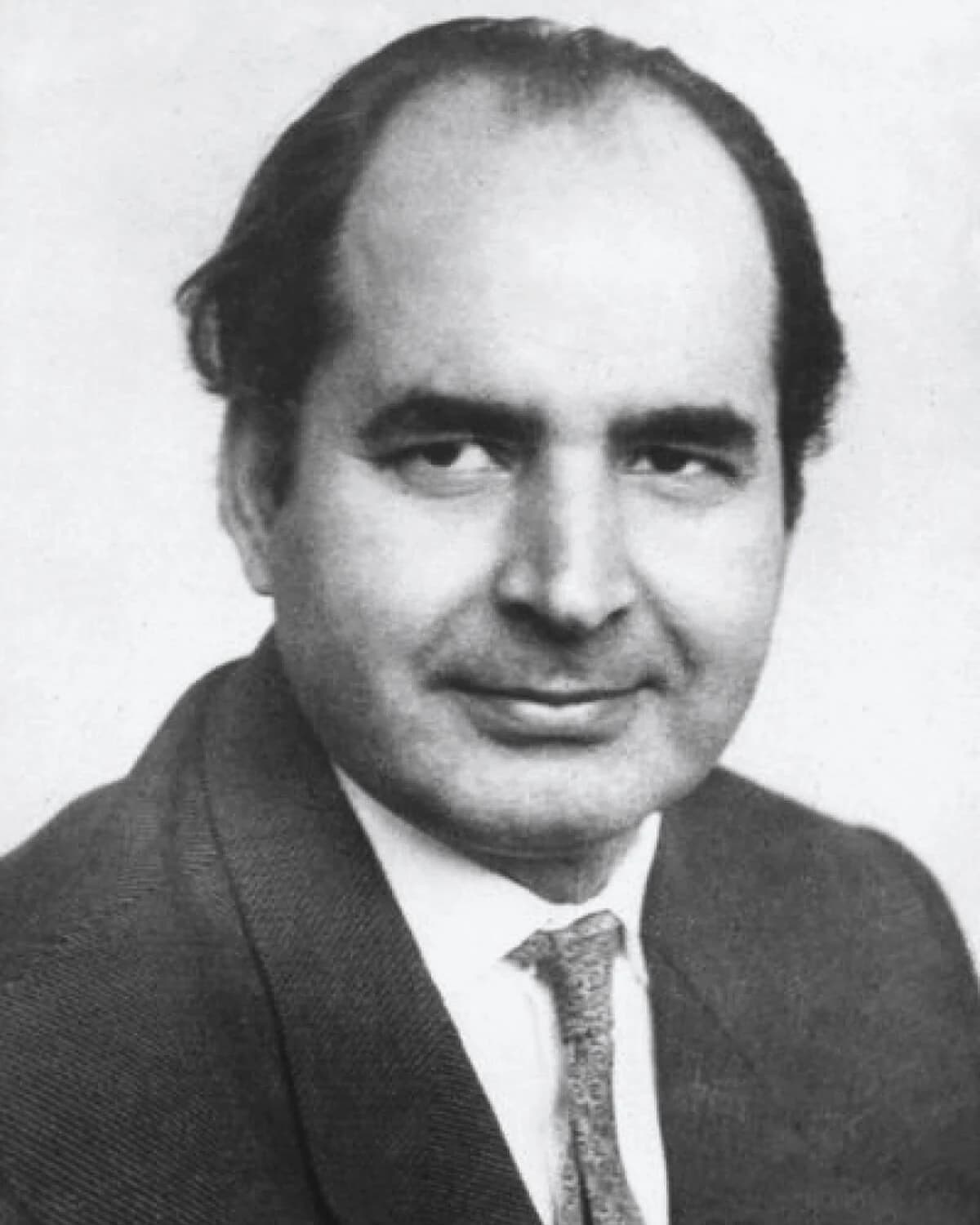
Biography
The mosaic panel with a portrait of Nizami, in the vestibule of the Baku metro station named after the poet, was made by an artist whom most passengers know not for this work but for his portraits. The station was decorated in 1973–1976; Mikayil Abdullayev took scenes from Nizami’s writings for the panel and painted the poet himself.
He was born on 19 December 1921 in Baku.
From 1935 to 1939 he studied at the Azerbaijan Art College (now the Azim Azimzade Art School) under Sadykh Bakhlulzade. Then he left for Moscow, to the Surikov Art Institute, where he studied from 1939 to 1949; his teachers were Sergey Gerasimov, Vera Favorskaya and Ivan Chekmazov. The ten years of study are explained by the war. He was not called up: according to his biographers, Azim Azimzade intervened on his behalf with Mir Jafar Baghirov, the first secretary of the Central Committee of the Azerbaijani Communist Party. I could not check this against documents. In 1941–1943, before leaving to finish his studies, he was already teaching at Azimzade’s school in Baku. His early known works are lyrical in tone: “An Evening” (1947), “Mingachevir Lights” (1948), “Builders of Happiness” (1951). Alongside them came graphic work: the drawing series “Beyond the Aras River” (1950), and illustrations to the epic “The Book of Dede Korkut” (1956) and to Fuzuli’s poem “Layla and Majnun” (1958). Later he illustrated Nizami, Vagif, Mirza Fatali Akhundov, Mirza Alakbar Sabir, Jafar Jabbarly, Samad Vurgun and Rasul Rza.
Literature occupied a great deal of his work. He painted portraits of Uzeyir Hajibeyov (1944), Samad Vurgun (in 1944, 1959 and 1975), Akhundov (1962), Imadaddin Nasimi (1973), the pianist Farhad Badalbeyli (1975), and “Gorky in Baku in 1928” (1950). There is also the portrait “The Hundred-Year-Old Carver Babayev” (1961), whose subject is a living, particular man rather than a writer’s name.
In 1956–1971 Abdullayev travelled widely: India, Afghanistan, Poland, Italy and other countries. From India came “Rajasthani Women”, “Bengali Girls” and the “Indian Series” (1957–1960). He painted portraits of Indira Gandhi, Renato Guttuso, Alberto Moravia and Giacomo Manzù. In 1970 the Indian government awarded him a gold medal and the diploma of a laureate of the Jawaharlal Nehru International Award for the cycle “Through India”. His trips to Italy produced the book “Memories of Italy” (Baku, 1958), and in 1962 a second book, “Through the Eyes of a Bakuvian”, followed. Solo exhibitions were held in Delhi, London, Montreal and Moscow. His work was also shown in Prague (1957), Beijing and Brussels (1958), Belgrade (1959), Paris (1960) and Berlin (1963). For the 1958 World’s Fair in Brussels he received a silver medal.
Besides the station Nizami Ganjavi, he decorated the Absheron Hotel and the Gulistan Palace, and worked in the theatre as a stage designer. His later paintings include the triptych “On the Fields of Azerbaijan” (1963–1965), the diptych “Rice Growers”, for which he received the State Prize of the Azerbaijan SSR in 1974, and “Khachmaz Girls” (1982).
From 1965 Abdullayev taught at the Azerbaijan Institute of Arts, became a professor in 1973, and in 1970–1975 headed the painting studio of the Academy of Arts in Baku. He was a corresponding member (1958) and then a full member (1988) of the USSR Academy of Arts. He became People’s Painter of the USSR in 1963. From 1959 he was elected a deputy of the Supreme Soviet of the Azerbaijan SSR, and in 1967–1975 he was its deputy chairman. Abdullayev died in Baku on 21 August 2002 and was buried in the Alley of Honor. On the façade of the house where he lived there is a memorial plaque with a bas-relief by Zeynalabdin Iskenderov.
Profile notes
Profile and sources
Image
Artist image
Unknown author Unknown author; Wikimedia Commons; Public domain.
