
04.05.1943–present
Mihail Chemiakin
Mihail Chemiakin (born 1943), a Leningrad nonconformist and former rigger at the Hermitage, was forced to emigrate in 1971 and lived in Paris, New York and then France. He is the author of the monument to Peter I in the Peter and Paul Fortress, the “Metaphysical Sphinxes” and the group “Children Are the Victims of Adult Vices”, and the designer of “The Nutcracker” at the Mariinsky Theatre. State Prize of Russia (1993).
Biography
In 1964 the Hermitage held an exhibition of artists who worked in its maintenance department. Among them was Mihail Chemiakin, who spent five years working in the museum as a rigger.
He never finished art school.
He was born on 4 May 1943 in Moscow, into a military family; his mother was an actress. From 1945 to 1957 the family lived in Dresden, where his father was serving, and Mihail came back to Leningrad at the age of fourteen. In 1957 he was admitted to the secondary art school attached to the Repin Institute, and in 1961 he was expelled. From 1959 to 1971 he worked as a postman, a watchman and a rigger. His first exhibition opened in 1962 in the editorial offices of the magazine “Zvezda”. In 1967 he showed his work at Akademgorodok near Novosibirsk, that same year staged Shostakovich’s opera “The Nose” in the studio of the Leningrad Conservatory, and founded the artists’ group “Petersburg”. With the philosopher Vladimir Ivanov he devised the theory of “metaphysical synthetism”: a search for new forms of icon painting through the study of the religious art of different periods and peoples. For two years he was a novice at the Pskov-Pechersky Monastery.
In 1971, after his exhibitions had been shut down more than once and his works confiscated, the authorities, under threat of criminal prosecution, forced Chemiakin to leave the USSR. He settled in Paris. That same year the Galerie Dina Vierny showed his exhibition “Saint-Pétersbourg 71”, and in Venice his illustrations to the collection “Classical Spanish Epigram” won a medal at a book competition. In Paris he organised exhibitions and published the work of Russian nonconformist artists and writers, and in 1976 he assembled the exhibition “Contemporary Russian Painting” at the Palais des Congrès in Paris. From 1975 to 1980 Vladimir Vysotsky recorded in his Paris studio. Mikhail Baryshnikov had introduced them, and they remained friends until the end of Vysotsky’s life: Vysotsky dedicated twelve songs and poems to Chemiakin, and Chemiakin drew illustrations to his verse and later made a monument to him in Samara (2008). Vysotsky’s recordings came out in 1987 as a series of seven LPs. In the same studio, in 1975, an album by the singer Alyosha Dimitrievich was recorded.
In 1981 Chemiakin moved to New York. Back in the 1960s he had begun collecting images from the art of all times and peoples, and over the years this grew into an archive of millions of images, sorted by technical, historical and philosophical categories. He calls it the “Imaginary Museum”, after André Malraux: on large sheets, pictures are pasted and grouped by likeness of subject, style and iconography. I think it is his main work, even though it does not look like a work in the usual sense. For this research he has received five honorary doctorates. In 2000 he opened the Museum of the Imagination in Hudson, New York; in 2002–2003 he made a series of twenty-one programmes for the Kultura television channel; and since 2009 his foundation in St Petersburg has been holding exhibitions such as “The Sphere in Art”, “The Hand in Art” and “Monsters in Art”.
The 1990s made him the author of St Petersburg monuments. In 1991 his monument to Peter I was put up in the Peter and Paul Fortress; on 28 April 1995 the memorial to the victims of political repression, the “Metaphysical Sphinxes”, was unveiled, and in the same year a monument to the architects who first built the city. In 2001 his monument to Peter the Great appeared in Deptford in London, and in Moscow the group “Children Are the Victims of Adult Vices”; in 2003 came “The Tsar’s Promenade” in Strelna. In 1998 his monument to Casanova stood for six months in front of the Doge’s Palace in Venice. Together with the clown Slava Polunin he stages processions and performances in St Petersburg, Moscow and Venice; in 1996 he, Polunin and Terry Gilliam made the show “Diablo”. For the Mariinsky Theatre Chemiakin designed “The Nutcracker” in 2001, with choreography by Kirill Simonov, and won a Golden Mask for it; in 2005 he staged the ballet “The Magic Nut” to his own libretto with music by Sergei Slonimsky, and in 2010 he created a “Coppélia” for the Lithuanian National Opera and Ballet Theatre. From 2001 to 2018 Soyuzmultfilm worked on the full-length puppet film “Hoffmaniada”, based on his designs.
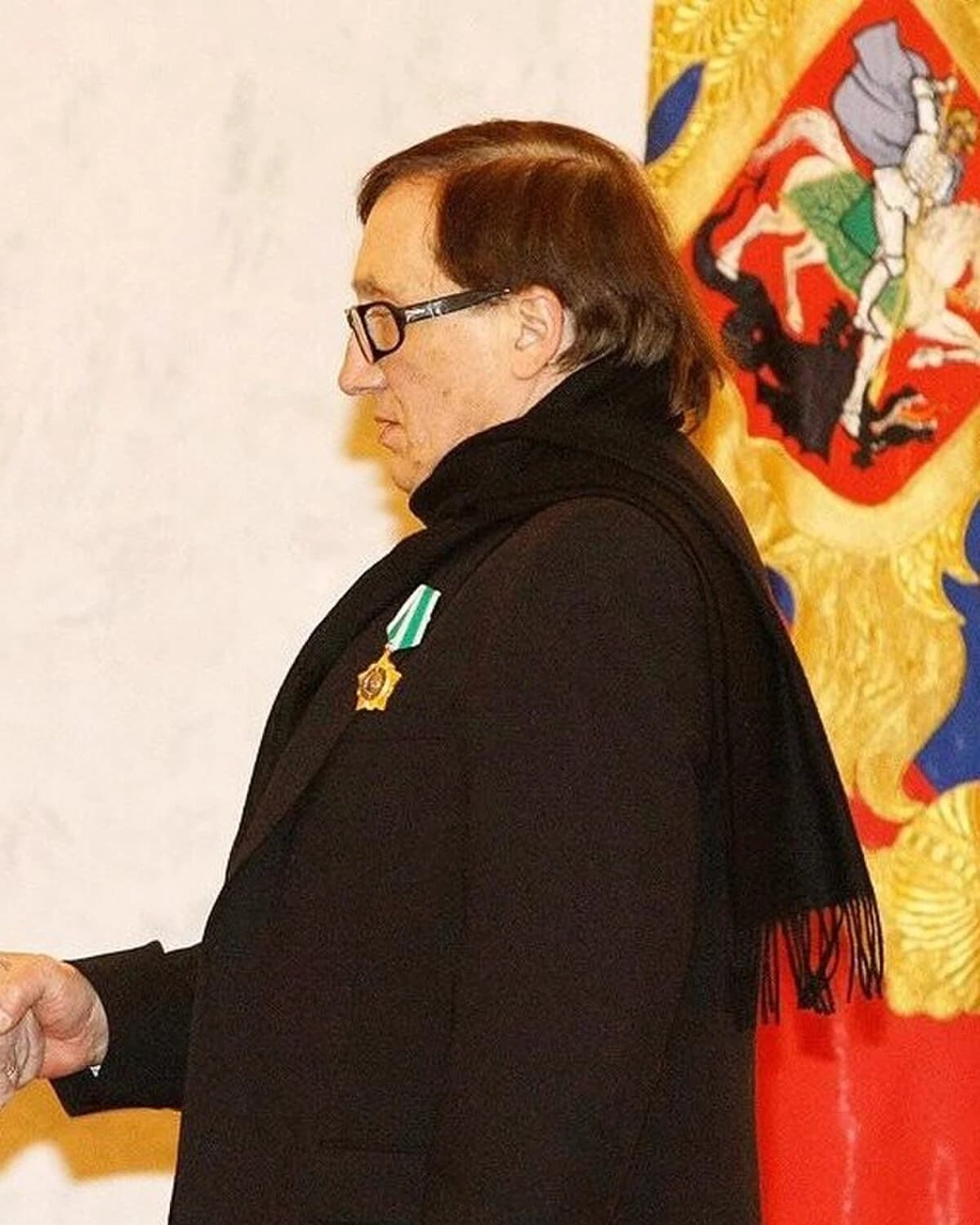
He received the State Prize of Russia in 1993, the French Order of Arts and Letters in 1994 and the Russian Order of Friendship in 2009; he is a People’s Artist of Kabardino-Balkaria and of Adygea. In 2007 Chemiakin returned to France and settled near Châteauroux. A copy of his Peter stands in the garden of his villa at Loches, on the banks of the Indre.
Profile notes
Profile and sources
Image
Artist image
Presidential Press and Information Office, edited by Elmasmelih at English Wikipedia; Wikimedia Commons; CC BY 4.0.
