
11.12.1946–present
Miguel Rio Branco
Miguel Rio Branco was born in the Canary Islands to Brazilian diplomats, spent his childhood in four countries and works in Rio de Janeiro. He began as a painter and a film cinematographer, and from 1980 worked with the Magnum agency. He is known for the photobooks “Dulce Sudor Amargo” (1985) and “Silent Book” (1997), full of colour, and for his pictures of Salvador.
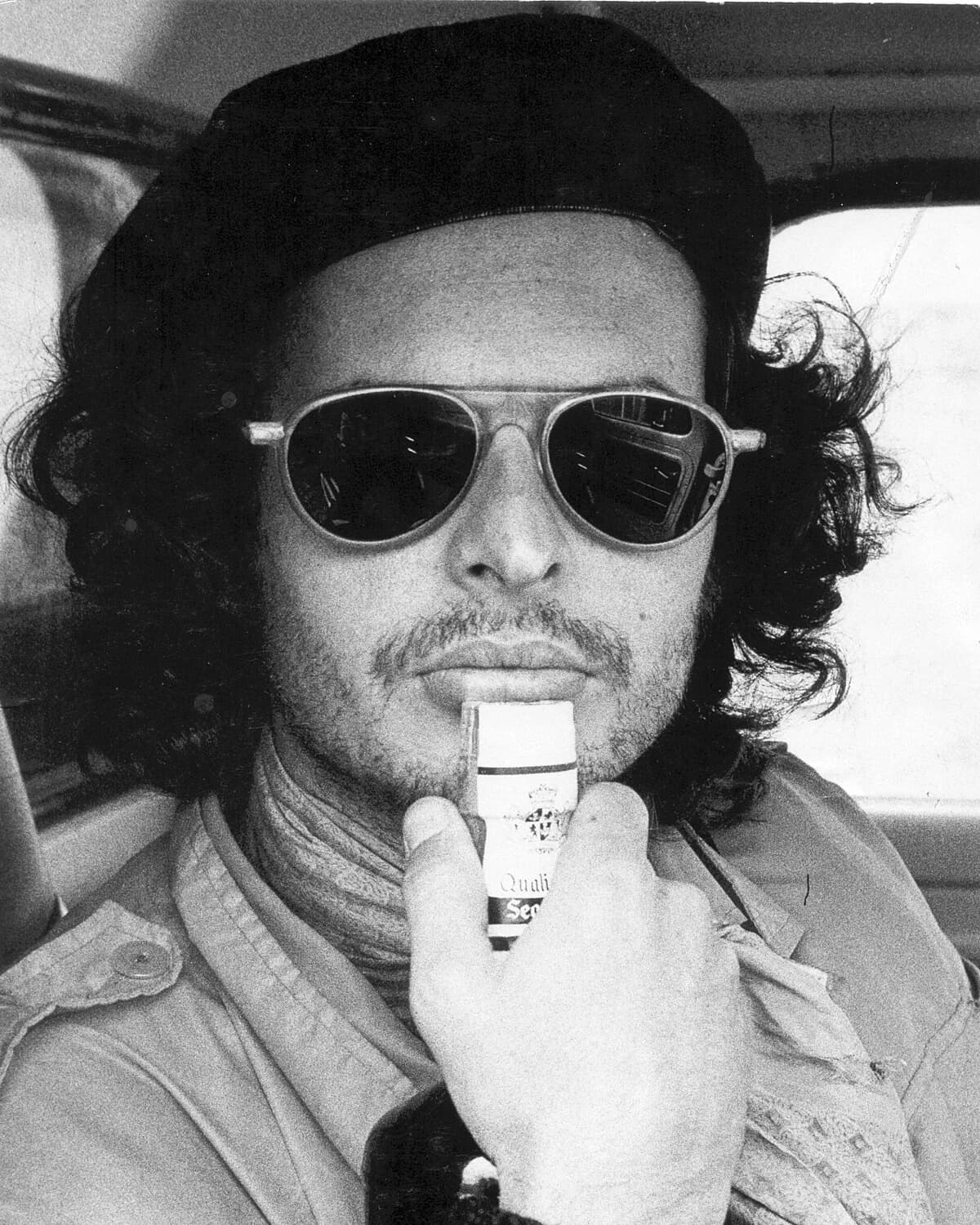
Biography
Miguel Rio Branco’s first book came out in 1985 in Mexico, from the publisher Fondo de Cultura Economica, and was called “Dulce Sudor Amargo”, that is, “Sweet Bitter Sweat”. It collects photographs of the old centre of Salvador, which then stood abandoned.
He was born on 11 December 1946 in Las Palmas de Gran Canaria. His parents were diplomats, so his childhood was spent in Portugal, Switzerland, Brazil and the United States. On his family’s side he is a great-grandson of the Baron of Rio Branco, a well-known Brazilian diplomat, and a grandson of a caricaturist (this is hard to verify).
He studied in New York and Rio de Janeiro, but the dates differ. By one account, in 1976 he moved to New York, took a bachelor’s degree and completed a one-month vocational course at the New York Institute of Photography, and in 1978 he moved to Rio de Janeiro and entered a school of industrial design. By another, he studied at the institute of photography as early as 1966 and at the design school in 1968. He began with painting: in 1974 his pictures were shown in Bern, where he was living at the time. In parallel he worked in film, chiefly as a cinematographer. In 1979 he photographed in the Pelourinho, the historic quarter of Salvador. Both a photobook and a short film grew out of these pictures: “Nada Levarei Quando Morrer, Aqueles Que Me Devem Cobrarei no Inferno” (“I Will Take Nothing With Me When I Die, and Those Who Owe Me Will Be Charged in Hell”). The author himself regards it as a “poetic documentary”. He was cinematographer on two films by the director Octávio Bezerra: “Memória Viva” (1987) and “Uma Avenida Chamada Brasil” (1989).
From 1980 he worked with Magnum, the photographers’ cooperative agency. By some accounts he was an associate member of the agency; by others, from 1982 he was a correspondent and never became a member. In 1982 he received second prize in the Kodak photography criticism awards. Critics noted his dramatic handling of colour: saturated, dense red and yellow walls against which people look almost like part of the set. The main subject of his work is Brazil, in photojournalism and in social and political criticism.
Beginning with the São Paulo Biennial of 1983, he made spatial installations of photographs and music, aiming at a kind of “documentary poetry”. Later came the books “Nakta” (1996), “Silent Book” (1997), “Pele do Tempo” (1999), “Entre os Olhos, o Deserto” and “Gritos Surdos” (both 2002), “Plaisir la Douleur” (2005), “Out of Nowhere” (2009), “Você está feliz?” (2012), “Mechanics of Women” (2017) and “New York Sketches” (2018). “Silent Book” is included in volume two of Martin Parr and Gerry Badger’s “The Photobook: A History”. His films also include “Trio Elétrico”, “Caveirinhas” and “Entre os Olhos o Deserto”.
Rio Branco’s works are held by the Museum of Modern Art and the Metropolitan Museum of Art in New York (37 and 25 works respectively, as of May 2019), by the Centre Pompidou, the San Francisco Museum of Modern Art and the Walker Art Center. He lives and works in Rio de Janeiro.
Profile notes
Profile and sources
Image
Artist image
Carlos Ebert from São Paulo, BrazilGRU; Wikimedia Commons; CC BY 2.0.
