
27.05.1695–16.05.1768
Miguel Cabrera
Miguel Cabrera, painter to the Archbishop of Mexico and favourite artist of the Jesuits, was admitted in 1751 to the cloak bearing the image of the Virgin of Guadalupe and in 1756 published “American Marvel”, an analysis of its painting technique; his copy of the image went to Rome, to Pope Benedict XIV. He painted the portrait of Sor Juana Inés de la Cruz, the “Virgin of the Apocalypse” and the series of sixteen casta paintings of 1763.
Biography
In 1751 the church authorities of Mexico City called together painters to examine the cloak of the Indian Juan Diego, on which, according to tradition, the image of the Virgin of Guadalupe had appeared in 1531. Miguel Cabrera, with six colleagues, examined it with a craftsman’s eye and counted four different techniques: the face and hands painted in oil, the tunic and the cherub at the feet in egg tempera, the mantle in gouache, and the golden rays as if woven into the coarse cloth of palm fibre “which we vulgarly call pita”. No painter of the eighteenth century, he concluded, could work like that, let alone one of the sixteenth. The analysis came out in 1756 as the book “American Marvel” (Maravilla americana) and confirmed the testimony of the witnesses of 1666 about the miraculous origin of the image.
Less is known about his birth than about his pictures. In both his wills, of 1760 and 1768, he named Antequera, today’s Oaxaca, as his birthplace. It was long thought that he was the Miguel baptised there on 27 February 1695, of unknown parents, with Gregorio de Cabrera and Juana de Reyna as godparents; but in 1760, giving testimony at the University of Mexico, he stated his age as fifty, which shifts his birth towards 1710, and at the same time recalled that “as a small boy” he had frequented the Mexico City workshop of Francisco Xavier Vázquez Loya. So he may have trained from childhood in Mexico City, under Vázquez or someone in his circle; the Rodríguez Juárez brothers and José de Ibarra are also named. The banns for his marriage are dated 1739. The earliest work found is a signed portrait of Fray Toribio de Nuestra Señora of 1740 in the church of San Fernando.
He called himself painter to Archbishop Manuel José Rubio y Salinas, although no official record of the appointment has been found, painted the prelate more than once (one portrait of 1754 is in the Museum of Fine Arts in Boston) and designed his funerary monument. His chief patron was the Society of Jesus. From 1753, together with the sculptor Higinio de Chávez, he designed the altarpieces of the church of San Francisco Javier at the Jesuit college of Tepotzotlán, painted the presbytery there and made canvases for the sacristy, the choir and the chamber of the Virgin of Loreto. In 1752 he was admitted to the Guadalupe image again and, with José de Alcíbar and José Ventura Arnáez, made three copies: for the archbishop, for the pope and as a model for further repetitions. In 1754 the Jesuit Juan Francisco López presented the copy in Rome to Benedict XIV; the pope, so the story goes, pronounced the verse of the psalm “He hath not dealt so with any nation”, in the same year declared the Virgin of Guadalupe patroness of New Spain by a bull, and in 1757 gave the painting to the nuns of the Visitation, who have it still. Cabrera’s workshop turned out copies of the image by the dozen, some with the note “touched to the original” and a date. All this was part of his struggle to have painting in New Spain counted a liberal art rather than a craft: in 1753 he and his colleagues revived the academy of painting that had earlier gathered around the Rodríguez Juárez brothers; whether he headed it himself, as José Bernardo Couto wrote in 1872, or Ibarra did until his death in 1756, the documents disagree.
Of the rest, almost everything is for the church: series on the lives of saints and of the Virgin, in which haste and the hands of assistants are at times visible. Singled out are the fourteen scenes from the life of Mary for the sacristy of the church of Santa Prisca in Taxco, of about 1759, with trompe-l’oeil fitted into the architecture, a commission from the mine owner José de la Borda, and the “Virgin of the Apocalypse” of about 1760, after the twelfth chapter of Revelation, now in the National Museum of Art in Mexico City; a second one, eight metres high, he signed in 1765 for the staircase of the college at Guadalupe, Zacatecas. For Mexico City Cathedral he painted four ovals in the crossing in 1767. He also painted the nobility: the Count of Santiago de Calimaya (1752) and María de la Luz Padilla y Cervantes (c. 1760), both in the Brooklyn Museum, the viceroy Güemes y Horcasitas, Capuchin nuns. The posthumous portrait of Sor Juana Inés de la Cruz of about 1750, with books around the poet, he built on the portrait by Juan de Miranda. Around 1763 he painted his only series of casta paintings, sixteen scenes of mixed marriages of Spaniards, Indians and Africans with their children: eight canvases in the Museo de América in Madrid, five in Monterrey, one bought by the Los Angeles County Museum of Art in 2015, one in private hands, one untraced. To my mind, it is these sixteen canvases that now keep his name alive outside Mexico.
He died in Mexico City on 16 May 1768 and was buried in the church of Santa Inés. He left a library of seventy-five books, known from the inventory. In the nineteenth century Couto called him the personification of the painter as such and wrote that a century after his death his supremacy remained intact; in 2024 the Museo de América in Madrid devoted an exhibition to his series of 1751 on the Virgin.
Related context
Associations
Works connected through artistic movements, cultural context and period. Priced works available in this market appear first.
Profile notes
Profile and sources
Image
Artist image
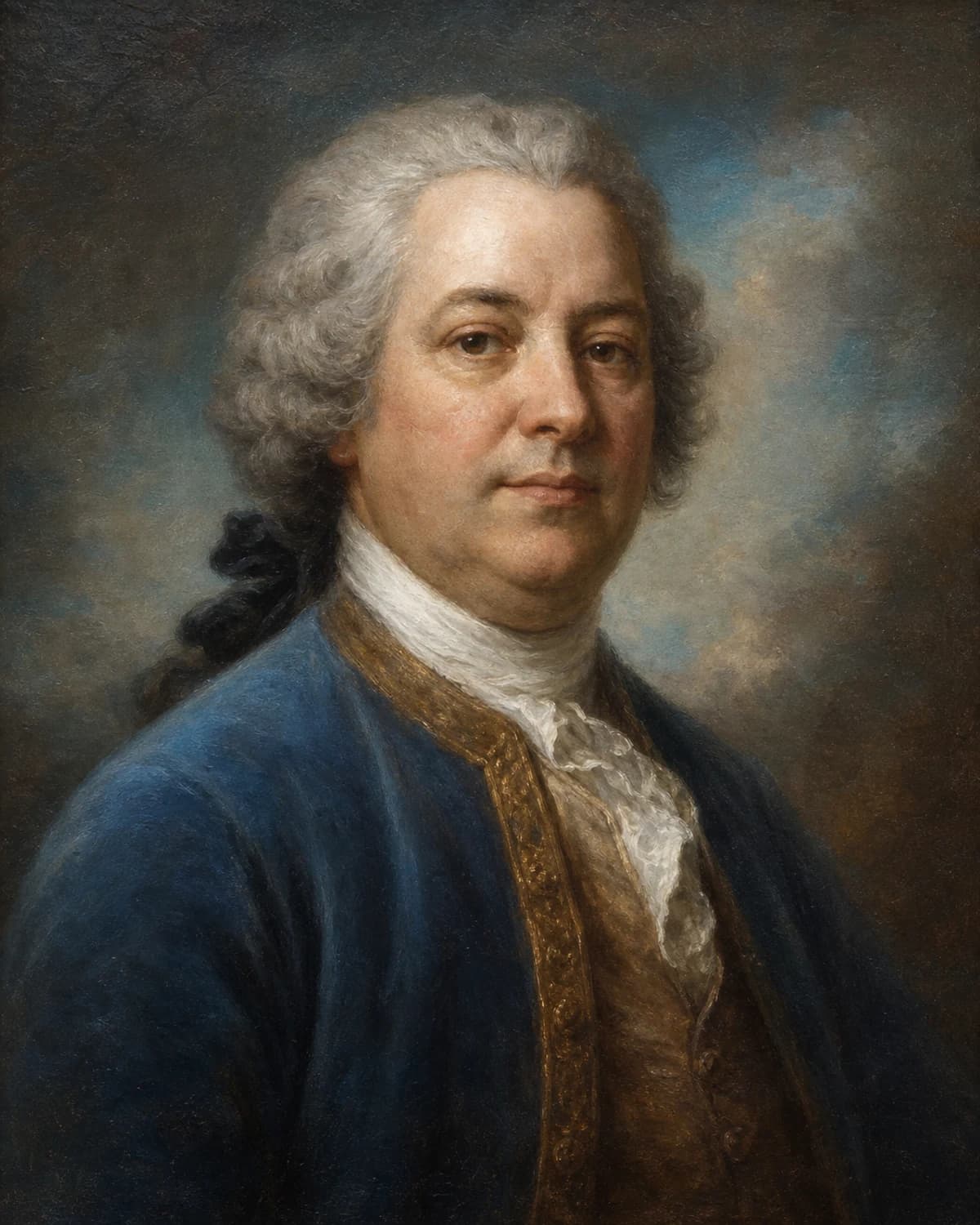
На основе открытого изображения: Luis Alvaz; Wikimedia Commons; CC BY-SA 4.0.
