
06.03.1475–18.02.1564
Michelangelo
Michelangelo trained under Ghirlandaio and at the court of Lorenzo de’ Medici, and before he was thirty he had carved the “Pietà” in Rome and the “David” in Florence. For the popes he painted the ceiling and the altar wall of the Sistine Chapel, in Florence he built the New Sacristy and the Laurentian Library, and from 1546 he directed the building of St Peter’s. He left more than three hundred poems.
Biography
Six days before his death, in February 1564, the eighty-eight-year-old Michelangelo was still working on the marble “Rondanini Pietà”. He worked in a strange way: he cut the stone back again and again until there was no longer enough of it for the figures. Of the earlier version there remain Christ’s legs and a separate arm, no longer attached to anything. I think it helps to look at this group in Milan’s Castello Sforzesco while keeping in mind the polished “Pietà” he made at twenty-four.
He was born on 6 March 1475 in Caprese (now Caprese Michelangelo) near Arezzo, where his father, Lodovico Buonarroti Simoni, was serving as podestà. For several generations the family had kept a small bank in Florence and had gone bankrupt, but it considered itself descended from the margravine Matilda of Canossa; Michelangelo believed this, though there is no proof. The Buonarroti soon returned to Florence. His mother was ill and died when her son was six, and he lived with his wet nurse, a stonecutter’s wife, in Settignano, where his father owned a quarry and a small farm. He later said that with his nurse’s milk he had taken in the chisel and the hammer.
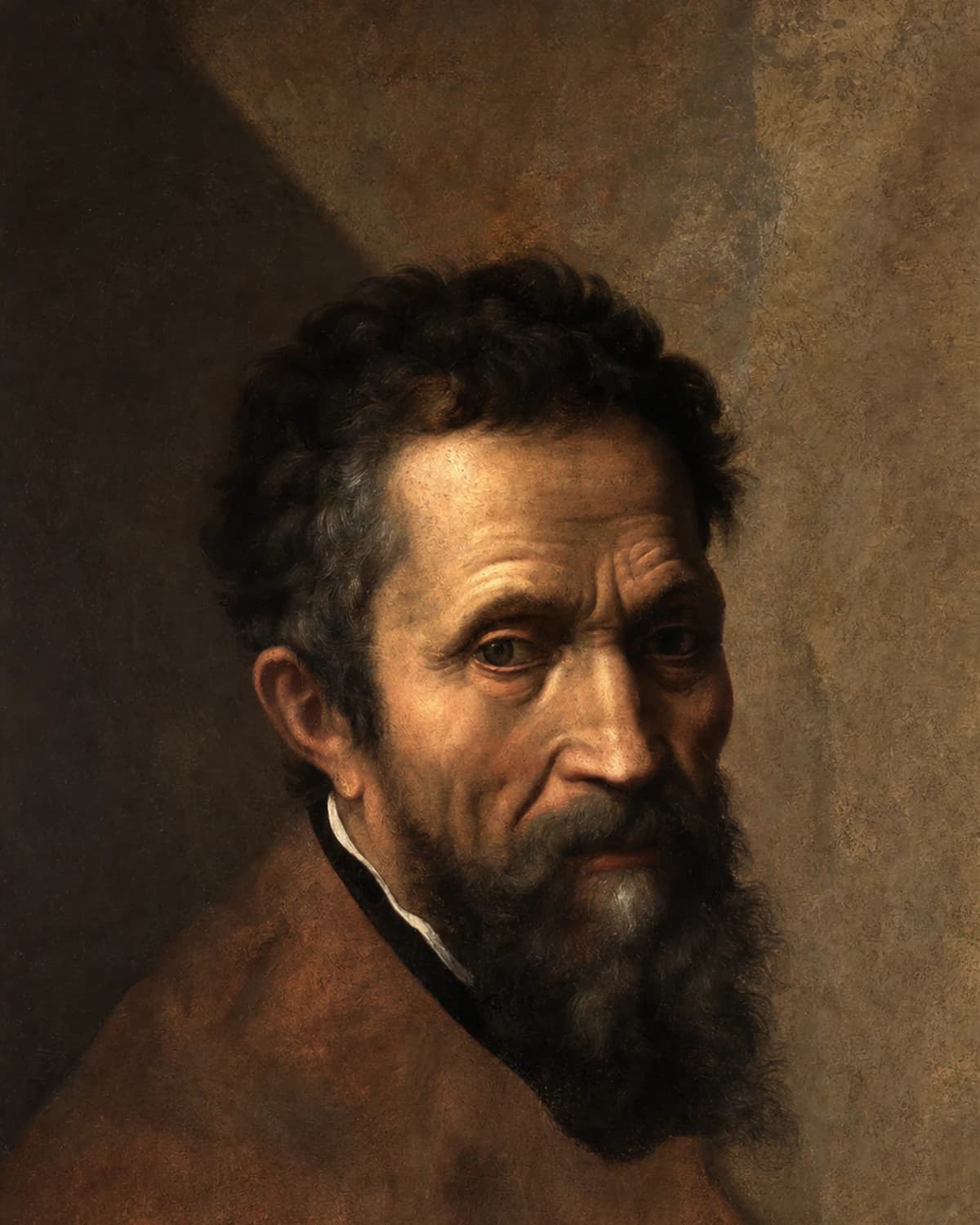
In 1488 the thirteen-year-old boy was placed in the workshop of Domenico Ghirlandaio; his drawings after frescoes by Giotto and Masaccio survive. A year later Lorenzo de’ Medici asked Ghirlandaio for his two best pupils, and until 1492 the young man lived at the Medici court, studied under the sculptor Bertoldo di Giovanni and listened to Ficino, Poliziano and Pico della Mirandola. It was then that the reliefs “Madonna of the Stairs” and “Battle of the Centaurs” appeared. It was there, too, that a fellow pupil, Pietro Torrigiano, broke his nose, hence the flattened profile in all his portraits.
After the Medici were expelled in 1494 he left for Venice and Bologna, where he carved the last small figures for the tomb of St Dominic. Back in Florence he made a sleeping Cupid, which the client asked him to “age” so that it could be sold at a profit in Rome as an antique. Cardinal Raffaele Riario uncovered the fraud but liked the work, and on 25 June 1496 the twenty-one-year-old sculptor arrived in Rome. The cardinal turned down the Bacchus, and the statue went to the garden of the banker Jacopo Galli. In November 1497 the French cardinal Jean de Bilhères commissioned the “Pietà”, and it was finished when its maker was twenty-four. It is the only work he ever signed: his name is carved on the band that runs across the Virgin’s breast. The “Pietà” stands in St Peter’s Basilica.
In 1499 he returned to Florence. The wool guild commissioned him to finish a colossus of Carrara marble begun forty years earlier by Agostino di Duccio, and in 1504 the “David” was ready. Its site was chosen by a committee that included Botticelli, Leonardo and Perugino; the statue was set up on the Piazza della Signoria in front of the Palazzo Vecchio and is now in the Galleria dell’Accademia. In the same period he painted a round picture of the Holy Family for Agnolo Doni and received a commission for a mural, “The Battle of Cascina”, for the Council Hall, opposite Leonardo’s “Battle of Anghiari”. Both murals remained unfinished and are lost.
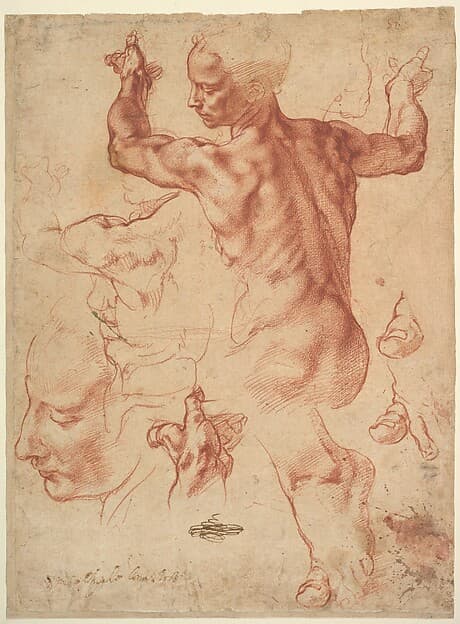
In 1505 Pope Julius II summoned him to Rome to build his tomb: forty statues in five years. Both men were quick-tempered, and on 17 April 1506 Michelangelo left secretly for Florence; they made peace in Bologna. He worked on the tomb on and off for forty years and completed it in a much reduced form: it stands in the Roman church of San Pietro in Vincoli, with the “Moses” (1516) at its centre, while the “Dying Slave” and the “Rebellious Slave” ended up in the Louvre. In 1508–1512 he painted the ceiling of the Sistine Chapel, although he did not regard himself as a painter. According to Condivi, it was Bramante who suggested the commission to the pope, counting on a failure. Julius wanted twelve apostles and ornament, but Michelangelo secured a free hand: nine scenes from the Book of Genesis, from the Creation to the Flood, prophets, sibyls, the ancestors of Christ.
Then came Florentine commissions from the Medici popes. The façade of San Lorenzo never got beyond a wooden model, and the church still stands with its brick bare. Attached to the church he built the New Sacristy, with the tombs of Lorenzo and Giuliano de’ Medici, and from 1524 the Laurentian Library, whose vestibule and staircase were later seen as a herald of the Baroque; the library opened in 1571, and the vestibule was completed in 1904. In 1527 the Florentines expelled the Medici once again, and in 1528–1529 Michelangelo fortified the city. When Florence fell in 1530, he faced reprisals. He is believed to have hidden for two months in a small room beneath the Medici Chapel, drawing on its walls in charcoal; the room was found in 1975, although its connection with this episode remains a conjecture. In 1534 he left for Rome for good.
There, for Paul III, he painted “The Last Judgement” on the altar wall of the Sistine Chapel, completing it by October 1541. Christ is beardless, powerful and naked; around him are the saints, among them Bartholomew holding his flayed skin, and in the face on that skin people recognise the artist himself. The nudity was judged blasphemous, and after the Council of Trent the master’s pupil Daniele da Volterra painted drapery over the figures. In 1546, after the death of Antonio da Sangallo the Younger, the seventy-one-year-old Michelangelo became architect of St Peter’s, returned to Bramante’s centralised plan and designed the dome, which was completed after his death. Alongside this came the Capitoline square, the top storey of the Palazzo Farnese and the Porta Pia gate.
He wrote more than three hundred poems, many of them addressed to Tommaso dei Cavalieri and to the poet Vittoria Colonna. His great-nephew, publishing them in 1623, changed the gender of the pronouns.
Michelangelo died in Rome on 18 February 1564. Pope Pius IV wanted to bury him in St Peter’s, but the body was secretly taken to Florence and buried in the church of Santa Croce, as the master himself had asked.
Artist works
Works by the artist
Works by Michelangelo available in this edition of NEOARCA.
Related context
Associations
Works connected through artistic movements, cultural context and period. Priced works available in this market appear first.
Profile notes
Profile and sources
Image
Artist image
На основе открытого изображения: Attributed to Daniele da Volterra; Wikimedia Commons; Public domain.
