
1547–1616
Matteo Pérez
Matteo Pérez (Matteo Pérez de Alesio, 1547 – no later than 1628) painted the halls of the Grandmaster’s Palace in Valletta: thirteen frescoes of the Great Siege of Malta in 1565. Before that he worked in Rome, in Seville he painted a huge Saint Christopher, and from the end of the 1580s he lived in Lima. There he ran a workshop with pupils; sources disagree on the year of his death.
Biography
In Seville Cathedral, on the wall near the Door of the Prince, beside the monument to Columbus, there is a fresco of a giant Saint Christopher carrying the Christ Child on his shoulder. The painter’s signature is said to be on the bird in the lower right corner. The fresco is dated 1584.
Its author was born in 1547 in Apulia. Some sources give Lecce as his birthplace, others a small town nearby, Alezio; hence his nickname Matteo da Lecce. His father was Antonio de Alessio, his mother Madama Lucente. He called himself a Roman painter, and for a long time it was believed that he came from Rome. He signed his name in different ways: Matheo Pérez de Alesio, Matteo d’Aleccio.
He is said to have studied under Michelangelo and to have worked in the Sistine Chapel. In 1570–1571 he painted an altarpiece for the Roman church of Sant’Eligio degli Orefici and decorated its dome. With Federico Zuccari he took part in painting the private chapel of the cardinal at the Villa d’Este in Tivoli, and he also worked at the Villa Mondragone in Frascati. Around 1574 he painted the fresco “The Dispute over the Body of Moses” in the Sistine Chapel; Gaspare Celio attributed to him only the figure of Saint Michael in it, but the fresco is more often given to him in full. An unrealised design for “The Fall of the Rebel Angels”, facing the “Last Judgment”, is also mentioned. The Accademia di San Luca, the Roman artists’ academy, admitted him in 1572 or 1573; the sources differ. For the church of La Rotta he painted “The Virgin and Child between Saint Catherine and Saint Apollonia”.
In 1576 he left Rome. In Naples he met Pablo Morón, who became his assistant for many years. Then he went to Malta.
He spent about five years on the island, until 1581, and became painter to the Order of St John. His main work of this period is in the Hall of St Michael and St George, also called the Throne Room, in the Grandmaster’s Palace in Valletta. Thirteen frescoes completed by 1581 show the Ottoman siege of Malta in 1565. The painter rendered costumes, armour, military architecture and troop formations with careful attention to detail, and for that reason these paintings are still regarded as a historical source. He is also credited with the first appearance of Mannerism on Malta. He painted the same subjects in oil: four canvases are in the Cube Room of the Queen’s House in Greenwich, where other pictures from the collection of Charles I are also kept. They are considered to be, probably, the artist’s own preparatory models. The artist himself engraved these subjects as early as 1582. On Malta he also painted the “Baptism of Christ”, originally the main altarpiece of St John’s Co-Cathedral, and an altarpiece for the church of St Paul’s Shipwreck in Valletta.
In 1583 he moved to Spain. He brought to Seville drawings after the works of Michelangelo, whom he admired. Besides the Christopher, in 1587 he painted a picture of the same subject for the church of San Miguel and worked in other public buildings of the city. For the church of Saint James in Seville he painted “Saint James the Moor-slayer at the Battle of Clavijo”.
He arrived in Lima together with Morón, with whom he had signed a ten-year contract in 1583: the assistant was to receive 200 ducats. In 1593 the contract was extended for two and a half years and the pay tripled, and in 1595 for two more years. Documents place the painter in Lima from 1588; by other accounts he arrived in 1589. He brought with him a collection of prints by Albrecht Dürer and opened a workshop where Morón, Francisco García, the Augustinian friar Francisco Bejarano, Domingo Gil, Cosme Ferrero Figueroa and later his son Adriano studied. Rubén Vargas Ugarte regarded this workshop as one of the first art academies in Lima. In 1590 he painted a portrait of the viceroy García Hurtado de Mendoza, Marquis of Cañete, and afterwards signed himself “painter to His Lordship the Viceroy”. In 1592 he received the rank of gentleman in the mounted company of arquebusiers of the royal guard of Peru.
Commissions also came from outside Lima. In 1591 he undertook several pictures for General Antonio Picado for 300 pesos, among them an image of the Virgin Mary on a copper plate and a full-length portrait of the patron’s wife. In Arequipa he made the high altarpiece of the church of Saint Dominic, and for the Mercedarian church in Huánuco he carved an altarpiece. In 1600, with Morón, he took on the main chapel of the Dominican church in Lima; according to some documents, the work had already begun in 1593–1594 with a donation from Alonso Picado. For the same church he painted the “Life of Saint Dominic” and “Saint Jerome with a Donor”. In 1606, at the request of Juan de Vega, he painted seven small pictures for a church in Huánuco, among them “Christ with the Cross on His Back and His Holy Mother”.
He also did business. In 1595 he bought from Francisco López, for 350 pesos, fifty portraits brought from Castile, and he tried his luck in the gold and silver mines of Vilcabamba and Huancavelica. Many commercial documents survive in which his work as a painter is barely mentioned. In 1602 he and his pupils searched for treasure at a sacred site near the city. To my mind, such a spread of interests is natural for an artist who lived on commissions in colonial Lima.
The year of his death is disputed.
Many biographies give 1616, and the same year is given for the painting of a chapel in Lima Cathedral. But a contract of 1628, by which he sold an image of the Virgin Mary to Friar Francisco Puche for the church of Monserrate, points the other way. In the same year he and Morón decorated the funerary chapel of Captain Bernardo de Villegas and his wife in the Mercedarian church in Lima.
Related context
Associations
Works connected through artistic movements, cultural context and period. Priced works available in this market appear first.
Profile notes
Profile and sources
Image
Artist image
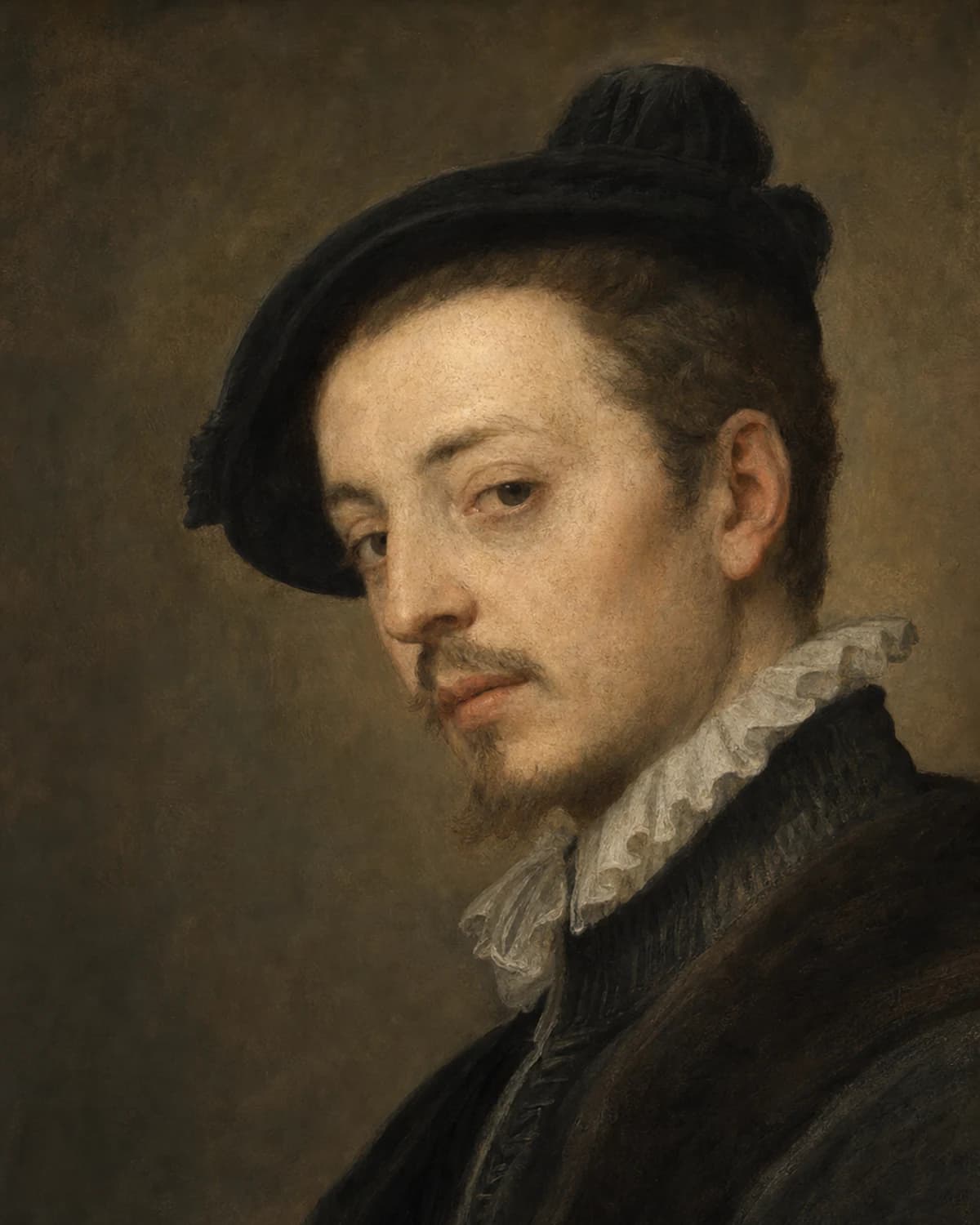
На основе открытого изображения: Attributed to Palma il Giovane; Wikimedia Commons; Public domain.
