
1250–1301
Master of Vyšší Brod
The name of this Bohemian painter is unknown. He is called after a cycle of nine altarpiece panels painted around 1350 for the Cistercian monastery at Vyšší Brod in southern Bohemia. The scenes of the Infancy of Christ, the Passion and the Resurrection are now in the National Gallery in Prague. He was probably from Prague, and was one of the first painters north of the Alps to absorb Italian painting of the early fourteenth century.
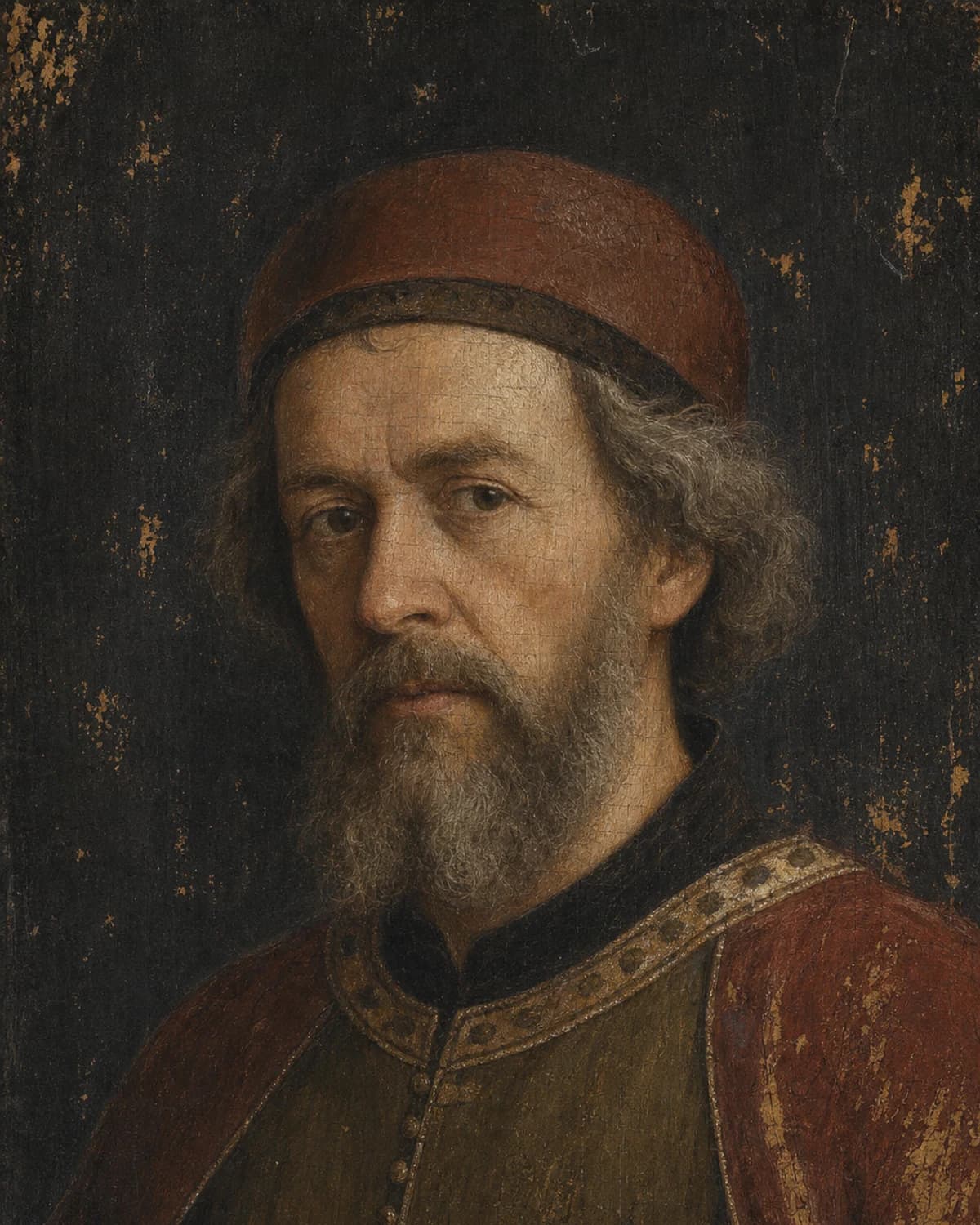
Biography
The nine panels that gave the painter his name were long ago separated from the altarpiece, and no one can say what it looked like as a whole. Most likely the panels were arranged in three tiers of three. Today all of them are in the former Convent of St Agnes in Prague, which houses part of the National Gallery’s collection.
There are no documents about the master himself. He is generally believed to have been born in Prague; the conventional birth and death dates of 1250 and 1301 do not fit with his work around 1350, and cannot be relied on. All that is known is that he was active in the 1340s and 1350s.
According to some accounts, the commission came from Peter I of Rosenberg, a court official of Charles IV, and was made before 1347. The patron is shown as a donor in the Nativity scene, with the Rosenberg coat of arms beside him. The painter is linked with the circle of Charles IV’s court in Prague, where Italian art was well known, and the emperor himself had visited Italy more than once. The cycle falls clearly into three groups. The first has the Annunciation, the Nativity and the Adoration of the Magi. The second has the Agony in the Garden, the Crucifixion and the Lamentation. The third has the Resurrection, the Ascension and the Pentecost, where the subject is the divine nature of the Saviour. The quality is uneven from panel to panel: the first three are considered the best, and after that the costumes, figures and compositions become simpler. For this reason some scholars credit the master himself with only part of the panels (the Annunciation, the Nativity, the Adoration and the Resurrection), assigning the rest to his workshop; others confidently attribute all nine to him.
His style grew out of Italian Trecento painting, above all Giotto and Duccio, and Bohemian book illumination. The figures stand in shallow space against a gold ground, the faces are animated, the gestures delicate. Many art historians hold that he was the first painter north of the Alps to make such careful use of Italian models; German panel painting of the early fifteenth century built on this.
Other works are attributed to him on grounds of style: the Madonna of Veveří, the Madonna of Most, the so-called Roman Madonna, the Madonna of Kladsko (Berlin) and the Kaufman Crucifixion. The link between these works and the Vyšší Brod cycle remains disputed. His sphere of influence is sometimes extended to Silesian works, to the wall paintings in the sacristy of the Church of St Thomas in the Lesser Town of Prague, and to the miniatures of the Lubin Codex.
I do not know whether his identity can be considered recoverable from such material. For now the name denotes above all a hand: four to nine panels painted in tempera, which combine Italian clarity with Bohemian refinement.
In 2011 the Nativity from this cycle appeared on a stamp issued on the island of Saint Kitts.
Related context
Associations
Works connected through artistic movements, cultural context and period. Priced works available in this market appear first.
Profile notes
Profile and sources
Image
Artist image
На основе открытого изображения: Master of Vyšší Brod; Wikimedia Commons; Public domain.
