
22.05.1844–14.06.1926
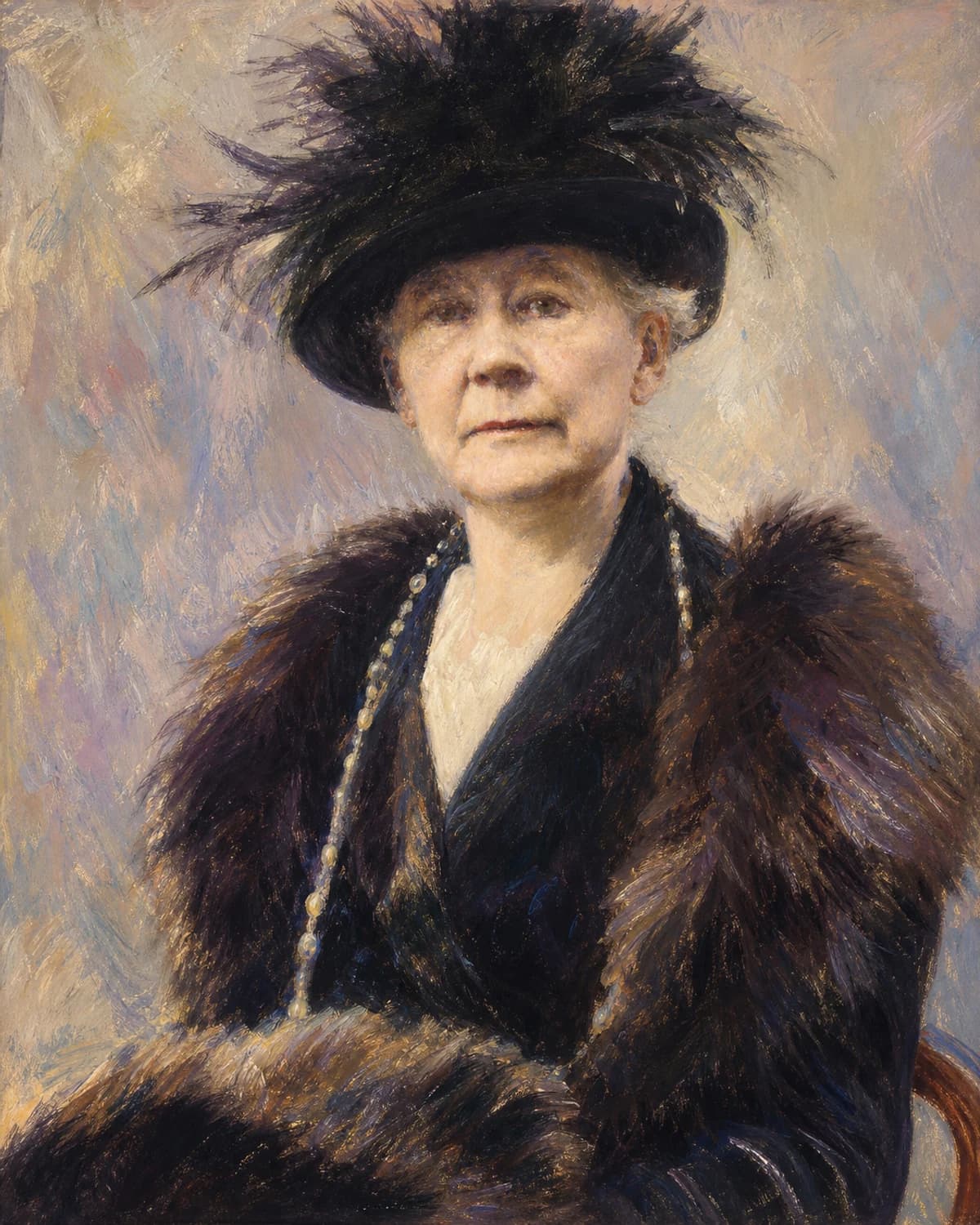
Mary Cassatt
Mary Cassatt (1844–1926), the daughter of a Pennsylvania stockbroker, lived in Paris from 1874 and became the only American officially associated with the Impressionists. She painted women in theatre boxes, at tea and with children, and after the Paris exhibition of Japanese prints she made a series of colour etchings. She advised American collectors on what to buy, and much of what they bought went to museums in the United States.
Biography
In 1875, in the window of a Paris art dealer, Mary Cassatt saw pastels by Edgar Degas. She later recalled going to that window, flattening her nose against the glass and absorbing all she could: “It changed my life. I saw art then as I wanted to see it.” She was thirty-one, and for several years she had been sending pictures to the Salon with little joy.
In 1877 the Salon jury rejected both her pictures. That same year Degas invited her to exhibit with the Impressionists.
Cassatt was born on 22 May 1844 in Allegheny, a town in Pennsylvania that is now part of Pittsburgh. Her father, Robert Simpson Cassatt, was a successful stockbroker and land speculator; her mother, Katherine Kelso Johnston, came from a banking family, and the household held that there was no education without travel. Mary spent five years of her childhood in Europe, saw London, Paris and Berlin, learned German and French and had her first drawing lessons. At fifteen, against her family’s objections, she began studying at the Pennsylvania Academy of the Fine Arts in Philadelphia and stayed there until 1865, throughout the Civil War; Thomas Eakins was among her fellow students. Women were not allowed to work from the live model, drawing was mostly from casts, and Cassatt later summed up the academy briefly: “There was no teaching.”
In 1866 she won her father over and left for Paris with her mother and family friends. Women were not admitted to the École des Beaux-Arts, so Cassatt took private lessons from Jean-Léon Gérôme and copied daily in the Louvre with an official permit. At the end of 1866 she studied with the genre painter Charles Chaplin, in 1868 with Thomas Couture. That same year, 1868, the Salon accepted a painting of hers for the first time, “A Mandoline Player”; together with Elizabeth Jane Gardner she was one of the first two American women to exhibit at the Salon. In the summer of 1870, as the Franco-Prussian War began, Cassatt returned to America and lived with her family in Altoona; her father paid for her keep but not for her paints. Some of her early pictures were lost in the Great Chicago Fire of 1871. Rescue came from the Bishop of Pittsburgh, Michael Domenec, who commissioned two copies after Correggio in Parma and gave her money for the journey. By the autumn of 1871 she was back in Europe. At the Salon of 1872 her “Two Women Throwing Flowers During Carnival” was well received and bought; then came Madrid and Seville and Spanish subjects, and in 1874 she settled in Paris for good.
At the fourth Impressionist exhibition, which opened on 10 April 1879, Cassatt had eleven works, among them “Woman with a Pearl Necklace in a Loge”, for which her sister Lydia sat. Critics wrote that her colours were too bright and her portraits too accurate to flatter the sitters. With her share of the takings she bought a work by Degas and one by Monet. Degas introduced her to pastel and etching. In the winter of 1879–1880 she printed in his studio, on his press, and in the evenings prepared studies for the next plate, until in April 1880 he abandoned their joint plan for a journal of prints. Lydia, who had come to Paris with their parents in 1877, often posed for her, and after Lydia’s death in 1882 Cassatt stopped working for a time. She exhibited with the Impressionists in 1880 and 1881 and remained in their circle until 1886. On seeing her “Two Women Picking Fruit”, Degas is supposed to have said that no woman had the right to draw like that.
In 1886 two of her paintings were included in the first Impressionist exhibition in the United States, organised by Paul Durand-Ruel. Her old friend Louisine Elder married Harry Havemeyer in 1883, and on Cassatt’s advice the couple began collecting the Impressionists on a grand scale; much of their collection is now in the Metropolitan Museum of Art. After 1886 Cassatt did not align herself with any movement. Her main subject became mother and child: “The Child’s Bath” (1893) in the Art Institute of Chicago, “The Boating Party” (1893–1894) in the National Gallery of Art in Washington. In 1891, a year after an exhibition of Japanese masters in Paris, she showed a series of colour drypoints with aquatint, among them “Woman Bathing” and “The Coiffure”, in light pastel tones and without black. At the same time the Chicago socialite Bertha Palmer commissioned from her a mural, “Modern Woman”, about 3.7 by 17.7 metres, for the Woman’s Building of the World’s Columbian Exposition of 1893. After Palmer’s death in 1918 the triptych disappeared. To my mind this is a painful loss: the conception can be judged only from the studies.
In the 1890s young American artists came to her for advice; she introduced Lucy Bacon to Pissarro. In the early twentieth century Cassatt advised major collectors and made it a condition that what they bought should eventually go to American museums. In 1904 France awarded her the Legion of Honour. Two of her mother-and-child paintings hung in the Armory Show of 1913 in New York. A trip to Egypt in 1910 overwhelmed her: she wrote that she was crushed by the strength of that art. After 1914, almost blind, she stopped painting, but in 1915 she lent eighteen works to an exhibition in support of votes for women organised by Louisine Havemeyer.
Mary Cassatt died on 14 June 1926 at the Château de Beaufresne near Paris. She was buried in the family vault at Le Mesnil-Théribus.
Related context
Associations
Works connected through artistic movements, cultural context and period. Priced works available in this market appear first.








Profile notes
Profile and sources
Image
Artist image
На основе открытого изображения: Unknown author Unknown author; Wikimedia Commons; Public domain.
