
31.01.1934–22.10.2016
Marwan Kassab-Bachi
Born in Damascus, Marwan Kassab-Bachi came to Berlin in 1957 to study painting and stayed there for the rest of his life. In the Berlin art world he was known simply as Marwan; for more than twenty years he was professor of painting at the Hochschule der Künste, he became a member of the Akademie der Künste, and his works are held by the Centre Pompidou, Tate Modern and the Städel in Frankfurt.
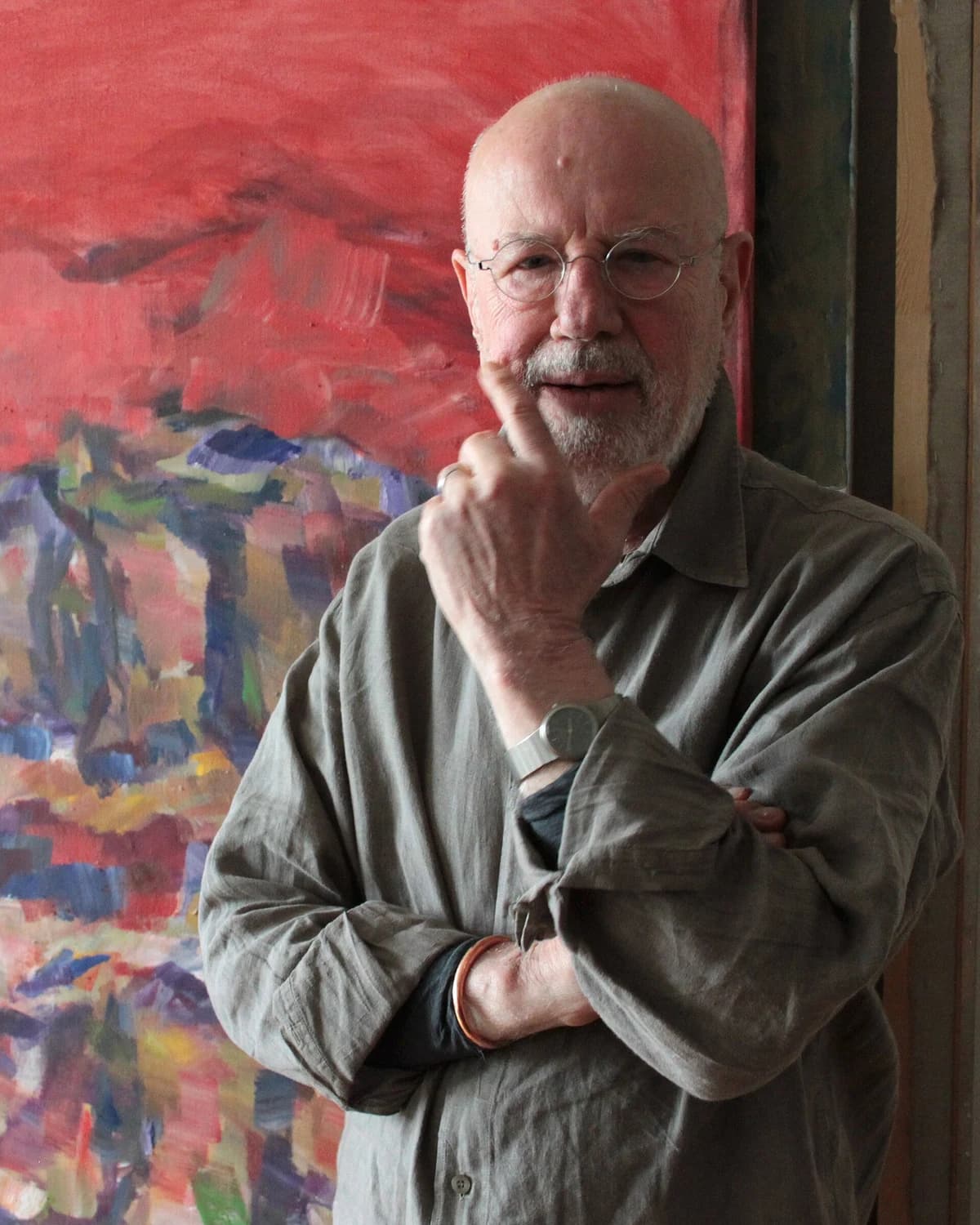
Biography
The collection of the Centre Pompidou in Paris includes a 1967 painting, “Man in a Green Waistcoat”. For almost sixty years its author was known in Berlin simply by his first name, Marwan, without a surname. It seems to me there is something of his situation in this: a Syrian artist who lived nearly all his life in Germany did not become wholly one or the other, and a single name suited him better than a choice between two countries.
He was born in Damascus on 31 January 1934. At first he did not study painting: in 1955–1957 he read Arabic literature at Damascus University. In 1957 he left for West Berlin and entered the Hochschule für Bildende Künste, in the painting class of Hann Trier; he studied there until 1963.
From 1963 Marwan worked in Berlin as a freelance artist and became part of the circle of Georg Baselitz and Eugen Schönebeck. His main subjects were the human face and landscape. He painted faces many times over, building up paint and texture layer upon layer, and his painting is seen as connected both with German Expressionism and with Sufi philosophy, with the search for a universal language beyond cultural borders. In 1966 he received the Karl Hofer Prize, and in 1973 a fellowship at the Cité internationale des arts in Paris. In 1977–1979 he taught at the Berlin Hochschule der Künste as a visiting professor, in 1980 he became a full professor of painting there, and he taught his class until 2002. His students included Monica Bonvicini, Said Baalbaki, Ali Kaaf and Salah Saouli. In 1992–2000 he sat on the jury of the Fred Thieler Prize, awarded by the Berlinische Galerie, and in 2002 he received the prize himself. From 1994 he was a member of the Akademie der Künste in Berlin.
He did not lose touch with the Arab world. In 1999–2003 Marwan directed the summer academy of the Darat al Funun foundation in Jordan; more than sixty young artists from Jordan, Palestine, Syria, Lebanon and Iraq passed through it. He designed book covers for the writer Abdul Rahman Munif, and Munif in turn wrote a biography of him, “A Journey of Art and Life”.
He had more than eighty solo exhibitions. In 1981 he was shown at Schloss Bellevue in Berlin, in 1991 at the Haus der Kunst in Munich, in 1993 at the Bibliothèque nationale de France and the Institut du monde arabe in Paris, in 2006 at the Berlinische Galerie, in 2008 at the Museum für Islamische Kunst in Berlin, in 2014 at the Serralves Museum in Porto, and in 2015 at the Mosaic Rooms in London. In 2005 he was awarded the Cross of Merit of the Order of Merit of the Federal Republic of Germany.
His works are in the Berlin State Museums, the Berlinische Galerie, the Städel in Frankfurt, the Galerie Neue Meister in Dresden, the Staatliche Graphische Sammlung in Munich, the Centre Pompidou, the Bibliothèque nationale de France, Tate Modern and the British Museum, the Museum of Modern Art in New York, the Carnegie Museum of Art in Pittsburgh and the Museum of Contemporary Art Chicago, and in the Middle East in the Abdul Hameed Shoman Foundation in Amman, Birzeit University, the National Museum of Damascus and the Khalil Sakakini Cultural Centre in Ramallah.
Marwan died in Berlin on 22 October 2016. A few months later, in 2017, his works were shown in the main exhibition of the 57th Venice Biennale, “Viva Arte Viva”.
Profile notes
Profile and sources
Image
Artist image
Dietmar Bührer ( de:Dietmar Bührer ); Wikimedia Commons; CC BY-SA 4.0.
