
12.06.1733–31.08.1795
Maruyama Ōkyo
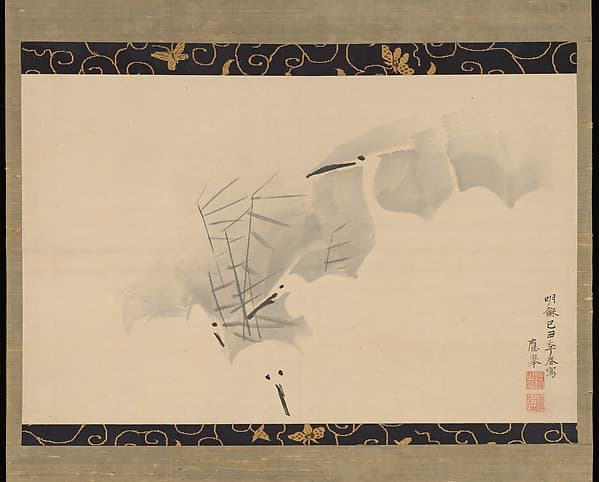
Maruyama Ōkyo (1733–1795), a farmer’s son from Tamba province, started out in a Kyoto toy shop, painting the faces of dolls, and there saw his first European stereoscope. From Western perspective, Chinese models and the Kanō school he put together a manner of his own: a bird, a fish or a snow-laden pine on an empty ground, from life, without outline, with a broad flat brush. His Maruyama school and the Shijō school that grew from it set the course of Kyoto painting for a century.
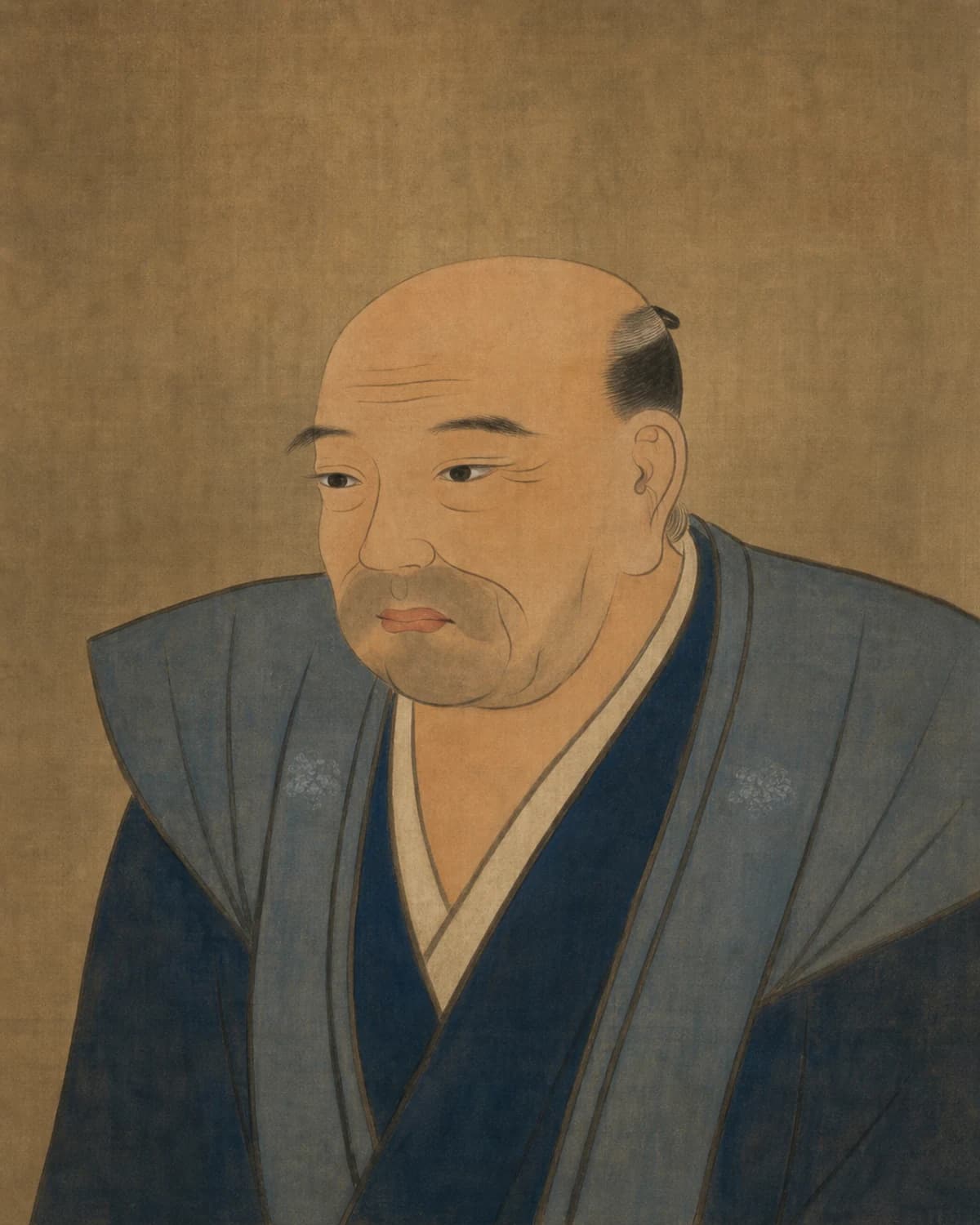
Biography
In 1767, in the shop of a Kyoto toy dealer where the young Maruyama Ōkyo painted the faces of dolls, European stereoscopes appeared: looking into such a box, a customer saw a picture with an illusion of depth. That was Ōkyo’s first encounter with Western perspective. That same year he painted a “Harbour View” of his own, in single-point perspective, and quickly mastered this genre of “eyeglass pictures”, megane-e.
He was born on 12 June 1733 into a farming family in the village of Ano-o in Kuwata district, Tamba province, now the city of Kameoka near Kyoto, and bore the name Masataka. As a teenager he moved to Kyoto and joined the class of townspeople. He studied painting under Ishida Yūtei, a master of the Kanō school, and this teacher, to my mind, meant more to him than the stereoscope. In parallel he studied Chinese painting: he loved Qian Xuan, the thirteenth-century painter of flowers, and the figure painter Qiu Ying, took the character “kyo” in his name in tribute to Qian Xuan and for a time even signed with a single character, in the Chinese manner. He looked at the work of Shen Quan, a Chinese painter who had lived in Nagasaki in 1731–1733, but did not like his proportions; he preferred Watanabe Shikō. And he eagerly examined any Western paintings and prints that came his way.
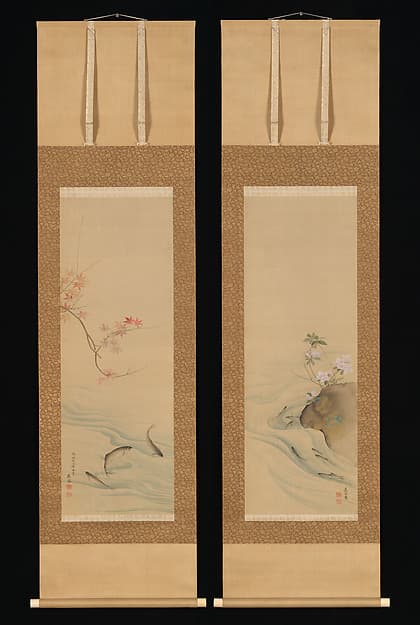
The first large commission came in 1768 from Yūjō, abbot of the temple Enman’in in Ōtsu: “The Seven Misfortunes and Seven Fortunes”, three scrolls about forty-five metres long in all, on the fruits of bad and good karma. Ōkyo painted them for three years and looked for a model for every figure, even for the man being torn in two by frightened bulls. In his introduction he explained that people needed to see reality, not invented pictures of Nirvana and Hell, if they were to believe in Buddhist teaching. The abbot was his patron for many years. Already in 1767, at Enman’in, he had painted “Geese Alighting on Water”, one of the first works in his mature manner; in 1769 came “Kingfisher and Trout”: the bird at the top waits, the fish swims under a large rock, and all of it looks as it does in nature, without the philosophical undertone the East Asian tradition had put into such subjects.
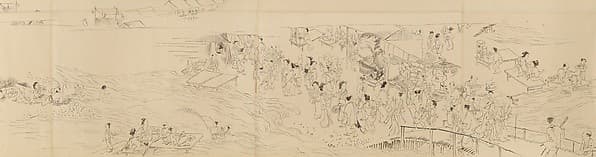
Other painters scolded his manner: too attached to the look of things, too dependent on the real world, the works not dignified enough. The public liked it. He was commissioned to paint Western-style landscapes, decorative screens, nudes; he drew from life and used those sheets in his paintings, and was probably the first Japanese artist to draw from a nude model. His clients included rich merchants, the shogunate and even the emperor. For the Mitsui family he painted “Pine Trees in Snow” in 1773, two six-panel screens in ink on gold: bark and needles rendered with different strokes, the snow seeming to weigh down the branches, the trunks painted without outline, in dark and light patches alone, by the tsuketate technique. His pictures have few midtones; the subject is usually single and on an empty ground; he loaded his broad flat brush with more paint on one side, so that the stroke came out uneven in density. An album of leaves with animals and plants, now a handscroll in the Nishimura Collection in Kyoto, is labelled as if it were a European field guide. He also painted ordinary scenes of commercial Kyoto. It was said that a daimyō commissioned from him a ghost portrait of a dead relative, and that the ghost, as soon as the picture was finished, came off it and flew away; that legend, of course, cannot be checked.
Success allowed him to open a school in Kyoto, where he taught his pupils to rely on nature and to render light, shadow and volume; the school grew, and branches appeared in Osaka. Among his pupils were his son Maruyama Ōzui, Nagasawa Rosetsu and Matsumura Goshun. Goshun came in 1787, the year the school received a commission for screens for the temple Daijō-ji in Kasumi; after the great Kyoto fire teacher and pupil lodged together in the temple Kiunin, became friends, and Ōkyo refused to regard their relationship as that of master and student. Goshun later founded the Shijō school, and the two schools together, Maruyama-Shijō, became one of the main lines of Japanese painting right up to nihonga. Much of the school’s work is kept today at Daijō-ji.
“Hozu Rapids” of 1795, two eightfold screens with a tree, rocks and dragons, was painted in the last year of his life; the rocks and water are convincing, but the dragons, in Paine’s view, he painted academically, and they lost the force of myth. Maruyama Ōkyo died on 31 August 1795 in Kyoto.
Artist works
Works by the artist
Works by Maruyama Ōkyo available in this edition of NEOARCA.
Related context
Associations
Works connected through artistic movements, cultural context and period. Priced works available in this market appear first.








Profile notes
Profile and sources
Image
Artist image
На основе открытого изображения: 谷文晁; Wikimedia Commons; Public domain.
