
10.02.1827–17.12.1902
Martín Tovar y Tovar
Martín Tovar y Tovar (1827–1902), a pupil of the Madrazos in Madrid and of Léon Cogniet in Paris, painted thirty portraits of the heroes of independence and “The Battle of Carabobo” for the Federal Legislative Palace in Caracas: canvases totalling 458 square metres, glued to an elliptical dome in 1888. Of the four battles commissioned from him he managed to finish three; in 1865 he opened one of Venezuela’s first photographic studios in Caracas.
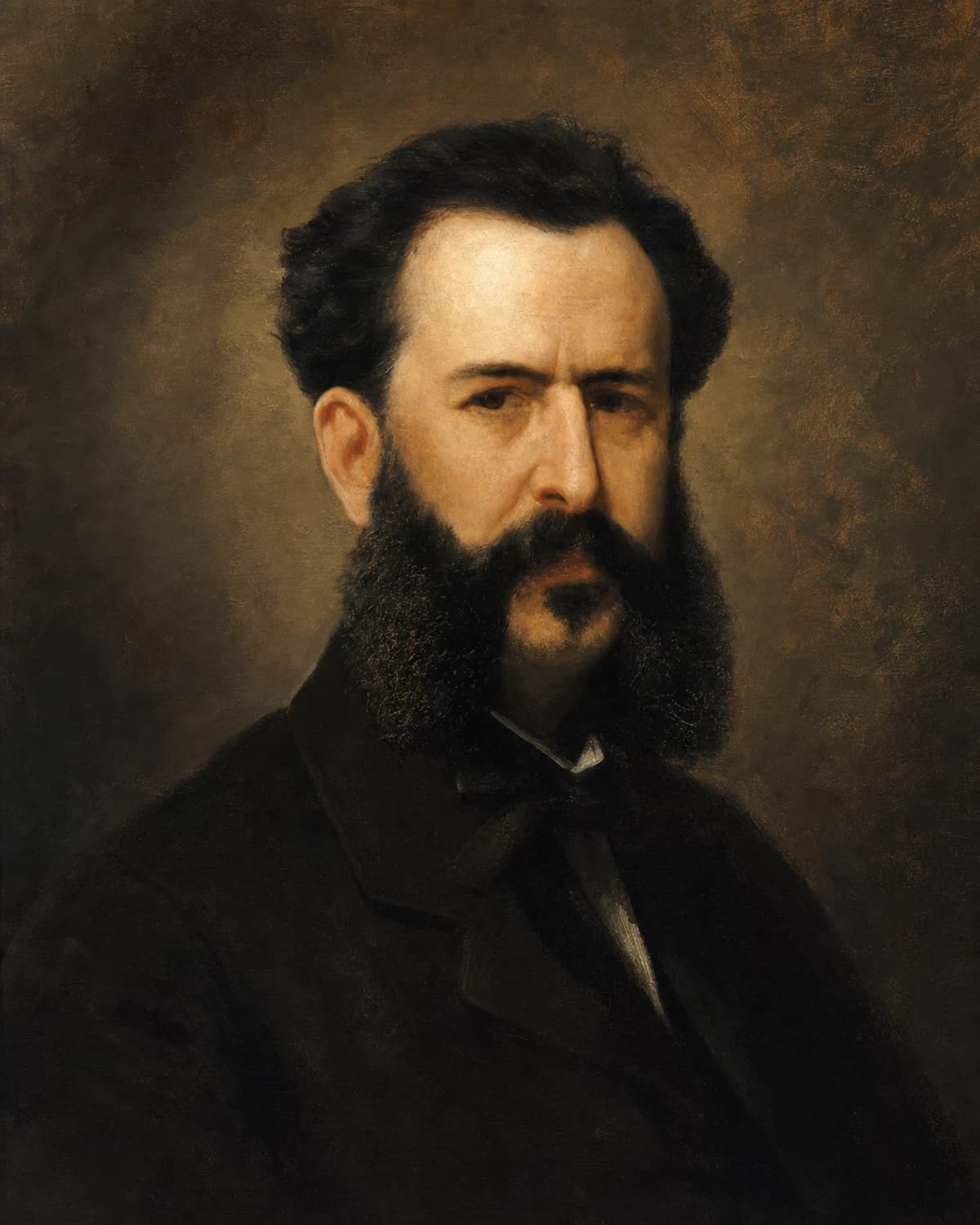
Biography
On 28 October 1888, under President Juan Pablo Rojas Paúl, the Elliptical Hall of the Federal Legislative Palace was opened in Caracas. Glued to its concave dome was “The Battle of Carabobo” by Martín Tovar y Tovar: canvases painted in oil in a Paris studio, brought over and mounted by the French firm A. Binant with its own workmen and tools, while the painter himself watched them being trimmed to the shape of the dome. The painted surface, 458 square metres, is still spoken of as a first.
Tovar y Tovar was born on 10 February 1827 in Caracas, the son of Antonio María Tovar, a retired Spanish official, and Damiana Tovar Liendo, a native of Caracas; before his birth his parents had lived in exile in Puerto Rico and had returned to Venezuela only shortly before. His first lessons came from Celestino Martínez, a nineteen-year-old instructor at the Drawing Academy; then he studied at the Academy itself under Antonio José Carranza and at the Colegio de La Paz under Carmelo Fernández. In 1844, with Fernández and two other companions, he bought a lithographic workshop from German emigrants and became one of Venezuela’s first lithographers.
In 1850 he left for Madrid, for the Royal Academy of San Fernando, where he studied under José de Madrazo and his son Federico, and in 1852 moved to Paris, to the studio of Léon Cogniet. In 1855 he went home, but a year later was in Paris again, copying paintings by the great masters for a future National Museum in Caracas. The project was approved, the money was not found, and the museum never came about; portraits remained his main business. In 1857–1859 he ran the class of life and topographical drawing at the Colegio de Roscio, and in 1862 the government sent two of his works, “Llaneros of Venezuela” and “Study of a Drunken Mulatto”, to the International Exhibition in London. In 1865 he opened in Caracas the “Fotografía Artística de Martín Tovar y Tovar”, one of the country’s first photographic studios, soon taking José Antonio Salas as his partner. At the 1867 Exposition Universelle in Paris he won a gold medal. From 1869 he headed the Academy of Fine Arts in Caracas, and in 1872 he took part in the first Annual Exhibition of Venezuelan Fine Arts, organised by the travellers James Mudie Spence and Anton Goering at the Café del Ávila.
The large commissions began in 1873: thirty portraits of the heroes of the War of Independence and other figures of the republic for the Elliptical Hall of the Legislative Palace. He painted them in Paris and delivered them in 1875. In 1881 President Antonio Guzmán Blanco commissioned from him “The Signing of the Act of Independence”; the picture was shown at the National Exhibition of 1883 and brought a gold medal, and with it new commissions: the battles of Carabobo, Boyacá and Junín for the ceiling of the Elliptical Hall, the Battle of Ayacucho for the Senate and “The Treaty of Coche” for the Chamber of Deputies. In 1885 he left for France and until the late 1890s kept a studio in Paris, travelling between it and Caracas and continuing to paint portraits. For “Carabobo” he chose three episodes: Bolívar with his staff on the hill of Buenavista and the entry of the British Legion, the deaths of Ambrosio Plaza and Manuel Cedeño, and the charge of the Apure llaneros led by Páez; the defeated royalists are pushed into the background. “Boyacá” and “Junín” were finished in 1895; “Ayacucho” remained a sketch, and in 1906 the picture was painted from his studies by Antonio Herrera Toro. It was Herrera Toro, too, who restored “Junín” in 1901, when the canvas came away from the ceiling.
From 1890 Tovar y Tovar took up landscape, above all the coast at Macuto: “View of Caracas from Gamboa” (1891), “The Ávila from Gamboa” (1896), “Macuto” (1898). It seems to me that these late views link the landscape of the travelling artists with what the Caracas Círculo de Bellas Artes did afterwards.
He died on 17 December 1902 in Caracas, aged seventy-five. In 1983 his remains were moved to the National Pantheon.
Related context
Associations
Works connected through artistic movements, cultural context and period. Priced works available in this market appear first.








Profile notes
Profile and sources
Image
Artist image
На основе открытого изображения: Antonio Herrera Toro; Wikimedia Commons; Public domain.
