
30.01.1943–present
Marta Minujín
Marta Minujín (born 1943) makes art out of events: happenings, labyrinths, huge structures that the public later takes apart piece by piece. In 1965 in Buenos Aires she built the labyrinth “La Menesunda” with Rubén Santantonín, and in December 1983 she raised on Avenida 9 de Julio a “Parthenon” of thirty thousand books banned under the military dictatorship.
Biography
The only way out of the dentist’s surgery was to dial a number on a giant rotary telephone. That was how one of the sixteen rooms of “La Menesunda” worked, the labyrinth that Marta Minujín and Rubén Santantonín built in 1965 at the Torcuato di Tella Institute in Buenos Aires. Visitors went through it in groups of eight, guided by neon lights, and squeezed from room to room through openings in the shape of a human figure. In one room televisions blared at full volume, in another a couple lay in bed, in a third there was a cosmetics counter with a saleswoman. There was a cold store hung with fabrics that looked like sides of meat, and a mirrored room with black light, confetti and the smell of frying. Advertising hung everywhere. To my mind, this is the best way to understand why Minujín is filed under Pop Art and why the label is too tight for her.
She was born on 30 January 1943 in Buenos Aires, in the San Telmo district. She studied at the art institute of the National University and first exhibited while still a student, in 1959, at the Teatro Agón. A grant from the National Arts Foundation took her to Paris in 1960: she was among the young Argentines in an exhibition assembled by the sculptor Pablo Curatella Manes.
In Paris she was taken with the Nouveaux Réalistes and their idea of turning art into life. In 1962 Minujín publicly burned her paintings. Then came the “livable sculptures”, and in 1963 “Destruction”: she put together a structure of mattresses in a Paris street and invited avant-garde artist friends, Christo and Paul-Armand Gette among them, to destroy the lot. This action is considered one of her first happenings.
In 1964 she won a national prize at the Di Tella Institute and staged two happenings there, “Erotics in Technicolor” and “Roll Around and Live”. The same year public television broadcast her “Cavalcade”: buckets of paint were tied to the tails of horses. In neighbouring Montevideo, at the Tróccoli stadium, “Events” took place, with five hundred chickens, motorcycles and performers of every conceivable build. Besides “La Menesunda”, 1965 brought “Sweet Obelisk”, the obelisk of Buenos Aires smeared with ice cream that three of her colleagues licked off, and “Reading the News”, in which the artist, wrapped in newspapers, walked into the waters of the Río de la Plata.
In 1966 Minujín received a Guggenheim Fellowship and left for New York. In June of that year General Juan Carlos Onganía took power in Argentina, and under the new regime exhibitions of this kind were often banned. In New York she turned to psychedelic art. The best-known piece of those years, “Minuphone” (1967), was made with Per Biorn, an engineer at Bell Labs, and shown at the Howard Wise Gallery: a person stepped into a telephone booth and dialled a number, the glass began to glow with colour, sounds played, and on a screen in the floor the caller saw themselves. In New York she became friends with Andy Warhol, and in 1972 her likeness appeared on Mary Beth Edelson’s well-known poster “Some Living American Women Artists”.
In 1976 she returned to Argentina.
Then came copies of famous images in unexpected materials. Minujín made plaster replicas of Greek classical sculpture, a miniature obelisk of panettone, a Venus de Milo of cheese. For a 1981 exhibition in Medellín she made a sheet-metal figure of the singer Carlos Gardel, stuffed it with cotton and set it on fire: Gardel had died in 1935 in a plane crash in that same Medellín. In 1982 she received the first of her Konex Awards. For Manhattan she proposed a reclining Statue of Liberty turned into a public park.
In 1983 the military dictatorship in Argentina came to an end. After Raúl Alfonsín’s inauguration on 10 December, the “Parthenon of Books” rose on the median strip of Avenida 9 de Julio: the frame of a temple filled with thirty thousand books banned between 1976 and 1983. There were Freud, Marx, Sartre, Gramsci, Foucault, Latin American authors and even Saint-Exupéry’s “The Little Prince”. Three weeks later the structure was dismantled and the books were handed out to people. Two years after that, following a conversation with Warhol about the Latin American debt crisis, came the photo series “The Debt”: Minujín symbolically pays Warhol in maize for Argentina’s foreign debt.
She came back to the “Parthenon” in 2017 in Kassel: this time a hundred thousand books that had been banned at one time or another were packed into a copy of the Athenian temple, in memory of the books the Nazis burned in the 1930s and 1940s. When it was dismantled, these books too were given away. In July 2021 a “Big Ben” half the size of the real one lay in Manchester’s Piccadilly Gardens, clad in books about British politics, and after the exhibition visitors were invited to take it apart by carrying off a book each; Minujín herself could not come because of COVID travel restrictions.
In 2023 her work was in an exhibition of abstraction by women artists of 1940–1970 at the Whitechapel Gallery in London. In November that year the Jewish Museum in New York opened “Arte! Arte! Arte!”, Minujín’s first survey exhibition in the United States: about a hundred works from six decades. At the same time “Sculpture of Dreams”, made of sixteen inflatable elements, stood in Times Square, her first public sculpture in New York.
Profile notes
Profile and sources
Image
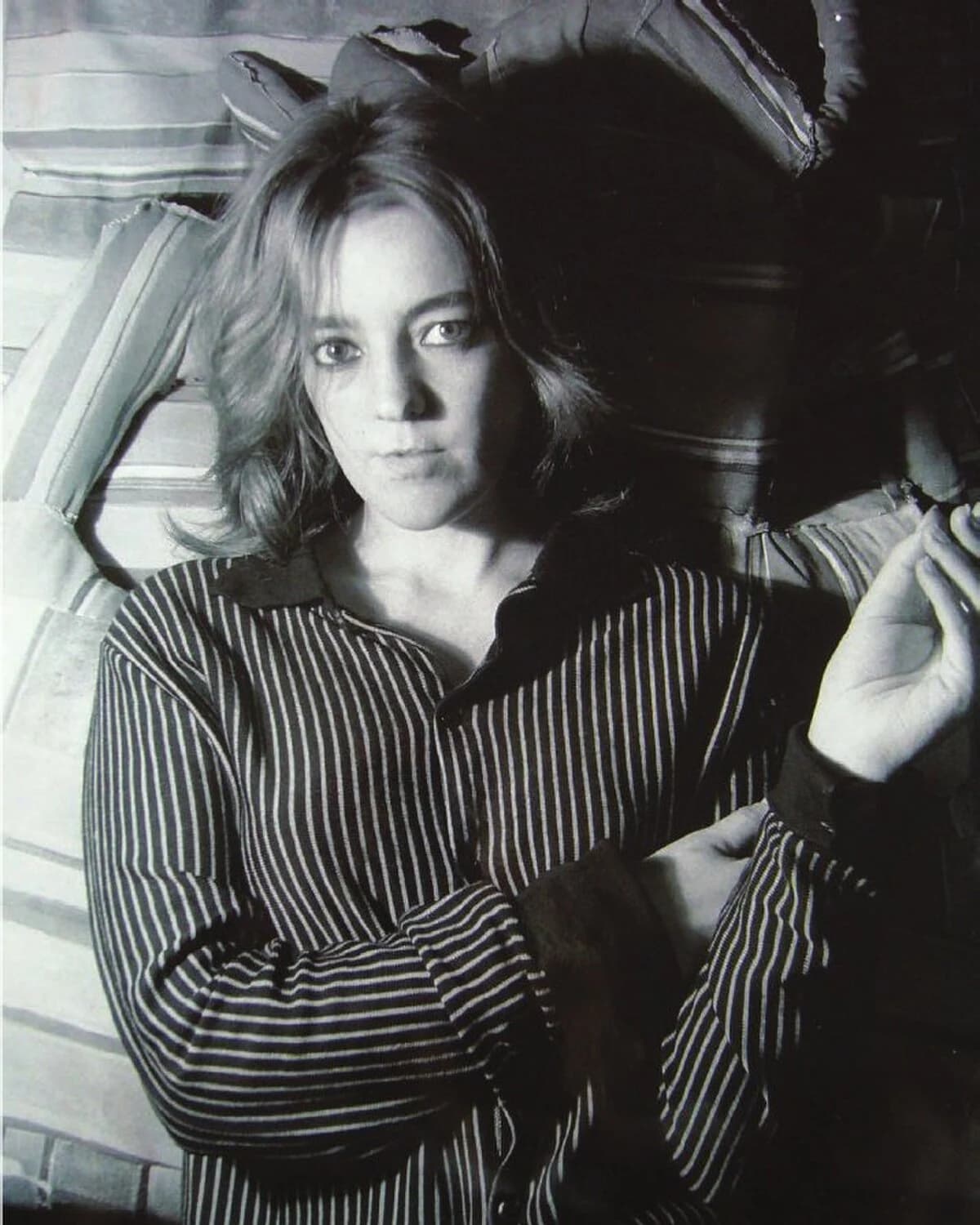
Artist image
Sameer Makarius; Wikimedia Commons; Public domain.
