
03.08.1953–present
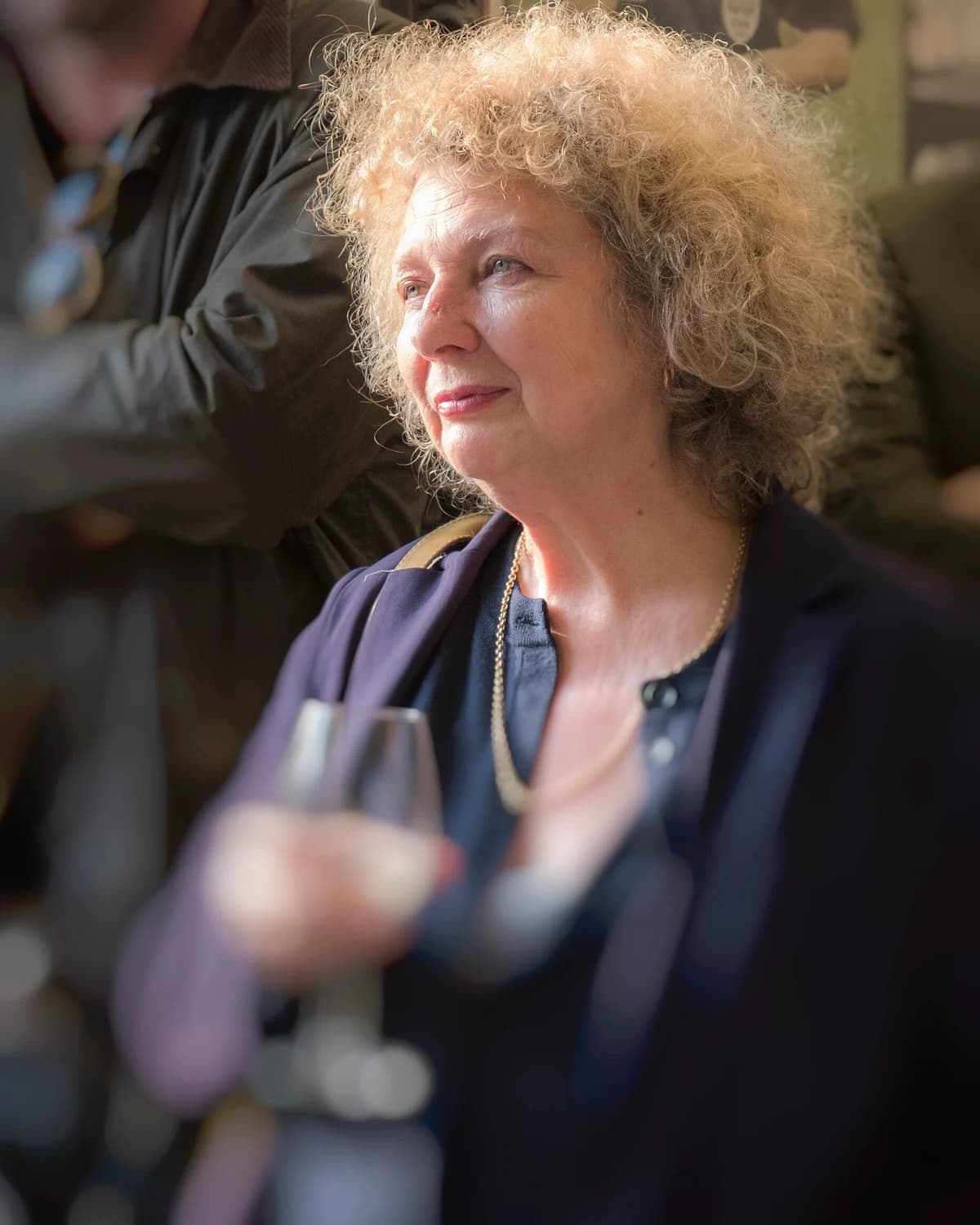
Marlene Dumas
Marlene Dumas (born 1953), a native of Cape Town, has lived and worked in Amsterdam since 1976. She paints portraits and figures in oil on canvas and ink on paper from Polaroids and newspaper photographs, and what matters to her more than likeness is a person’s state of mind. In 1995 she represented the Netherlands at the Venice Biennale; in 2025 a cycle of nine paintings by her entered the Louvre’s permanent display.
Biography
In December 2025 the Louvre hung Marlene Dumas’s nine-part cycle “Liaisons” in the Gallery of the Five Continents in the Denon Wing. With it she became the first contemporary woman artist whose work entered the museum’s permanent display.
Dumas was born on 3 August 1953 in Cape Town and grew up nearby, in Kuils River in the Western Cape. Her childhood fell in the years of apartheid. In 1972–1975 she studied art at the University of Cape Town; she began painting in 1973, and her first works dealt with politics and with what it meant to be a white woman from an Afrikaner family in South Africa.
In 1976 she moved to the Netherlands. Until 1978 she worked at the Ateliers ’63 studios in Haarlem, and in 1979–1980 she studied psychology at the University of Amsterdam.
Her portraits care little about likeness. What interests Dumas is what a person might have been feeling: her themes are almost always on a borderline, sexuality and race, guilt and innocence, violence and tenderness. Her subjects include newborn babies, friends, models, strippers, and figures from popular culture and politics. She works from other people’s photographs and her own: Polaroids of friends, pictures from newspapers and magazines, explicit ones among them. The brushwork is loose and the figures distorted, but then a very precise detail suddenly appears beside the distortion. She likes to paint wet-on-wet, combining thin layers of paint with thick ones. It seems to me that ink on paper matters to her no less than oil, and is even more honest: the wash leaves nothing to correct. Her small erotic works, she has said, are better seen in the original; they are too intimate for reproduction.
“Miss January” (1997), a canvas 2.82 metres high, reworks her own childhood picture “Miss World”, made when she was ten.
In 1995 Dumas represented the Netherlands at the Venice Biennale, and in 2007 she received the Düsseldorf Prize for her contribution to contemporary art. She has taught at the academies in Tilburg and Enschede, at the Rijksakademie van Beeldende Kunsten in Amsterdam and at De Ateliers. In 2015–2016 she illustrated Hafid Bouazza’s Dutch translation of Shakespeare’s poem “Venus and Adonis”. Since 2014 she has been working on the series “Great Men”: ink portraits with inscriptions of men who were persecuted and punished for their sexual orientation; the magazine Frieze placed the series fourteenth in its list of the twenty-five best works of the twenty-first century.
Dumas’s works are in the Museum of Modern Art in New York, Tate in London and the Dordrechts Museum. In 2022 they were included in the exhibition “Women Painting Women” at the Modern Art Museum of Fort Worth. The University of Antwerp has awarded her an honorary degree.
Profile notes
Profile and sources
Image
Artist image
Jan Harm Bakhuys; Wikimedia Commons; CC BY-SA 4.0.
