
02.04.1647–13.01.1717
Maria Sibylla Merian
At thirteen Maria Sibylla Merian was raising silkworms, and at fifty-two she sailed to Suriname with her daughter, having sold hundreds of her own works to pay for the trip. She was the first among European artists to draw insects at every stage of development together with their food plants. Her main book, Metamorphosis Insectorum Surinamensium, appeared in Amsterdam in 1705.
Biography
In 1699 a fifty-two-year-old Amsterdam woman boarded a ship bound for Suriname and took her younger daughter with her. She had raised the money herself, by selling part of her collections and paintings. The aim was clear: to spend five years drawing insects whose origins were little understood in Europe.
Maria Sibylla Merian was born on 2 April 1647 in Frankfurt am Main, into the family of the engraver and publisher Matthäus Merian the Elder. Her father died when she was three. In 1651 her mother married the flower painter Jacob Marrel, who began to teach his stepdaughter drawing; when he was away, his pupil Abraham Mignon took over the lessons. She had been busy with caterpillars since childhood. She began, in her own words, with silkworms in Frankfurt, and then collected every caterpillar she could find in order to see what they turned into.
In 1665 she married a pupil of Marrel, Johann Andreas Graff of Nuremberg. In 1670 the family moved to Nuremberg. Merian painted textiles and did needlework, sold paints and painting supplies, and taught girls from well-off families to draw and embroider. For them she engraved flower patterns: the “Neues Blumenbuch” (“New Flower Book”) came out in three parts, in 1675, 1677 and 1680. Women were not then allowed to use oil paints, so she worked in watercolour and gouache on parchment and paper. In 1679 the first volume of “Der Raupen wunderbare Verwandelung und sonderbare Blumennahrung” (“The Caterpillars’ Marvellous Transformation and Strange Floral Food”) appeared; the second followed in 1683. Each has fifty plates, which she engraved herself. It was a new kind of image: the insect in the centre, shown at every stage from egg to butterfly, with the plant showing what it feeds on. Many people at the time still believed that insects were born of mud. The book was written in German, not Latin, and it was read more by educated amateurs than by scholars.
In 1685 Merian, her mother and her two daughters went to Friesland, to the Labadist community at Walta Castle near Wieuwerd, where her half-brother Caspar already lived. Her husband followed, but could not settle in the community and went back to Nuremberg; the marriage broke down, and the divorce was granted in 1692. During her three years in the community she studied Latin and natural history, observed frogs and kept a “study book” of watercolours on parchment. In 1691, after her mother’s death, she moved with her daughters to Amsterdam.
There she ran a workshop with her daughters, taught painting to women and sold paints. Among her pupils was the flower painter Rachel Ruysch. Through her acquaintances (the mayor Nicolaes Witsen, the anatomist Frederik Ruysch, the director of the botanical garden Caspar Commelin) she gained access to private cabinets of curiosities and orangeries. It was there, I think, that the decision to go to the tropics took shape.
The voyage took about two months. Merian spent two years in Suriname, went deep into the colony, drew plants and animals, and recorded local names of plants and the ways they were used. She was helped by enslaved people and local inhabitants. In her notes she condemned the colonial merchants: they laughed, she wrote, at her looking for anything in the country other than sugar. In June 1701 illness, possibly malaria, forced her to return.
In Amsterdam she opened a shop and sold the specimens she had gathered, along with her engravings. In 1705 “Metamorphosis Insectorum Surinamensium” appeared: sixty engraved plates after her designs, published at her own expense. This time three hired engravers did the cutting, while she supervised the work. Twelve subscribers paid in advance for the expensive edition coloured by hand. Later researchers note that the food plants and the pairings of caterpillar and butterfly are often wrong in her plates, and that some of them are rather decorative.
In 1713 and 1714 she reissued both volumes on European caterpillars in Dutch. In 1714 or 1715 she suffered a stroke that left her partly paralysed.
Merian died on 13 January 1717 in Amsterdam and was buried four days later at the Leidse kerkhof cemetery. The funeral was paid for quite respectably: fourteen pallbearers were hired. Her daughter Dorothea published the third volume on caterpillars that same year. Peter the Great, who had visited Amsterdam, bought her drawings, and they are now kept in Saint Petersburg.
Artist works
Works by the artist
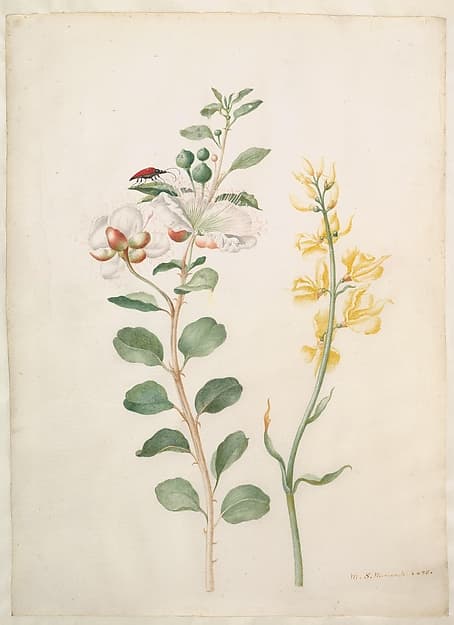
Works by Maria Sibylla Merian available in this edition of NEOARCA.
Profile notes