
24.05.1895–21.04.1984
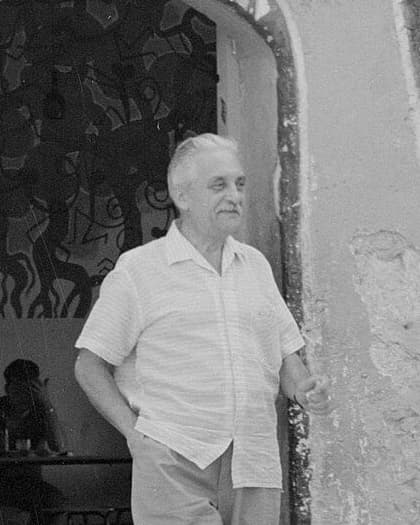
Marcel Janco
Marcel Janco (born Iancu) left Bucharest for Zürich at twenty, carved masks for the Cabaret Voltaire and took part in the birth of Dada. In Romania he edited the magazine Contimporanul and built some of the first modernist houses in the capital. After the pogrom of 1941 he moved to Palestine, and in 1953 he became one of the founders of the artists’ village of Ein Hod.
Biography
The first drawing Janco ever saw in print, in the magazine Flacăra in March 1912, showed the pianist Clara Haskil, a friend from his school days. He was sixteen, and that same year, with his schoolmates Tristan Tzara and Ion Vinea, he began producing the Symbolist magazine Simbolul. Tzara later recalled it with embarrassment; Janco regarded it to the end of his life as his first part in an artistic revolution.
He was born on 24 May 1895 in Bucharest, into a well-to-do Jewish family: his father was a textile merchant, his mother came from Moldavia. He was taught drawing by Iosif Iser. After Simbolul closed he worked as an illustrator for the daily Seara, read Verlaine and Apollinaire, and took an interest in Futurism.
At the start of the First World War Janco left for Zürich with his brothers. According to different accounts, this was a search for new opportunities or a quiet pacifist gesture. He enrolled in chemistry at the university, then at the Federal Institute of Technology, although he dreamed of painting. No money came from home, his paintings did not sell, and until October 1917 he and his brother earned their living in cabaret: Marcel played the accordion, sang chansons and performed Romanian folklore. There they got to know Hugo Ball and his circle. Janco helped decorate the Cabaret Voltaire and carved grotesque masks for performers on stilts; Ball singled them out for praise. He took part in the “simultaneous poems” with Richard Huelsenbeck and Tzara. His painting of the same name, “Cabaret Voltaire” (1916), is believed lost. By one account, it was Janco who told the story that Tzara alone invented the word “Dada”. He also designed productions of plays by Oskar Kokoschka and made the linocuts for Tzara’s “The First Heavenly Adventure of Mr. Antipyrine”.
He left Dada around 1919. He quarrelled with Tzara more and more often; in a late text Janco wrote of “two speeds” in Dada and of how “spiritual violence” had overshadowed the best Dadaists, above all Hans Arp. With Arp he joined Das Neue Leben, a group close to Constructivism. He did not manage to get his degree: he failed the final examination.
In December 1919 Janco went to France, to Béthune, where he married a Swiss woman, Lily Ackermann, and designed buildings for the reconstruction of war-damaged French Flanders. In the autumn of 1921 he returned to Romania.
With Vinea he founded the magazine Contimporanul in 1922, the longest-lived organ of the Romanian avant-garde. For it Janco made about sixty illustrations and forty articles on art and architecture, and organised the international exhibition of 1924, which included Constantin Brâncuși, Arp, Paul Klee and Kurt Schwitters. In 1925 he and Vinea were briefly detained by the police for publishing a photograph of Brâncuși’s “Princess X”. With his brother Jules he opened the Birou de Studii Moderne (Office of Modern Studies). The villa for Jean Fuchs on Negustori Street, built in 1927, is regarded as the first Constructivist building in Bucharest; the press compared it to a morgue and a crematorium. Until 1933, when he received his architect’s certification, his designs were officially registered under other names. By 1938 the brothers had designed about forty buildings, among them the large Bazaltin Company building on Jianu Square (1935). I would say that in these houses he applied most consistently what he had written about in the magazine: plain walls without decoration and shifted volumes.
In the 1930s a wave of antisemitism rose. The review Țara Noastră called Janco the “painter of the cylinder” and a cosmopolitan outsider. Later he said that never before had anyone in Romania asked him whether he was a Jew. In 1939 his friends and he himself came under racial restrictions, the estate of Jacquesmara was confiscated by the state, and he was then forbidden to publish. In January 1941 he witnessed the Bucharest pogrom and, in his words, became a “militant Jew” within a few days. The drawings he made on the subject later appeared in the album “Kav Haketz / On the Edge” (1981). With his family he left through the port of Constanța, reached Turkey on 4 February and arrived in Tel Aviv on 23 February.
There he worked as an architect for the city government, designed sets for the Cameri Theatre and influenced younger artists: Avigdor Stematsky, Yehezkel Streichman and Joseph Zaritsky. He received the Dizengoff Prize in 1945, 1946, 1950 and 1951. In 1952 he showed work in the first Israeli pavilion at the Venice Biennale. He belonged to the New Horizons group but left it in 1956: its commitment to pure abstraction and its rejection of narrative art were foreign to him. He taught at the Seminar HaKibbutzim college.
In May 1953 the government commissioned him to survey the mountainous region south of Mount Carmel for a national park. He found the deserted village of Ein Hod, whose inhabitants had largely been displaced in 1948, obtained a lease and, with fellow artists, turned it into an artists’ village. His role and the fate of the former residents have since been disputed; in 1960 Palestinians who returned tried to reclaim the land, and he had to organise a guard for the village until the police intervened. He called the project “the last act in the spirit of Dada”.
Janco received the Histadrut prize (1958) and the Israel Prize (1967). He died on 21 April 1984 in Ein Hod; the Janco-Dada Museum had opened in the village a year earlier.
Related context
Associations
Works connected through artistic movements, cultural context and period. Priced works available in this market appear first.








Profile notes
Profile and sources
Image
Artist image
Willem van de Poll; Wikimedia Commons; CC0.
