
28.07.1887–02.10.1968
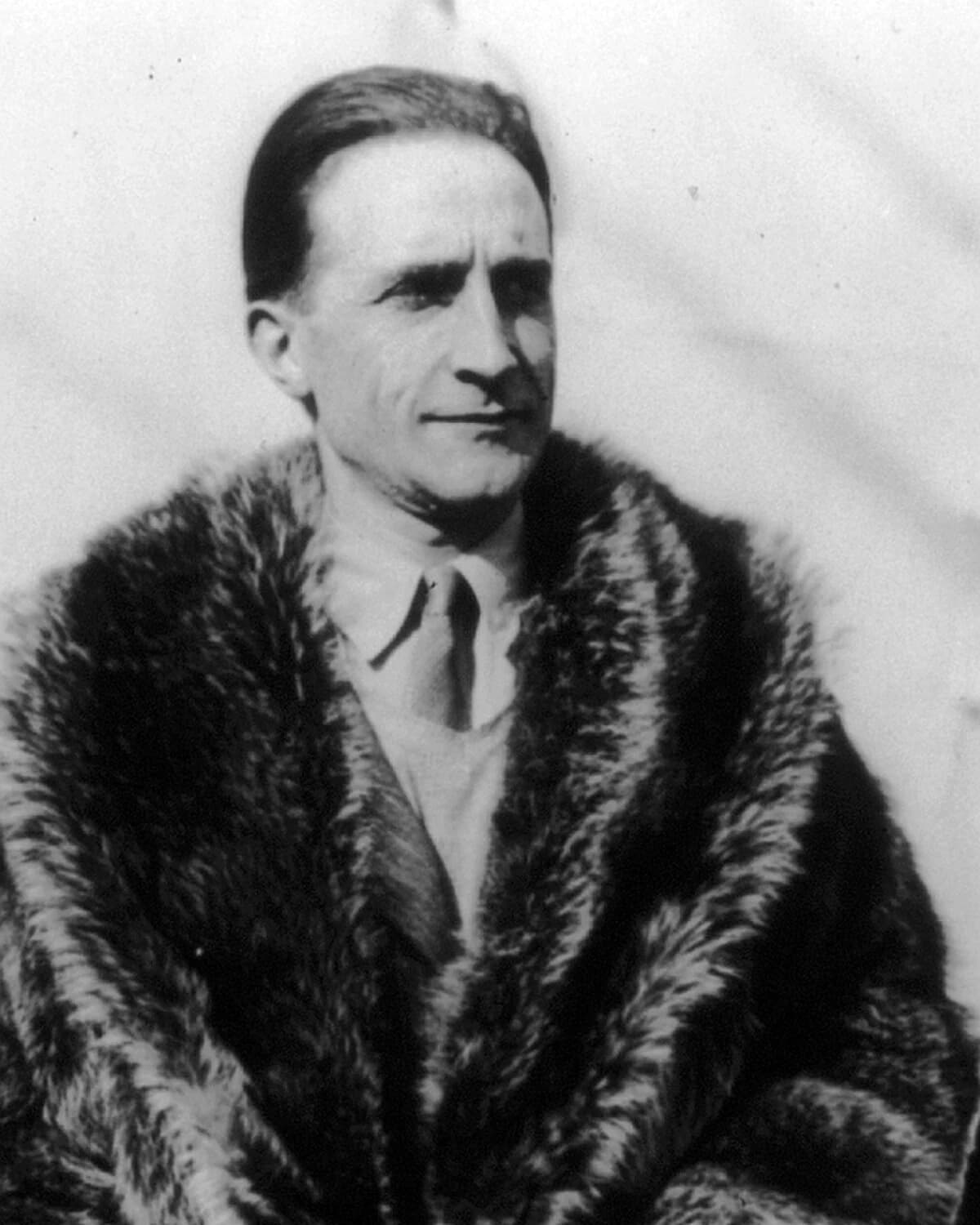
Marcel Duchamp
Marcel Duchamp (1887–1968) painted “Nude Descending a Staircase” in 1912 and then all but gave up painting: he signed ready-made objects such as a bottle rack or a urinal, spent eight years putting together “The Large Glass” and became a chess master. He lived in New York for the last twenty-odd years of his life and worked in secret for twenty years on the installation “Étant donnés”, which became known only after his death.
Biography
In 1969 the Philadelphia Museum of Art put on public view a wooden door with a peephole. Looking through it, the viewer sees a naked woman lying on her back with her face hidden; in her raised hand is a gas lamp, and behind her a landscape. The work is called “Étant donnés: 1. The Waterfall, 2. The Illuminating Gas”. Marcel Duchamp made it between 1946 and 1966 in his studio in Greenwich Village, and even his close friends were sure he had long since given up art for chess.
By the time it opened, he had been dead for several months.
Henri Robert Marcel Duchamp was born on 28 July 1887 in Blainville-Crevon, to Eugène and Lucie Duchamp. Of their seven children, four became artists: his elder brothers, the painter and printmaker Jacques Villon and the sculptor Raymond Duchamp-Villon, Marcel himself, and his younger sister Suzanne. Marcel went to the Lycée Pierre-Corneille in Rouen and in 1903 won a school drawing competition. In 1904 he settled in Montmartre and enrolled at the Académie Julian, but he liked billiards better than classes. During his military service in 1905 he worked for a printer in Rouen and learned typography, a craft that would serve him in later works. His first pictures, landscapes and portraits of his sister, look now to Cézanne, now to the Fauves. From 1908–1909 he exhibited at the Salon d’Automne and the Salon des Indépendants, and Apollinaire, who later became his friend, disparaged his “very ugly nudes”.
In 1912 Duchamp brought “Nude Descending a Staircase, No. 2” to the Salon des Indépendants: a figure broken into overlapping facets, like frames of film. Albert Gleizes asked him, through his brothers, to withdraw the picture or at least paint over the title, which was written on the canvas itself. Duchamp said nothing to his brothers, went to the exhibition and took the picture home in a taxi; after that, he recalled, groups no longer interested him. In 1913 the same “Nude” became the chief scandal of the Armory Show in New York, and all four of his paintings shown there were sold. Meanwhile he took a job at the Bibliothèque Sainte-Geneviève in Paris and read Poincaré, and in his studio he fixed a bicycle wheel upside down on a stool and spun it now and then, just to watch it, as one watches a fire in the hearth. For “3 Standard Stoppages” he three times dropped a metre-long thread from a height of one metre and fixed with varnish whatever curve it made.
In 1915 he left for New York and found that he was famous. The patrons Walter and Louise Arensberg let him a studio on condition that the rent would be paid with “The Large Glass”, that is, “The Bride Stripped Bare by Her Bachelors, Even”. The idea had come to him back in 1912, after a stage version of Raymond Roussel’s novel “Impressions of Africa”; the work went on from 1915 to 1923 on two panes of glass, with lead foil, fuse wire and dust, and it came with “The Green Box” of notes. In 1923 he declared the piece unfinished. After its first exhibition the glass came back in its crate with a large crack. Duchamp repaired it but left the smaller cracks as part of the work. It seems to me that this decision says more about his method than any manifesto.
He chose his ready-mades so that the object would attract him neither by beauty nor by ugliness. “Bottle Rack” (1914) is considered the first pure example; it was followed by a snow shovel, “In Advance of the Broken Arm” (1915). In 1917 a urinal signed “R. Mutt” and titled “Fountain” was submitted to the exhibition of the Society of Independent Artists, which had no jury, but the committee decided it was not art, and Duchamp resigned from the board. In 1919 he drew a moustache and goatee on a cheap reproduction of the “Mona Lisa” and inscribed it with the letters L.H.O.O.Q., which, read aloud in French, make an indecent pun. In 1921 Rrose Sélavy appeared, his female alter ego photographed by Man Ray; her name sounds like “Eros, c’est la vie”, and it is signed on the birdcage with marble cubes “Why Not Sneeze Rose Sélavy?” and on the film “Anémic Cinéma” (1926). With Man Ray and Katherine Dreier he founded the Société Anonyme in 1920, the first collection of modern art in the United States.
During nine months of 1918–1919 in Buenos Aires he did little but play chess. On returning to Paris in 1923 he was, in effect, no longer a practising artist. At the French Championship of 1925 Duchamp scored half the points and earned the title of master; in 1928–1933 he played for France at the Olympiads, won the correspondence championship of 1932–1933 and, together with Vitaly Halberstadt, published a treatise on a rare type of endgame. Chess, he said, has all the beauty of art and is far purer, because it cannot be sold.
He did not abandon art completely, all the same. He made the “Box in a Valise” (1935–1941), hung 1,200 coal sacks from the ceiling of the International Surrealist Exhibition in Paris in 1938, and wove a web of string through the rooms of the New York exhibition “First Papers of Surrealism” (1942). It was also he who suggested to Alexander Calder that his moving sculptures be called mobiles. From 1942 Duchamp lived in Greenwich Village, and in 1955 he became an American citizen. In the late 1950s he was rediscovered by Robert Rauschenberg and Jasper Johns; in 1963 Walter Hopps organised his first retrospective, in Pasadena. In 1968, at a concert called “Reunion”, he played chess with John Cage on a board fitted with photoelectric cells, and the moves were turned into music.
Duchamp died at his home in Neuilly-sur-Seine early in the morning of 2 October 1968, after dining with Man Ray and Robert Lebel. He was buried in the cemetery at Rouen. His gravestone reads: “Besides, it’s always the others who die.”
Related context
Associations
Works connected through artistic movements, cultural context and period. Priced works available in this market appear first.








Profile notes
Profile and sources
Image
Artist image
Unknown author Unknown author; Wikimedia Commons; Public domain.
