
24.06.1887–28.03.1985
Marc Chagall
Marc Chagall grew up in Jewish Vitebsk and spent seventy years painting it from memory: fiddlers, lovers above the rooftops, wooden houses. He studied under Pen, Roerich and Bakst, lived at La Ruche in Paris, and after the revolution opened an art school in Vitebsk. From 1923 he worked in France, lived through the war in New York, and in his later years painted the ceiling of the Opéra Garnier and made stained glass for cathedrals and for a synagogue in Jerusalem.
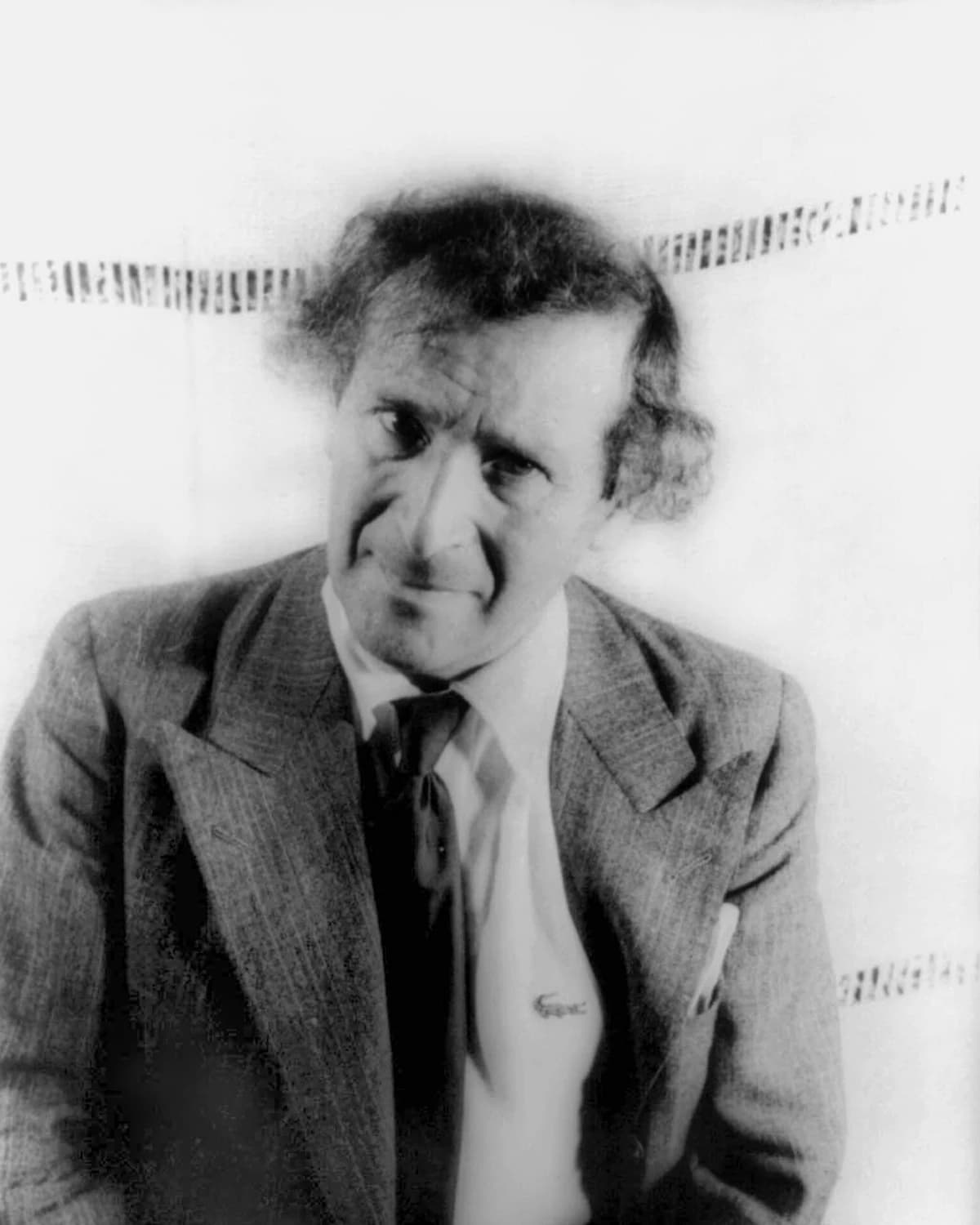
Biography
Only once in his life did his father give him money for his studies: twenty-seven roubles, which he threw under the table. The son, as he later told it in his book “My Life”, crawled about the floor picking them up, choking on tears and pride, and with that money left Vitebsk for St Petersburg to study painting.
He was born on 24 June (6 July) 1887. According to some sources he was born in the shtetl of Liozna near Vitebsk, where much of his childhood was spent with his maternal grandfather, but Chagall himself, both in his memoirs and in a handwritten note in the Tretyakov Gallery archive, named Peskovatiki, on the outskirts of Vitebsk. It is hard to check this now. His name was Movsha, his patronymic Khatskelevich; the name Marc appeared in Paris. His father worked as a clerk for a herring merchant. After a Jewish education at home and the municipal school, in 1906 he entered the drawing school of Yehuda Pen, who taught him free of charge.
In St Petersburg a Jew needed a residence permit, and at first Chagall lived on a temporary passport obtained through an acquaintance. For two seasons he studied at the Drawing School of the Society for the Encouragement of the Arts, which was run by Nicholas Roerich, and he was admitted straight into the third year. He then moved to Léon Bakst at Elizaveta Zvantseva's private school; Bakst, himself a Jew, was proof to him that an artist like himself could win recognition. In the autumn of 1909, in Vitebsk, his friend Thea Brachman introduced him to Bella Rosenfeld, who was studying at the Guerrier school in Moscow. To judge by “My Life”, everything was decided at first sight. He went on painting her large dark eyes for decades, and Bella can be recognised in almost every woman on his canvases.
In May 1911, with a stipend from M. M. Vinaver, Chagall left for Paris. He studied at the Académie de La Palette, where Cubism then reigned, and made friends with Blaise Cendrars, Guillaume Apollinaire, and Robert and Sonia Delaunay. In 1912 he settled at La Ruche and showed at the Salon d'Automne. He tried Cubism in earnest (“Self-Portrait with Seven Fingers”, “Adam and Eve”). And yet his main material remained Vitebsk: figures floating above the town, enormous fiddlers over toy houses. Almost all of it was painted in Paris, from memory, and Apollinaire found a word for such pictures: “supernatural”. I think this is the whole of Chagall: he almost always painted his town from far away. Many years later he was asked about the main events of his life, and he named two: “My meeting with Cendrars and the Russian Revolution.”
In 1914 Herwarth Walden showed some forty of his canvases and a hundred and fifty gouaches and drawings at the Der Sturm gallery in Berlin. From Berlin Chagall went on to Vitebsk, intending to marry and return to Paris with Bella within a few weeks.
Then the war began, and the border closed.
The wedding took place on 25 July 1915, and in 1916 their daughter Ida was born, later her father's biographer. From September 1915 Chagall served in Petrograd at the War-Industrial Committee. After the revolution he was appointed commissioner for the arts of Vitebsk Governorate, and on 28 January 1919 he opened an art school in the town, and then a museum. He invited El Lissitzky, Kazimir Malevich and his first teacher, Pen, to teach there. They could not get along: the Suprematists regarded his painting as bourgeois individualism, and in May 1920 Chagall left for Moscow.
On the recommendation of A. M. Efros he went to Alexei Granovsky's Jewish Chamber Theatre, painted its auditorium and foyer, and designed “An Evening of Sholem Aleichem”, the production with which the theatre opened in 1921. He taught drawing to homeless children at a colony in Malakhovka. The family was often hungry. While waiting for permission to leave the country, he wrote “My Life”.
In 1922 the family left via Kaunas for Berlin, and in the autumn of 1923, at the invitation of Ambroise Vollard, the Chagalls moved to Paris, where Vollard commissioned etchings from him for “Dead Souls”, La Fontaine's “Fables” and the Bible. For the sake of the Bible he travelled to Palestine in 1931. Of the 105 plates, 66 were ready by 1939; Tériade published the complete series in 1956. In 1937 Chagall became a French citizen, and in April 1941 the Vichy regime stripped him of that citizenship. At the request of the Museum of Modern Art in New York, his name was added to the lists of Varian Fry, who was getting people out of France. On 21 June 1941 his ship from Lisbon arrived in New York.
In America he designed Léonide Massine's ballet “Aleko”, to music by Tchaikovsky (premiered in Mexico City, 1942). On 2 September 1944 Bella died. For several months Chagall could not work; the first pictures after the break were “Wedding Candles” and “Around Her”. In 1947 he returned to France, and in 1952 he married Valentina Brodsky.
His late decades went into walls, windows and ceilings. From 1960 he made twelve stained-glass windows for the synagogue of the Hadassah Medical Center in Jerusalem, one window for each of the tribes of Israel, then tapestries and mosaics for the Knesset, and windows for the cathedrals of Reims and Metz. André Malraux commissioned the ceiling of the Opéra Garnier from him in 1963, and the commission provoked protests: some were annoyed that a national monument would be painted by a Jew from Russia, others that it would be painted by a modernist. The canvas, about 220 square metres, peopled with characters from operas and ballets from “Boris Godunov” to “The Firebird”, was unveiled on 23 September 1964. In 1966 his panels “The Sources of Music” and “The Triumph of Music” were hung at the Metropolitan Opera, and he himself moved to Saint-Paul-de-Vence.
In 1973 he came to Moscow and Leningrad, visited his exhibition at the Tretyakov Gallery and gave the gallery several works. He refused to go to Vitebsk, afraid the emotion would be too much for him.
On 28 March 1985 the weaver Yvette Cauquil-Prince sat with him until four in the afternoon choosing colours for the tapestry “Job”, commissioned by a rehabilitation institute in Chicago. That evening Chagall died. He is buried in the cemetery of Saint-Paul-de-Vence.
Related context
Associations
Works connected through artistic movements, cultural context and period. Priced works available in this market appear first.








Profile notes
Profile and sources
Image
Artist image
Carl Van Vechten; Wikimedia Commons; Public domain.
