
15.12.1944–present
Manuel Mendive
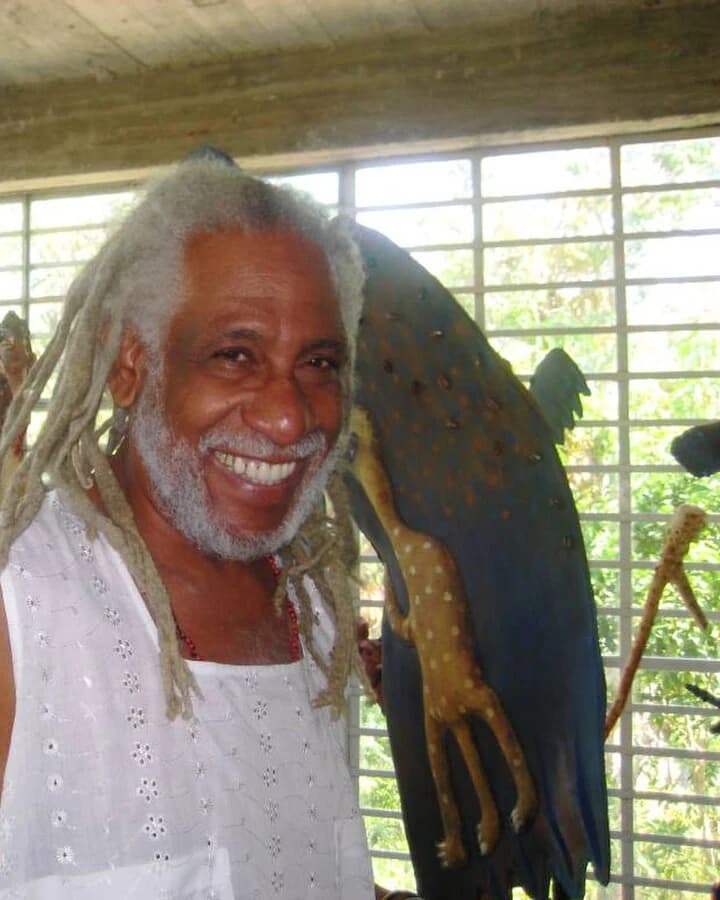
Manuel Mendive was born in Havana in 1944 into a family that practised Santería, and he has spent his career painting and carving the gods and spirits of the Yoruba. His first solo show was held in Havana in 1964. In the 1980s he spent a year travelling in West Africa, and in 1986 he staged the performance “La vida”, painting the bodies of dancers. His work is in museums in Cuba, Russia, Africa and Europe.
Biography
In 1986 Manuel Mendive brought dancers onto a stage with their faces and bodies covered by him in flowing lines that stood for spirits. The performance was called “La vida”. By then painting, drawing, wood carving and body painting had long been a single practice for him.
He was born in Havana on 15 December 1944. His family practised Santería, an Afro-Cuban religion rooted in the beliefs of the Yoruba of the West African coast. He is of mixed race and holds his roots dear. He was drawn to drawing from childhood, finished eight grades at an ordinary school, and in 1959 entered the San Alejandro Academy, where he studied painting and sculpture. Sculpture interested him more. The sources give different years for his graduation: 1956, 1962 and 1963. He also studied ethnology and folklore at the Cuban Academy of Sciences and art history at the Faculty of Arts and Letters of the University of Havana.
His first solo exhibition took place at the Centre of Art in Havana in 1964. In 1968, at the Salon de Mai in Paris, he received the Adam Montparnasse prize for the works he showed, and in the same year third prize at the National Salon of Plastic Arts in Havana.
The 1960s and 1970s are regarded as the time of his most significant works. He carved, burned and painted wood, depicting saints and Lukumi gods, and assembled pieces from whatever came to hand: twigs, feathers, human hair, sand, glass. Materials were scarce on the island, so this resourcefulness was partly out of necessity. The “Voodoo Altar” in the National Museum of Guanabacoa is made of just such materials. In 1967 he painted “Oya”, the goddess of storms, who is associated with the passage from life to death; in the late 1960s, his biographers say, he was especially preoccupied with death. Among the works of that time is also a portrait of Che Guevara from 1968. “Slave Ship” (Barco negrero, 1976), a painted wood carving, turns to the Middle Passage, colonialism and the history of the island; it is held in the National Museum of Fine Arts of Cuba.
The Cuban critic Gerardo Mosquera wrote that Mendive’s art does not serve ritual but carries a “living mythological thought” and uses Afro-Cuban imagery to speak about life today. To my mind, these words have exact confirmation: in his works the gods appear alongside concrete men and women of the present, not heroes of an ancient tale.
In 1982 Mendive travelled to West Africa for the first time and spent about a year there. After his return, images of nature became more noticeable in his work, as in the painting “Viento a Fete” (1984). In 1997 he painted “Olofi, the Spirits, Man and Nature”.
Honours followed one after another. In 1988 he received the Alejo Carpentier Medal from the Council of State of Cuba; in 1994 he was made a Chevalier of the Order of Arts and Letters of France and received the Félix Varela Order. In 2001 he was awarded Cuba’s National Prize for Plastic Arts, and in 2009 the UNESCO Five Continents Medal.
He has exhibited in Hungary, Poland, Angola, Russia and Congo. In February 1993 his work was shown at the “Ouidah ’92” festival in Benin, devoted to Vodun art and the African diaspora. In 2014 he exhibited at the N’Namdi Center for Contemporary Art in Detroit. Mendive’s works are held in museums in Cuba, Russia, Somalia, Benin, Congo, Norway, Denmark, Finland, Jamaica and the United States.
Profile notes
Profile and sources
Image
Artist image
Soydcuba; Wikimedia Commons; CC BY-SA 3.0.
