
03.06.1835–14.07.1903
Manuel Antonio Caro
Manuel Antonio Caro (1835–1903) was born in Ancud into a wealthy family and was the first Chilean to enter the École des Beaux-Arts in Paris. Back home, he opened a studio in Valparaíso and painted portraits, scenes of popular life and historical subjects. His best-known picture is “The Zamacueca” (1873), a scene of a folk dance.
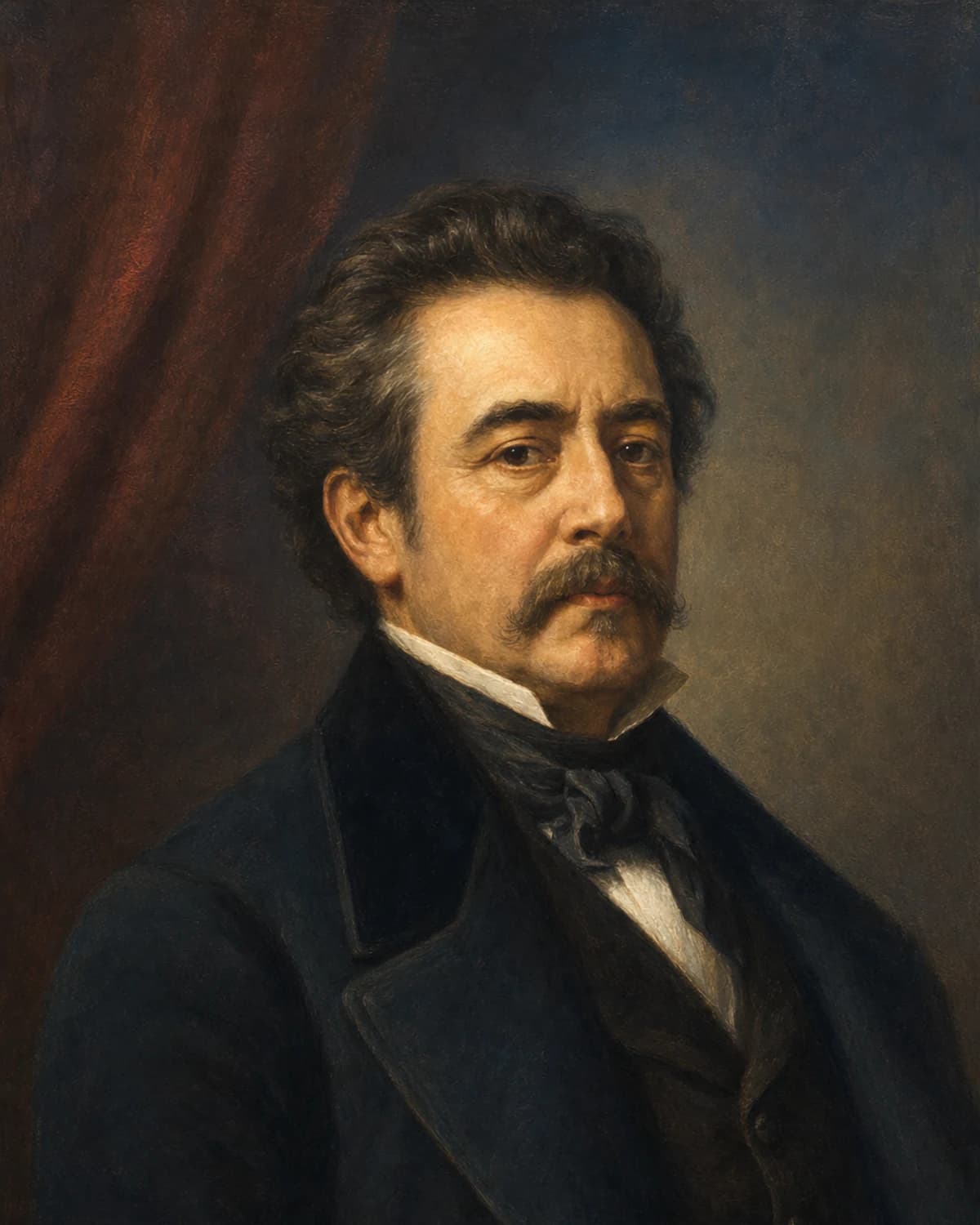
Biography
At first Caro meant to become a businessman. A long illness that kept him in bed changed that: it was then that he became interested in the visual arts.
He was born on 3 June 1835 in Ancud, into a well-off family. His parents were Victorino Caro y Cárcamo and Asunción de Olavarría y Sierpe. He studied at the Academy of Painting in Santiago and took lessons from its director, the Italian painter Alessandro Ciccarelli.
In 1859, at the age of twenty-three, he went to Paris; according to some accounts, his father pressed him to go. There Caro became friends with the French painter Paul Césaire Gariot, who worked in the Neoclassical style. Gariot trained him in portrait painting, and Caro helped him with the decoration of the Tuileries Palace. After that the sources diverge. By some accounts he stayed in Paris until 1865 and studied at the École des Beaux-Arts; by others he was admitted to the school only in 1865. In either case, he was the first Chilean at that institution. In 1866 Caro returned home and opened a studio in Valparaíso, on the square near the Iglesia de la Matriz.
He worked in an academic manner, not in the bolder styles then gaining a foothold in Europe. He painted portraits of members of nineteenth-century Chilean urban society, genre scenes of popular life, and historical and costumbrista subjects (figures in costume acting out an event). The Museo Histórico Nacional in Santiago holds his “Portrait of Juan Williams Rebolledo” and “The Abdication of O’Higgins” (both 1871). The National Museum of Fine Arts has the “Portrait of Ramón Ocampo” (1877), several other portraits and “Girl in a Blue Dress”.
His best-known work is “The Zamacueca” (1873), a colourful scene of a folk dance. Some confusion surrounds it: the catalogue of a 1942 exhibition in Toledo described the painting as destroyed in a fire. But Caro, it is claimed, painted two versions, and one of them is now in the collection of the Presidency of the Republic of Chile. It is also said that the picture went missing for a time under the Pinochet regime.
In 1872 he showed “La Chueca Chilena” and “El Velorio” in Santiago. At the Paris Salon of that year and at the Central Market Exhibition in Santiago he received several high honours, and at the 1875 International Exposition in Santiago he was awarded a grand medal.
On his return he had to withstand strong competition from other painters; his contemporaries are named as Pascual Ortega Portales, Antonio Smith, Nicolás Guzmán and Miguel Campos. This is thought to have affected the recognition of his work after his death.
Caro died in Valparaíso on 14 July 1903. Several of his works belong to British and German museums.
Related context
Associations
Works connected through artistic movements, cultural context and period. Priced works available in this market appear first.








Profile notes
Profile and sources
Image
Artist image
На основе открытого изображения: Hugo Zea from Bogota, Colombia; Wikimedia Commons; Public domain.
