
1600–1700
Manohar Das
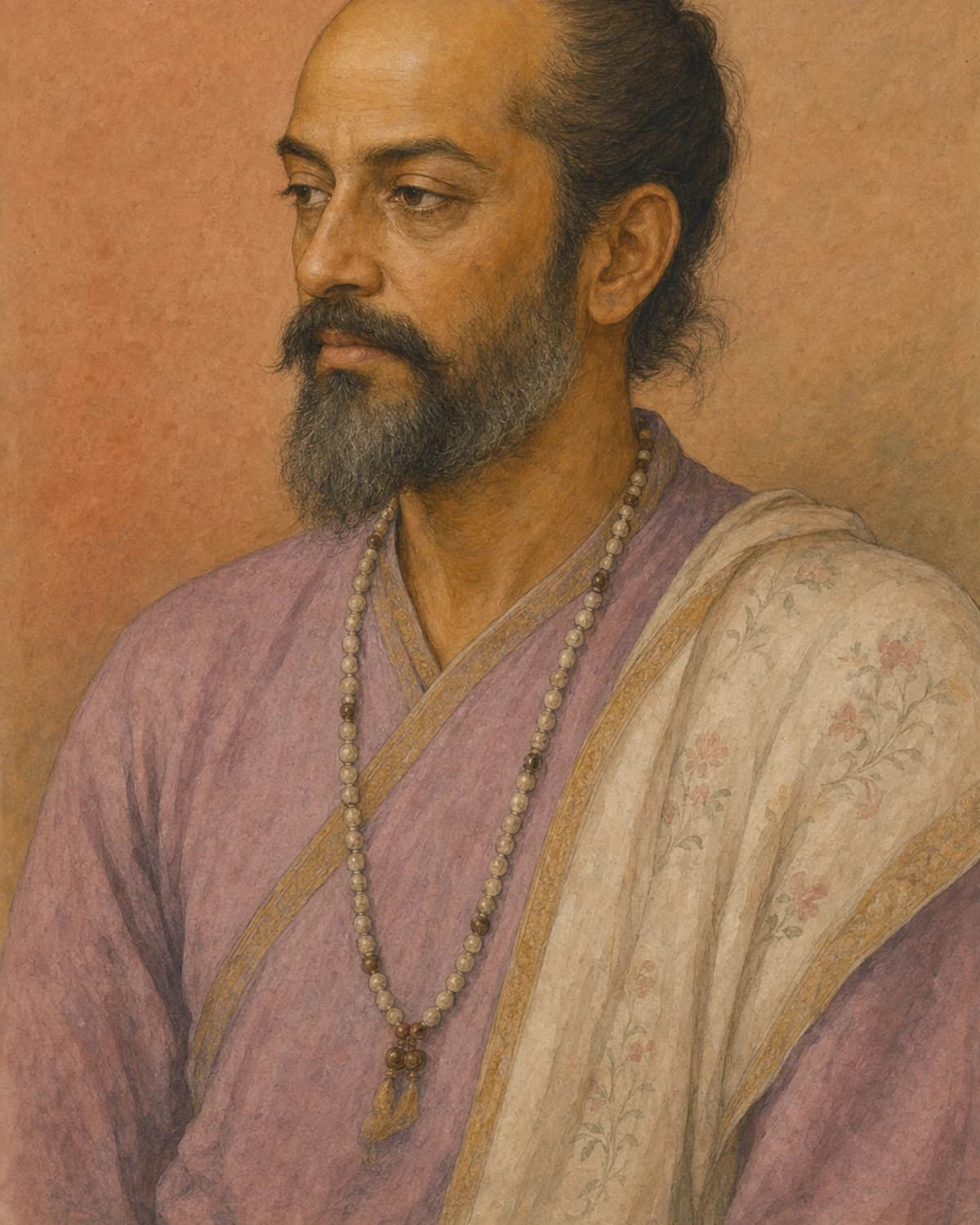
Manohar Das, son of the court master Basawan, grew up in the imperial workshop of the Mughal court and worked for three rulers: Akbar, Jahangir and, according to some accounts, Shah Jahan. He is known as a master of the miniature portrait and took part in illustrating manuscripts of the Akbarnama and the Jahangirnama. His works are in the British Museum and the Victoria and Albert Museum.
Biography
No one knows the exact dates of Manohar Das’s life. The familiar “1600–1700” found in reference works is clearly approximate: a hundred years of life for a painter whose work is documented from about 1582 to 1624 looks implausible. It is safer to speak of a period of activity than of years of birth and death.
He was born into a Hindu family of artists. His father, Basawan, was one of the leading painters at the court of the emperor Akbar, and the son grew up in an environment where the miniature was both a craft and a family business. He most likely received his first training from his father. His place of birth and the circumstances of his childhood are unknown; there are no documents. From 1582 Manohar worked in Akbar’s book workshop (the kitabkhana). He took part in illustrating the Akbarnama, the chronicle of the emperor’s reign, as well as manuscripts of the Razmnama and the Timurnama. This was an early stage: his name still stands beside those of older masters, and his work shows the influence of his father and of Abd al-Samad, the Persian artist who stood at the origins of the Mughal school. He received most of his commissions under Akbar’s son Jahangir. The emperor, attentive to portraiture and to accuracy of observation, drew the painter close to him: Manohar belonged to the ruler’s retinue and produced miniatures for the Jahangirnama, the emperor’s memoirs. His subjects were mostly connected with court life: portraits of the rulers themselves, their relatives and courtiers, and scenes at court. Modern scholars note in his portraits an accuracy in rendering the appearance and character of the sitter.
One of his finest works is considered to be the miniature “Prince Khurram Being Weighed Against Gold, Silver and Other Precious Goods”. Prince Khurram was the future Shah Jahan, and the weighing ceremony itself was part of court ritual. It seems to me that this page shows well what Manohar was doing: he recorded court ceremony with attention to faces, and to more than the splendour of the setting.
According to some accounts, his career continued under Shah Jahan, until the end of the 1620s; according to others, his period of activity ends in 1624. When and where he died is unknown.
Manohar Das’s works are today in the British Museum and the Victoria and Albert Museum in London. Material about him appears in the catalogue of the Metropolitan Museum of Art exhibition “The Emperors’ Album: Images of Mughal India”.
Related context
Associations
Works connected through artistic movements, cultural context and period. Priced works available in this market appear first.
Profile notes
Profile and sources
Image
Artist image
На основе открытого изображения: Manohar Das; Wikimedia Commons; CC0.
