
06.06.1936–05.01.2011
Malangatana Ngwenya
Malangatana Valente Ngwenya, a Mozambican painter and poet, signed his work simply “Malangatana”. As a youth he was a ball boy at a tennis club in Lourenço Marques; by the early 1960s he was exhibiting in Africa, Europe and Asia, painting bright pictures crowded with people and monsters, making murals, and for many years he worked in the cultural life of independent Mozambique.
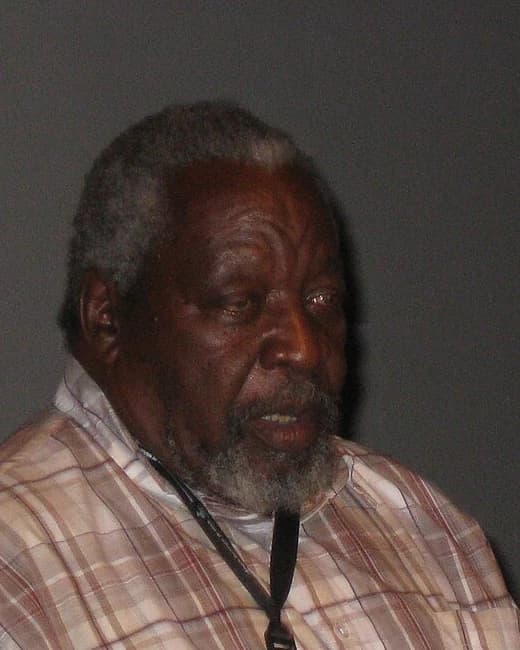
Biography
In the 1964 painting “Sending off to War”, a mother on the left nurses an infant, painted yellow and holding a yellow flower. On the right another mother holds the hand of her soldier son, and his rifle stands between them. Behind the soldier, open jaws hang in the air, like a crocodile’s. The picture was painted as FRELIMO was beginning its armed struggle for independence, and it is read as an open call to arms: the soldier leaves so that the child with the flower may grow up in a different country. The artist himself said that the birth of a new world in his country was difficult and bloody.
That same year, 1964, he was arrested.
Malangatana Valente Ngwenya was born on 6 June 1936 in the village of Matalana, in the south of what was then Portuguese Mozambique. He attended mission schools and helped his mother on the farm; his father worked in the mines of the Transvaal. At twelve he went to the capital, Lourenço Marques, now Maputo, to look for work, and in 1953 he became a ball boy at a tennis club. This allowed him to resume his education at evening classes, where he became interested in drawing. Two members of the club, Augusto Cabral and Pancho Guedes, supported him: Cabral gave him paints and helped him sell his work.
In 1958 he began to attend the local artists’ association, the Núcleo de Arte, where the painter Zé Júlio helped him. In 1959 his work appeared in a group exhibition for the first time, and in 1961, at twenty-five, he had his first solo show. That same year he exhibited with Guedes in Nigeria, and within three years his pictures had travelled to South Africa, Rhodesia, Angola, France, England, Pakistan and India. In 1963 the literary magazine “Black Orpheus” published his poems, and they were also included in the anthology “Modern Poetry from Africa”.
Having joined FRELIMO, he was detained in 1964 by the PIDE, the Portuguese secret police, and spent eighteen months in prison. In 1971 the Gulbenkian Foundation gave him a grant, and he studied engraving and ceramics in Portugal, and afterwards, right up to independence, he exhibited in Lourenço Marques and Lisbon. After the Carnation Revolution of 1974 and the proclamation of independence, he openly rejoined FRELIMO, now the ruling party, and took part in political campaigns and in the drive against illiteracy. In 1979 his work was shown in West Berlin in an exhibition of modern African art as part of the Horizonte festival.
From 1981 he devoted himself entirely to art. He painted in oils because they dry slowly: the paint runs slightly, the outlines of the figures blur, and this makes his scenes look even more surreal. The bright, contrasting colours and the people and monsters living side by side draw on African imagery that European Surrealists had appropriated before him, and he himself carried on a dialogue with those Surrealists. His attitude to Christianity was ambivalent: he saw it as a religion imposed by the colonisers, but knew that Protestant missionaries in Mozambique had often been allies of the liberation movement. In “Last Judgement”, people stand against a black background, some still human in appearance, others already changed into something unrecognisable, while dark demonic faces emerging from the darkness drink their blood. On the left stands a priest with blood running from his eyes. To my mind, his whole quarrel with his mission childhood is in that figure. Later he also worked in screen printing.
He made murals, among them for FRELIMO and UNESCO. A large mural decorated the stairwell of the Africa Centre in London, on King Street in Covent Garden; in June 2022 it was moved to the centre’s new building in Southwark. His work is in the National Museum of African Art in Washington. Ngwenya helped to set up cultural institutions in Mozambique and was among the founders of the Mozambican Peace Movement. He received the Nachingwea Medal for his contribution to Mozambican culture and the Portuguese Order of Prince Henry (with the rank of Grand Officer); in 1997 he became a UNESCO Artist for Peace and a laureate of the Prince Claus Award, and in 2010 the University of Évora gave him an honorary degree.
Malangatana died on 5 January 2011 in Matosinhos, in northern Portugal, at the age of 74.
Profile notes
Profile and sources
Image
Artist image
Bunks; Wikimedia Commons; CC BY-SA 3.0.
