
27.04.1930–26.03.2017
Mai Dantsig
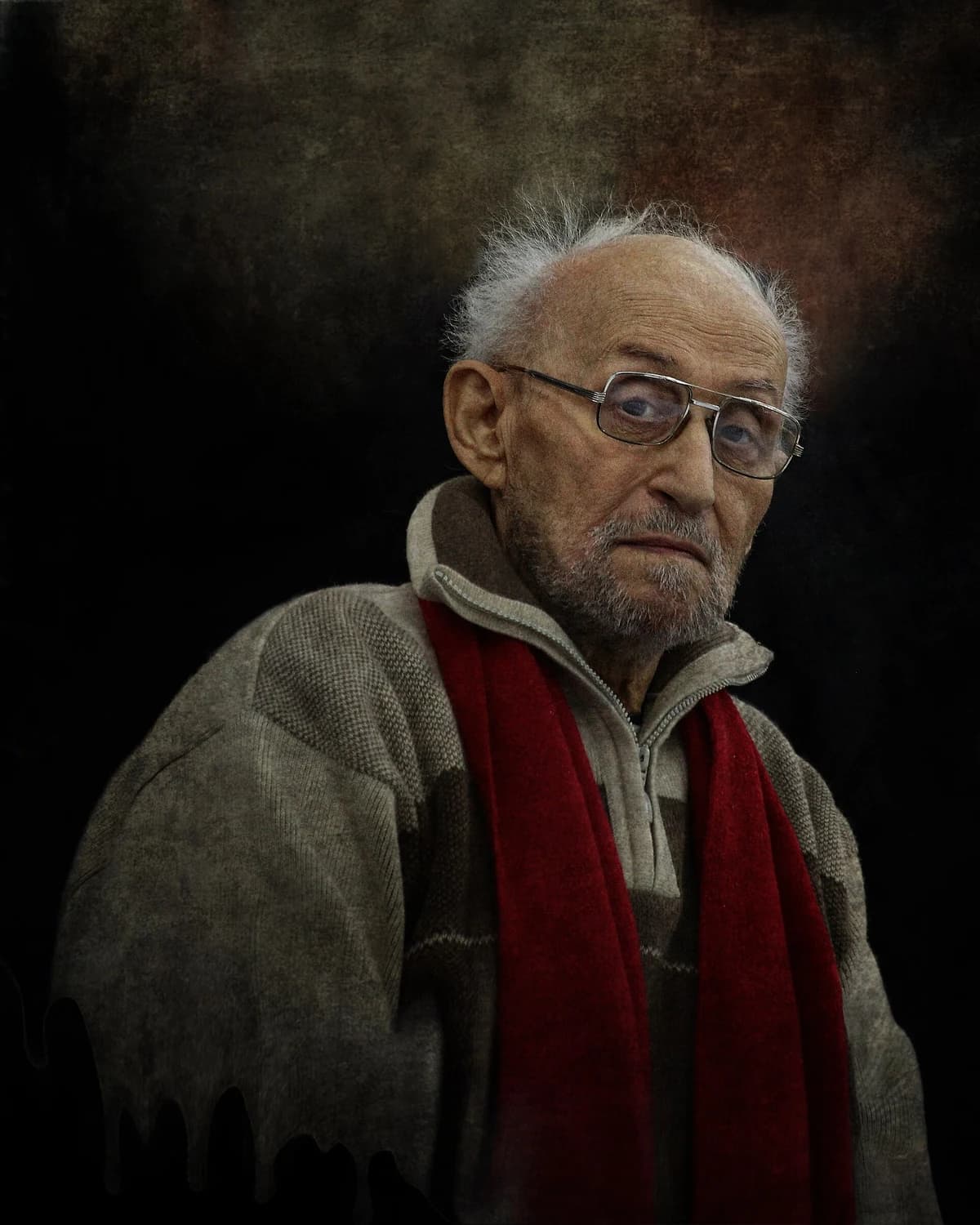
Mai Dantsig (1930–2017) grew up in Minsk, was evacuated to Ulyanovsk during the war, and after his studies in Moscow taught in Minsk for almost sixty years. He painted subject pictures about partisans and the war, lyrical views of the city and portraits of writers and film directors, and made mosaics for Minsk buildings. For many years he also headed the city’s Jewish cultural association.
Biography
Dantsig worked on the painting “And the Saved World Remembers…” from 1985 to 1995. Those are the dates on it, and they show how much space the memory of the war occupied in his life.
He was born on 27 April 1930 in Minsk, into a Jewish family, in the Nemiga district. His father taught physical education. Before the war Mai finished five grades of School No. 12 and three grades of music school. In 1941 he was evacuated with his parents and sister to Ulyanovsk, and the family returned to Minsk in 1944. He continued his schooling at School No. 42 and at the same time attended the children’s art studio of Sergei Katkov at the Palace of Pioneers and Schoolchildren. In 1952 Dantsig graduated from the Minsk Art College, and in 1958 from the Surikov Moscow State Academic Art Institute, where he studied under Mikhail Kurilko and Viktor Tsyplakov. His diploma work was the painting “Towards Life”. That same year he began teaching at the Belarusian State Theatre and Art Institute, now the Belarusian Academy of Arts, and stayed there for the rest of his life. He became a professor in 1980, and from 2001 to 2011 he headed the department of easel painting. From 1962 he sat on the board of the Artists’ Union of the Belarusian SSR, and he had been a member of the Artists’ Union of the USSR since 1960.
He worked in various genres of easel painting. Among the subject pictures I would name “Morning of the New Minsk” (1959), “The New Settlers” (1962), “Partisan Wedding” (1968), “Kupala’s Lines” (1972) and “Legend of Belarus” (1975). The city is the subject of the lyrical landscapes “Old and New Minsk” (1963), “My Minsk” (1967) and “My City, Ancient and Young” (1972), and later “My Lahoysk Region” (1985) and the series “Vitebsk, Chagall’s Homeland” (1994). There are still lifes: “Lilac” (1962), “The Fir Tree” (1971), “The Palette of New Buildings” (1979) and “About the Great Patriotic War…” (1968). He often painted on large canvases, and ordinary subjects gained from this a scale that is almost monumental; to my mind this can already be seen in “Partisan Wedding”.
There were also true monumental works, murals and mosaics for public buildings: the mosaic panel “Partisan March” in the Partizan cinema (1966) and a mosaic in the Yubileinaya hotel (1969), made together with Boris Nepomnyashchy, both in Minsk.
His portraits include a steelworker (1956), the film director Elem Klimov (1985), the writers Ales Adamovich and Vasil Bykau (both 1986), and Anatoly Anikeichik. He also painted Alexei Kosygin and Mikhail Suslov. Portraits of Bulat Okudzhava and Georgy Tovstonogov are also named, but I found little to confirm them, so I would for now leave them aside with caution.
From 1988 to 2001 Dantsig chaired the Minsk city association of Jewish culture named after Izi Kharik. With his participation the first Jewish Sunday school opened in Minsk in 1990. In the first half of the 1990s he chaired the public commission for creating the memorial complex “The Pit” and worked on commemorating the prisoners of the Minsk Ghetto. In 1995 he sat on the editorial board of the newspaper Aviv Khadash and was vice-president of the Union of Belarusian Jewish Public Associations and Communities. Honours came from the late 1960s: the Lenin Komsomol Prize of Belarus (1968), the title of Honoured Art Worker of the Belarusian SSR (1973), People’s Artist of Belarus (1995), the Order of Francysk Skaryna (2005) and the Order of Honour (2010).
Mai Dantsig died in Minsk on 26 March 2017 and is buried in the Eastern Cemetery.
Profile notes
Profile and sources
Image
Artist image
Eugeny Kolchev; Wikimedia Commons; CC BY-SA 4.0.
