
24.01.1930–09.08.2025
Mahmoud Farshchian
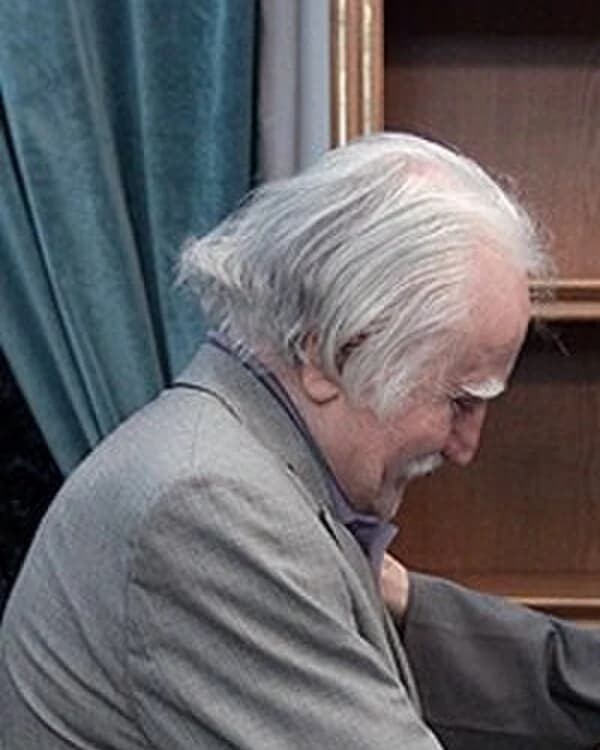
Mahmoud Farshchian (1930–2025), a master of Persian miniature painting from Isfahan, kept to the classical forms but developed painting as an independent art, not tied to a text. He taught in Tehran, took part in decorating the shrine of Imam Reza in Mashhad, illustrated the Shahnameh, Hafez and Khayyam, and from 1983 lived in the United States. A museum in Tehran is devoted to him.
Biography
The house where Mahmoud Farshchian grew up had a corner known as the Chicken House: there the boy played with sparrows, hens and roosters. Birds later appeared often in his pictures, and he himself linked them to his childhood memories.
His father, Gholamreza, dealt in Persian carpets.
Farshchian was born on 24 January 1930 in Isfahan. His mother, Zahra, often took the children to the shrine of Imamzadeh Ismail. He began drawing early and studied for several years under Haji Mirza-Agha Emami and Isa Bahadori. His first solo exhibition was held in 1948 at the Isfahan office of the Iranian-British Cultural Association, when he was eighteen. After graduating from Isfahan’s High School for the Fine Arts he went to Europe to study the Western masters, and the High Council of Culture and Art later awarded him its highest degree, equivalent to a doctorate, in Iranian painting and Islamic arts.
Back in Iran, he joined the National Institute of Fine Arts, which later became the Ministry of Culture and Art, in time became head of its Department of National Arts and a professor at the School of Fine Arts of the University of Tehran. In the 1950s he taught at the School of Decorative Arts for Boys in Tehran founded by Jalil Ziapour; one of his pupils was the painter Faramarz Pilaram. His first exhibition abroad was held in Istanbul in 1960, his first American ones in 1972 and 1973. In all he had 57 solo and 86 group exhibitions in Iran, Europe, America and Asia and more than ten awards, among them a gold medal at an international art festival in Belgium (1958) and the first prize of the Iranian Ministry of Culture and Art (1973).
Farshchian is called the founder of his own school of Iranian painting. He kept the classical forms of the miniature but introduced new techniques, and he led painting away from its centuries-old dependence on poetry and literature, making it an independent art. He himself said that his manner was built on a combination of the traditional and the contemporary. His sheets show fantastic scenes in bright colours, birds, flowers, people; the subjects are more often than not love scenes, rather daring for the Islamic world. One of his well-known works is “The Evening of Ashura”. At the same time, his illustrations to Ferdowsi’s Shahnameh (1991), to the poems of Hafez (2002) and to the rubaiyat of Omar Khayyam (2004) came out as separate books, so I would not overstate the break with literature. UNESCO selected two volumes of his work for publication (1991 and 2004). His paintings were in the collections of Emperor Akihito of Japan, Queen Elizabeth II and Prince Philip, and Queen Juliana of the Netherlands. In 2007 the British-Omani designer Amr Ali based his collection for London Fashion Week on his painting “The Fifth Day of Creation”.
He also worked as a designer: the zarih (the latticed enclosure over the tomb), the roof and the door in the shrine of Imam Reza in Mashhad were made to his designs, and he sat on the committee that supervised the construction. In 2001 the Cultural Heritage Foundation opened the Museum of Master Mahmoud Farshchian in the Sa’dabad Complex in Tehran.
From 1983 Farshchian and his family lived in Englewood Cliffs, New Jersey. He often spoke and exhibited at universities and art institutes, and six books have been published about him.
Mahmoud Farshchian died on 9 August 2025 in the United States, at the age of 95. On 18 August he was buried in Isfahan, in the Saeb Mausoleum.
Profile notes
Profile and sources
Image
Artist image
Mohammad Kazempour; Wikimedia Commons; CC BY 4.0.
