
17.09.1915–09.06.2011
M. F. Husain
Maqbool Fida Husain (1915–2011) started out painting film posters and billboards in Bombay, in 1947 became one of the founders of the Bombay Progressive Artists’ Group and grew into one of the leading Indian modernists. He painted in a manner derived from Cubism, in series on Gandhi, the Ramayana, the Mahabharata and Indian life, made films, and spent his last years outside India, in Doha and London.
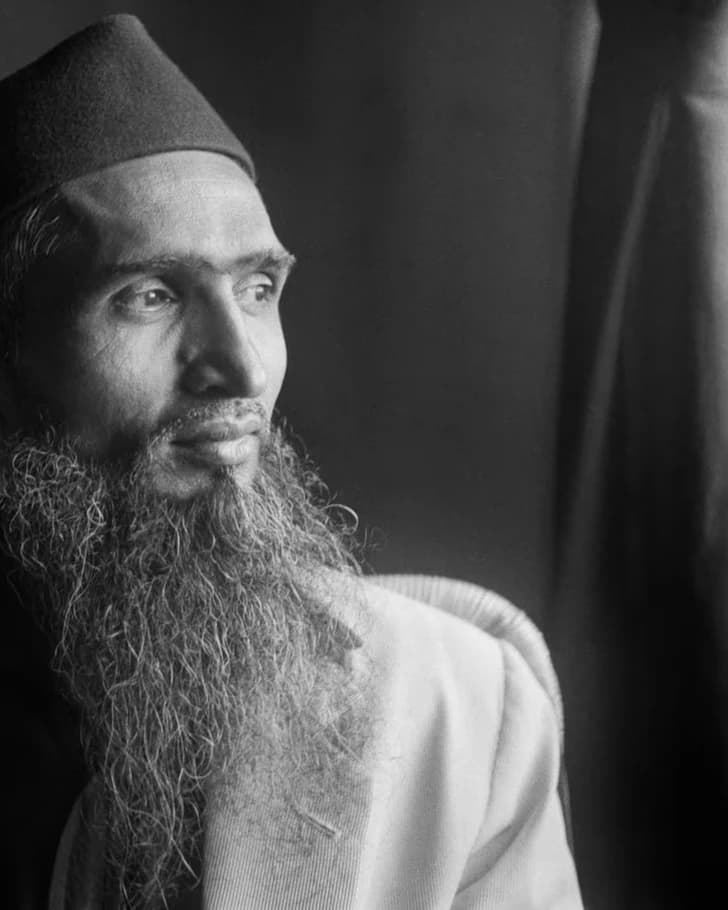
Biography
In the 1930s the young Husain earned his living in Bombay painting billboards and posters for the cinemas of the fast-growing film industry. Money was short, and he also worked for a toy company, designing and building toys. Whenever he could save enough for the fare, he went off to Gujarat to paint landscapes.
Cinema would come back into his life later, from the other side of the camera.
Maqbool Fida Husain was born on 17 September 1915 in Pandharpur, in the Bombay Province (now the state of Maharashtra), into a family of the Sulaymani Bohra community. He lost his mother at the age of a year and a half and later himself linked that loss with the recurring image of Mother India in his work. His taste for art came through calligraphy, which he studied while living at a madrasa in Baroda. Then came the Sir Jamsetjee Jeejebhoy School of Art in Bombay, which he did not finish. His father, an accountant, wanted to see him in business.
In December 1947, a few months after the Partition of British India and the religious violence that followed it, the Progressive Artists’ Group was formed in Bombay, and Husain was among its founders. Its members wanted to break with the nationalist tradition of the Bengal school and create an Indian avant-garde able to speak an international language. They regarded the Partition as a turning point both for the country and for their art. Husain’s manner is usually described as a modified Cubism: bold, brightly coloured narrative paintings, sometimes caustic and funny, sometimes serious and sombre. He often worked in series: Gandhi and Mother Teresa, the Ramayana and the Mahabharata, the British Raj, scenes of urban and village life.
His first solo exhibition was held in 1952 in Zurich, his first in America in 1964 at India House in New York. In between came the first prize at the National Exhibition of the Lalit Kala Akademi (1955) and an award at the Tokyo Biennale (1959). His film “Through the Eyes of a Painter”, made for the state documentary studio, was shown in Berlin in 1967, where it won the Golden Bear for short films; it also received India’s National Film Award, and the Museum of Modern Art in New York bought a copy. In 1971 he was a special invitee, together with Picasso, at the São Paulo Biennial. The state honoured him with the Padma Shri (1966), the Padma Bhushan (1973) and the Padma Vibhushan (1991), and in 1986 he was nominated to the upper house of parliament.
His later films grew out of his painting. He signed a series of paintings devoted to the actress Madhuri Dixit with the name Fida, and in 2000 he made the film “Gaja Gamini” with her, in which she plays various incarnations of womanhood, from Kalidasa’s muse to the Mona Lisa. He made “Meenaxi: A Tale of Three Cities” together with his son, the artist Owais Husain; in 2004 it was screened at the film market of the Cannes Festival. After several Muslim organisations objected to one of its songs, Husain withdrew the film from cinemas himself, although critics had received it well.
Most of the controversy surrounded his images of Hindu goddesses. Paintings from 1970 became the target of protests only in 1996, when a Hindi monthly reprinted them under a hostile headline; eight criminal complaints were filed against the artist. In 1998 his house was attacked and works were damaged; the police detained twenty-six people. Protests also led to the closure of an exhibition of his in England. In 2004 the Delhi High Court dismissed the complaints, but in 2006 new charges followed, concerning nude images of gods and a painting in which Mother India appears as a nude woman across a map of the country. Husain apologised and promised to withdraw that painting from auction. By 2007 hundreds of lawsuits had piled up against him, and after he failed to appear in court a warrant was issued for his arrest, later suspended. He himself said that leading Hindu religious figures had not spoken out against his paintings, and that the dispute was being fanned by people with political aims.
From 2006 Husain lived outside India, mostly in Doha, spending summers in London, and said he would like to return. In 2010 he took Qatari citizenship and surrendered his Indian passport, while keeping his status as an Overseas Citizen of India. In Qatar he worked on two large cycles, on the history of Arab and of Indian civilisation; the first was commissioned by Sheikha Moza bint Nasser. Of thirty-two large paintings on the history of India commissioned in 2008, he finished eight. The Raja Ravi Varma Award, given to him in 2007 by the government of Kerala, was challenged in court, and its presentation was stayed. It seems to me that his last years cannot be described without this duality: recognition and bans went hand in hand to the very end.
Husain died on 9 June 2011 in London, at the age of ninety-five, and was buried the next day at Brookwood Cemetery. In nearly eight decades of work he painted, by some counts, about forty thousand pictures.
In 2025 a museum devoted to him, Lawh Wa Qalam, opened in Doha’s Education City, its building based on his own sketches.
Profile notes
Profile and sources
Image
Artist image
Habib Rahman; Wikimedia Commons; Public domain.
