
24.04.1889–25.05.1924
Lyubov Popova
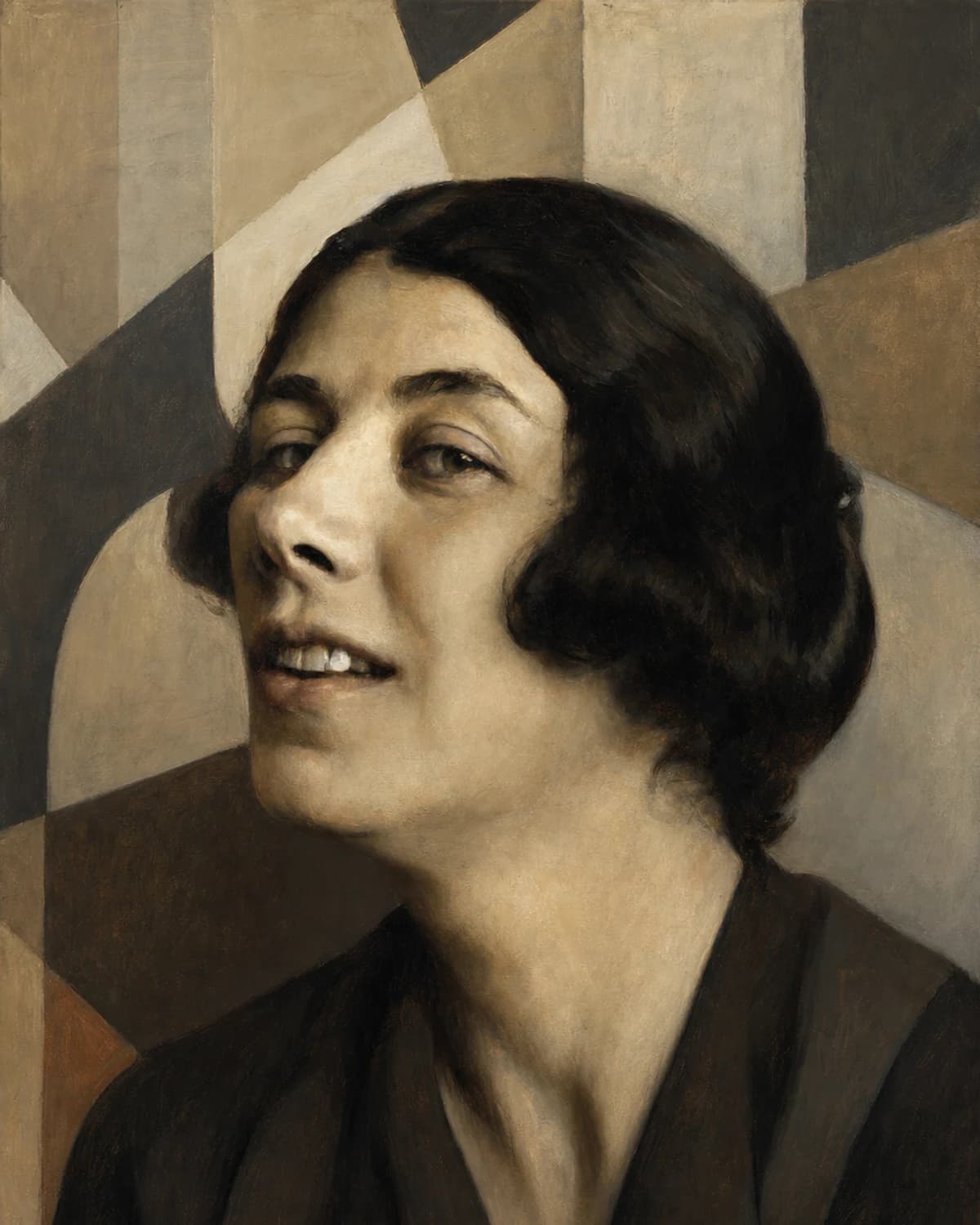
In ten years Lyubov Popova (1889–1924) went from Cubo-Futurism through Suprematism to Constructivism. Her “Painterly Architectonics” of 1916–1918 are built from coloured planes laid one over another. After the “5×5=25” exhibition (1921) she gave up easel painting for the theatre, books, posters and textile designs; for Meyerhold she designed “The Magnanimous Cuckold” (1922).
Biography
In September 1921 an exhibition with an arithmetical title, “5×5=25”, opened in Moscow: five artists, each with five abstract works. Besides Popova, the participants were Rodchenko, Varvara Stepanova, Alexander Vesnin and Exter. They declared that the easel picture was finished and that all of an artist’s work must now serve the new society. For Popova this was a line after which she hardly painted pictures at all.
Meyerhold saw the exhibition and invited her to work in the theatre.
She was born on 24 April (6 May) 1889 on the Krasnovidovo estate in Zvenigorod district (according to other sources, in Ivanovskoe near Moscow). Her father, the manufacturer Sergei Maximovich Popov, traded in textiles and was a patron of the arts; her mother, Lyubov Vasilievna, came from the Zubov family; her grandfather was a merchant of the first guild. Her first drawing lessons were given by a friend of the family, the artist Konstantin Orlov. In 1906 the family moved to Moscow, where Popova finished Arsenyeva’s gymnasium. Then came lessons with Stanislav Zhukovsky and, in 1908, the private studios of Konstantin Yuon and Ivan Dudin. Her brother Pavel became a philosopher and after her death looked after her legacy.
What interested her most were Old Russian icons, Giotto and the Italians of the fifteenth and sixteenth centuries. She travelled to Kiev (1909), to Italy, Pskov and Novgorod (1910), and the following year to other old Russian towns to look at icons. In 1912 she worked in the Moscow studio known as “The Tower” with Ivan Aksyonov and Vladimir Tatlin, and looked at the French painters in Sergei Shchukin’s collection. In 1912–1913 she studied in Paris with the Cubists Henri Le Fauconnier and Jean Metzinger, together with Nadezhda Udaltsova, and met Archipenko and Zadkine. Back in Russia in 1913, she worked with Tatlin, Udaltsova and the Vesnin brothers. In 1914 she went to France and Italy again.
By 1913, in “Composition with Figures”, she was already working in Cubo-Futurism, the Russian fusion of French Cubism and Italian Futurism. In 1914–1915 her Moscow home became a place where artists and writers gathered. With Exter, Udaltsova and Olga Rozanova she exhibited in 1914–1916 at the Knave of Diamonds, at “Tramway V” and “0.10” in Petrograd, and at “The Store” in Moscow. At “0.10” she showed painted cardboard reliefs, still figurative. “The Violin” of 1914 stands halfway between Cubism and what she would call architectonics.
In 1916 Popova joined Malevich’s Supremus group and, with other Suprematists, worked at Verbovka, a village centre of folk art, and at Skoptsy. From that year her canvases became entirely non-objective. She called the series of 1916–1918 “Painterly Architectonics”: sharp-angled planes overlap and intersect, while a strong pure colour at the centre pulls the composition together. For Malevich, Suprematism was a spiritual quest. To my mind, the very title of the series shows that Popova was more concerned with the material properties of painting: her planes have density and weight, like real materials.
In 1918 she married the art historian Boris von Eding, author of the book “Rostov the Great, Uglich”, and gave birth to a son. A year later von Eding died; Popova too was seriously ill at the time, but recovered.
As early as 1917, alongside her Suprematist work, she was designing textiles and agitational books and posters. She showed the architectonics at the Tenth State Exhibition, “Non-Objective Creativity and Suprematism”, and went on painting abstract pictures until 1921. At the end of that year she joined the Working Group of Constructivists. She based her teaching at Vkhutemas on her “spatial force constructions”. For the Meyerhold Theatre she designed two productions in the spirit of stage Constructivism: Crommelynck’s “The Magnanimous Cuckold” (1922) and “The Earth in Turmoil” (1923), Sergei Tretyakov’s version of Marcel Martinet’s play “Night”. From 1923 she made designs for the First State Textile Printing Factory in Moscow, worked there briefly alongside Stepanova, designed books and proposed dress designs for the magazine LEF.
Lyubov Popova died in Moscow on 25 May 1924, two days after the death of her son, and was buried in the Vagankovo Cemetery. In December of that year a posthumous exhibition of her work opened in Moscow: seventy-seven paintings, books, posters, textile designs. In the catalogue her contemporaries called her an “artist-constructor”. In 2012 a crater on Mercury was named after her.
Related context
Associations
Works connected through artistic movements, cultural context and period. Priced works available in this market appear first.








Profile notes
Profile and sources
Image
Artist image
На основе открытого изображения: Unknown author Unknown author; Wikimedia Commons; Public domain.
