
07.04.1927–03.05.2004
Lygia Pape
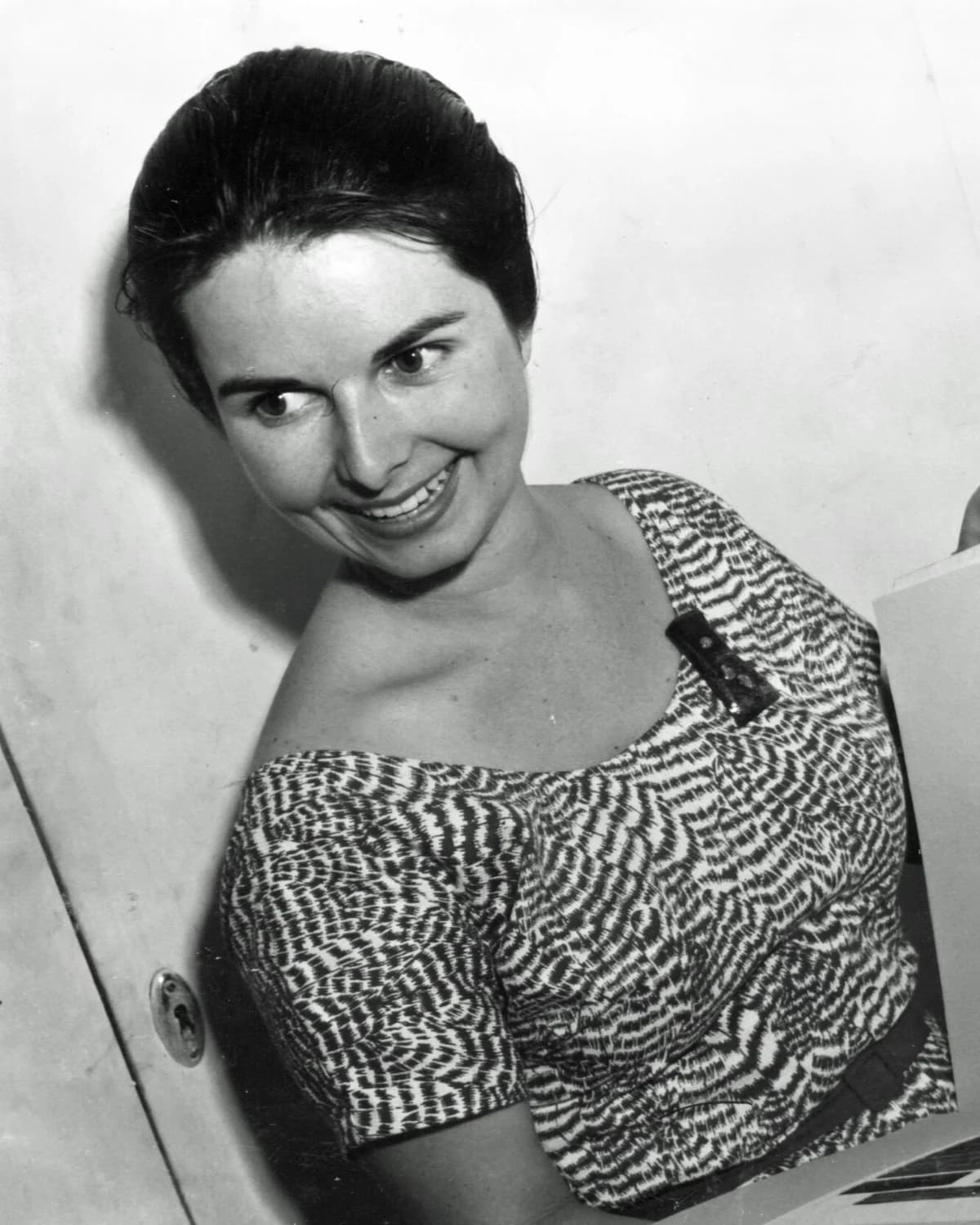
Lygia Pape (1927–2004) began in Rio de Janeiro with geometric woodcuts, signed the Neo-Concrete Manifesto in 1959 and went on to make more and more works that the viewer enters with the body: from the “Book of Creation” to the cube-shaped “O Ovo” (The Egg) and the gold threads of the “Ttéias”. From 1972 she taught at universities in Rio de Janeiro.
Biography
In 1967 Lygia Pape invited viewers to climb inside a cube of wooden boards covered in plastic film, and then to push through the film and come out, as if being born again. The work was called “O Ovo” (The Egg).
Pape was forty, and for almost twenty of those years she had been working in geometric abstraction.
She was born on 7 April 1927 in Nova Friburgo, in the state of Rio de Janeiro. She studied philosophy at the Federal University of Rio de Janeiro and received her art training without a formal course, studying with Fayga Ostrower at the Museum of Modern Art. At about twenty she came to Concrete art, the term the Dutchman Theo van Doesburg had coined in 1930. In Brazil the movement made itself felt after the São Paulo Biennial of 1951, and soon two groups formed: Grupo Ruptura in São Paulo and Grupo Frente in Rio de Janeiro, led by Ivan Serpa. Pape joined the latter, along with Hélio Oiticica and Aluísio Carvão. What held the Frente artists together was less a set of shared devices than a rejection of figuration and of the national Brazilian painting of earlier years. The group exhibited in 1954 at the Ibeu gallery and in 1955 at the Museum of Modern Art in Rio.
Her woodcuts of the 1950s, the series “Tecelares” (Weavings), look at first sight like model Concrete works. Pape incised the whole surface of the block with thin parallel lines and added a few oblique ones, so that the flat sheet broke into separate planes and gained movement and depth; the black ink lay on thin rice paper, and the white showed through in the cuts. She drew the lines with a ruler and compass, yet their width wavers slightly, the paper absorbs the ink unevenly, and between the cuts the grain of the wooden block shows. The word “weaving” pointed to handwork and to Brazil’s traditional culture: Pape spoke of how indigenous peoples had expressed the most fundamental concepts through geometry, such as collective identity. For her, geometry had nothing to do with the machine and industry. The 1959 sheet from this series is now regarded as transitional between Concrete and Neo-Concrete art, and the 1960 sheet is more organic still. Both are in the Museum of Modern Art in New York.
The transition came in 1959. A dispute between Waldemar Cordeiro of Ruptura and Ferreira Gullar of Frente over each other’s excessive rigour pushed former members of Frente towards Neo-Concretism, and Pape, together with Lygia Clark and Oiticica, signed the manifesto. She was preoccupied with the idea of “living the body”: the body as the mediator of every sensory experience. “My concern is always invention,” she said; art was for her a way of getting to know the world. The same year saw the “Book of Creation”, sixteen unbound cardboard pages roughly 30 by 30 centimetres each. The abstract forms on them stand for moments in the creation of the world: the receding of the waters, the discovery of fire and of agriculture, hunting, navigation. The book is meant to be picked up and leafed through, and each person, as the artist put it, will read it in their own way.
To my mind, “O Ovo”, eight years later, grew straight out of this book: the viewer’s participation simply became physical.
In the 1960s and 1970s Pape made films and installations with caustic, critical metaphors aimed at the military dictatorship; from the 1980s these metaphors became subtler. In the film “Eat Me” (1975) a woman’s mouth and a man’s mouth move in slow motion, and she herself insisted that the film should not be read as a thesis. From 1972 to 1985 she taught semiotics at the School of Architecture of Santa Úrsula University in Rio de Janeiro; in 1980 she received a master’s degree in philosophy, and in 1983 she became a professor at the School of Fine Arts of the Federal University. She took her students, mostly from well-off families, to study the informal architecture of the favelas, above all Maré. In 1981 she was awarded a Guggenheim Fellowship.
In 1978, with her students in the Parque Lage, she began laying out and rearranging metal threads. From these experiments came, in 1979, the idea of the “Ttéias”; she made up the word from the Portuguese for “web” and for “a thing of grace”. The series was built at full scale only in the 1990s: semi-transparent prisms of stretched gold thread through which the viewer walks. One of these works, “Ttéia 1, C”, is dated 2003. Her first retrospective, built around her prints, took place in 2000, and in 2003 she took part in the Venice Biennale.
Lygia Pape died in Rio de Janeiro on 3 May 2004, at the age of seventy-seven. Her works are in the Museum of Modern Art in New York, the Museo Reina Sofía in Madrid and the Tate. Posthumous exhibitions were held at the Serpentine Gallery in London (2011) and the Metropolitan Museum of Art (2017), and in 2025–2026 the Bourse de Commerce in Paris gave her her first solo exhibition in France.
Profile notes
Profile and sources
Image
Artist image
Unknown Unknown; Wikimedia Commons; Public domain.