
23.10.1920–25.04.1988
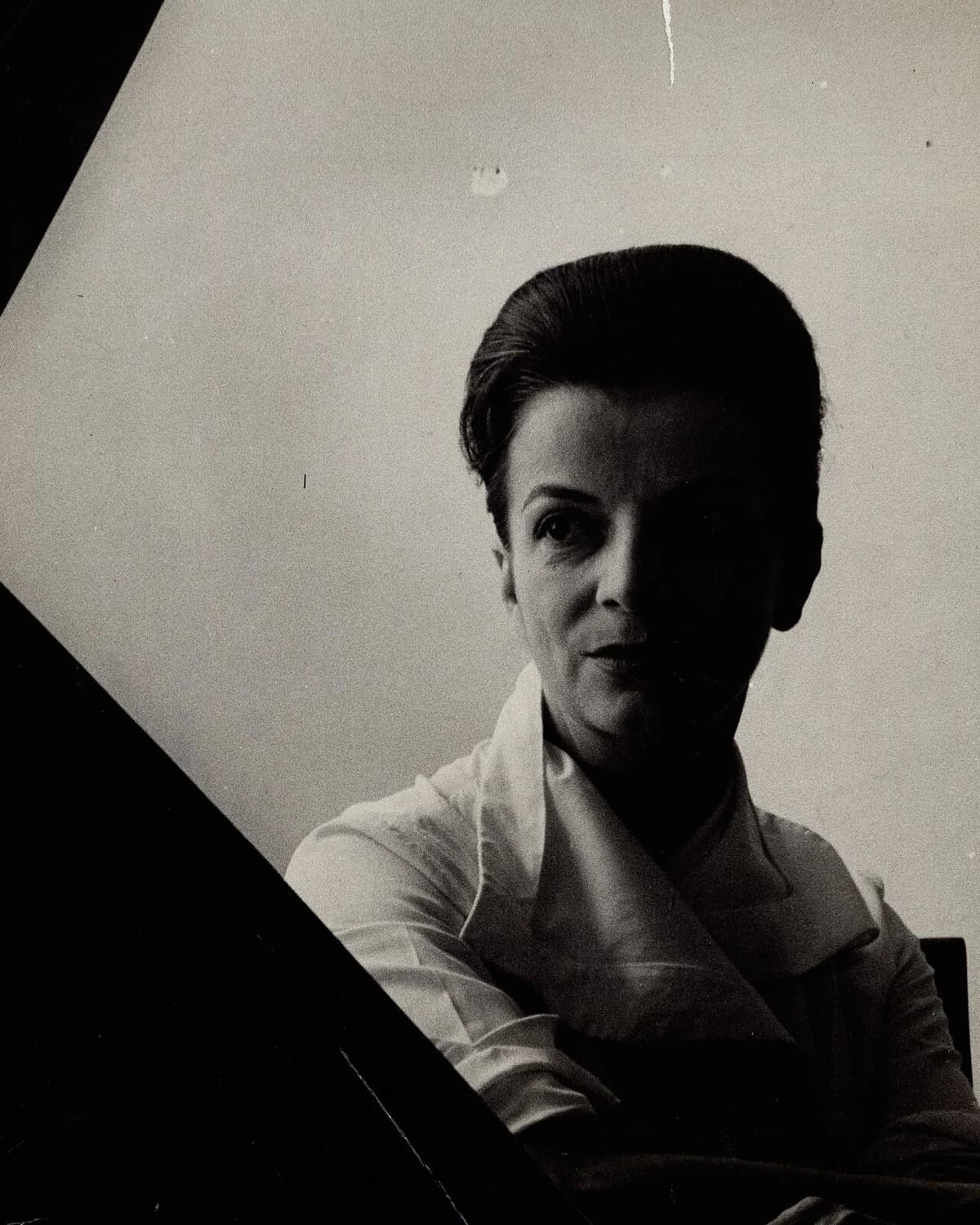
Lygia Clark
Lygia Clark began with black, grey and white geometric painting, and in 1960 she invented the “Bichos”, hinged metal “critters” that viewers fold into shape themselves. She was one of the founders of Brazilian Neo-Concretism and taught at the Sorbonne in the 1970s. In her last decade she worked with her “relational objects” as a tool of art therapy.
Biography
A pebble sits on a small plastic bag blown up with air and is held in place by a rubber band. Squeeze the bag between your palms and the pebble starts to jump. This is “Stone and Air” (1966), and the piece has a medical origin. That year Lygia Clark was in a car accident and injured her arm; she was told to fasten the bag to the broken arm. She added the pebble and the rubber band and arrived at an exercise that repeats the natural rhythms of the body and the beating of the heart. It is the first of her “sensorial objects”, and to my mind all of Clark’s later work is already there: the thing means nothing until someone takes it in their hands.
She was born on 23 October 1920 in Belo Horizonte. Her real name was Lygia Pimentel Lins. It was a family of lawyers: her father, Jair Pereira Lins, was an attorney and the son of a Supreme Court justice; her mother, Ruth Mendes Pimentel, was a lawyer’s daughter. At eighteen, in 1938, Lygia married the civil engineer Aluízio Clark Ribeiro and took his surname. Between 1941 and 1945 they had three children.
She decided to become an artist only in 1947, when she began studying in Rio de Janeiro with the landscape architect Roberto Burle Marx and the sculptor Zélia Salgado. In 1950–1952 she studied in Paris with Árpád Szenes, Isaac Dobrinsky and Fernand Léger. Her first solo exhibition was put on in 1952 by the Institut Endoplastique in Paris, after which she returned to Rio and exhibited at the Ministry of Education and Culture.
Her early works are small and almost monochrome: black, grey, white. This is geometric abstraction of the European kind, with Constructivism and Max Bill behind it. Clark was among the founders of the Grupo Frente, together with Ivan Serpa, Hélio Oiticica, Décio Vieira, Abraham Palatnik and others; she took part in the 1954 Venice Biennale and, in 1957, in the first National Exhibition of Concrete Art in Rio. Among her works of those years are the series “Modulated Surfaces” (1952–1957) and “Planes in Modulated Surface” (1956–1958). Cold rationalism, however, soon began to weigh on her. In the late 1950s she and like-minded artists broke away from the Concretists, and in 1959, together with Amílcar de Castro, Ferreira Gullar, Franz Weissmann, Lygia Pape, Reynaldo Jardim and Theon Spanudis, she signed the “Neo-Concrete Manifesto”. The manifesto demanded subjectivity from abstraction and the living experience of the viewer. Oiticica joined the group a year later. A work, Clark wrote, is neither a machine nor an object; it is an “almost-body” that becomes whole only when the viewer takes part.
She carried this idea through to the end in the “Bichos” (“Critters”, 1960–1963). These are metal plates joined by hinges: they can be folded flat, opened out into a volume, turned into dozens of positions. On a museum stand such a thing loses its meaning; it has to be touched. Clark described the exchange between a person and a “Bicho” as a dialogue between two living organisms. In 1961 she won the prize for best sculptor at the São Paulo Biennial.
From 1964 came the “propositions” that anyone can carry out with paper, plastic bags and rubber bands, and the series “Nostalgia of the Body”. In “Dialogue of Hands” (1966), made together with Oiticica, the hands of two participants are bound by an elastic Möbius strip. In “Breathe with Me” (also 1966) a rubber tube coiled into a ring is held to the ear, and you listen to the air moving through it.
After 1966 Clark declared that she had given up art.
She spent the years of the military dictatorship in voluntary exile in Paris, and in the 1970s she taught at the Sorbonne, in the new faculty of plastic arts of the University of Paris. “I and You” (1967) consists of two industrial rubber suits joined by a kind of umbilical cord: the participants are connected but cannot see each other. In “Anthropophagic Drool” (Baba Antropofágica) participants wet threads with saliva and lay them on the body of one of the group; the idea grew out of an unpleasant dream she had. In “Elastic Net” (1974) participants and Clark together wove a huge net, then threw it over themselves and, stretching their arms upward, changed its shape. Clark called her actions of that period “ritual without myth”. One of her phrases sounds like a programme: “Alone, we do not exist.”
She returned to Rio de Janeiro in 1976 or 1977 (the dates differ). From 1979 Clark devoted herself more and more to therapy, using “relational objects” in sessions with people suffering from psychoses. She wanted to know why certain objects awaken a vivid memory in a patient; the sessions ran sometimes as a short course, sometimes as a long one. In 1983 her “Book-Work” came out in a small edition, tracing her path from her first works to the Neo-Concrete period. Her only major retrospective in her lifetime was a special section at the 9th Salon of Plastic Arts in the Paço Imperial in Rio in 1986, where she was shown together with Oiticica.
Lygia Clark died in Rio de Janeiro on 25 April 1988. In 2014 the Museum of Modern Art in New York opened her first large American retrospective, “The Abandonment of Art”; in 2025 a retrospective was shown at the Neue Nationalgalerie in Berlin and the Kunsthaus Zürich. Her works are in the Museum of Modern Art in New York, Tate Modern in London, the Centre Pompidou, the Museo Reina Sofía in Madrid, the Museum of Modern Art of Rio de Janeiro and the Walker Art Center in Minneapolis.
Profile notes
Profile and sources
Image
Artist image
Unknown Unknown; Wikimedia Commons; Public domain.