
26.05.1933–09.04.2025
Luis Felipe Noé
In 1961 Luis Felipe Noé (1933–2025), together with Ernesto Deira, Rómulo Macció and Jorge de la Vega, showed an exhibition called “Otra Figuración” in Buenos Aires. His paintings of the 1960s are built from crowds, placards and a broken, “divided canvas”. His book “Antiestética” appeared in 1965, and ten years later he returned to painting after a long break.
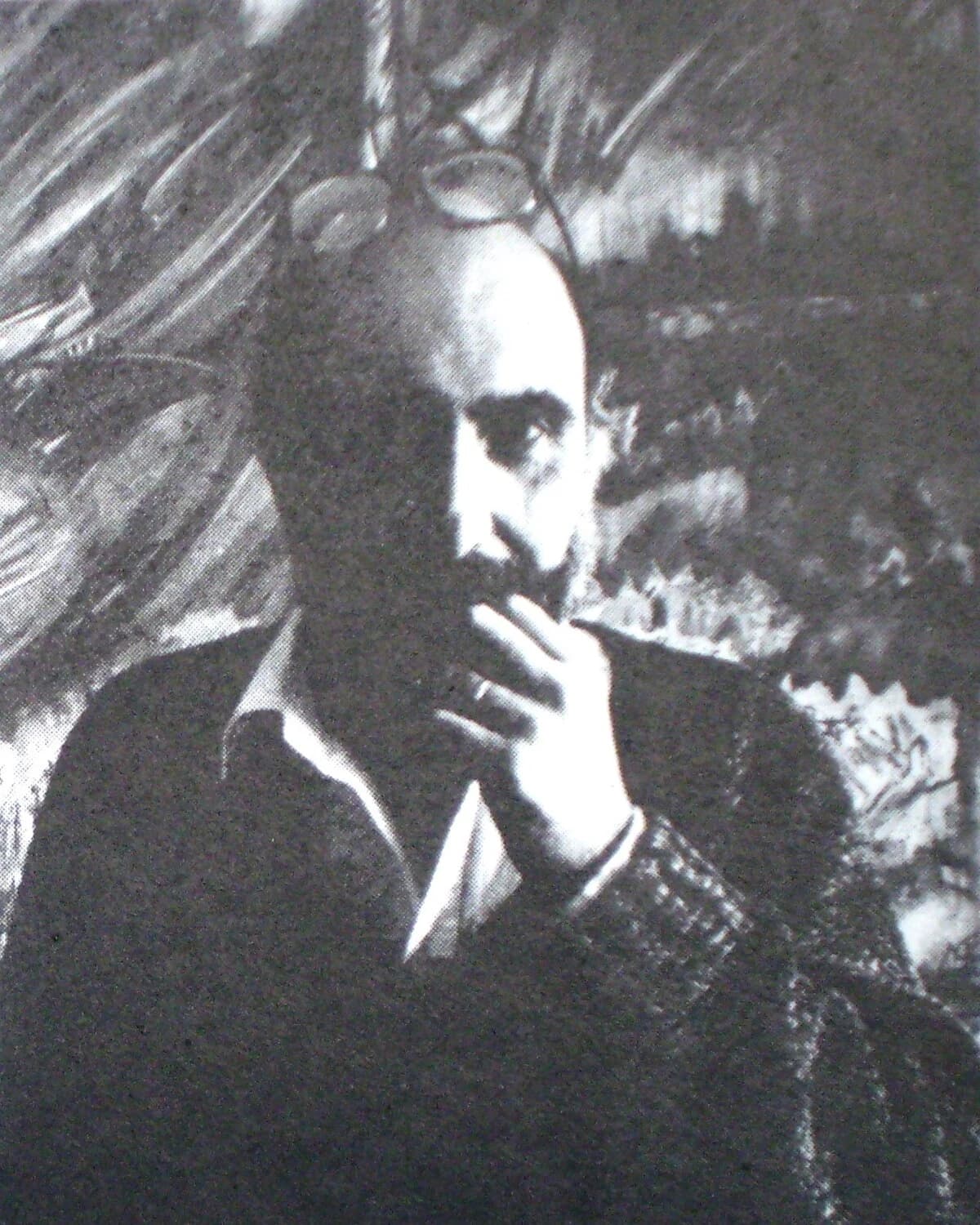
Biography
In 1966, at the Bonino Gallery in New York, Noé showed the installation “Balance”: large canvases lay on the floor and leaned against one another and against the walls, while parts of the image had been popped out and stood up like paper dolls on a stand. After this exhibition he gave up painting for several years.
The story that he threw his huge works into the Hudson is usually repeated as fact. To my mind it is more likely a legend: he later admitted himself that the installations were hard to transport and to sell, and that he got rid of them when he was preparing to go home.
Noé was born on 26 May 1933 in Buenos Aires and was known from childhood as Yuyo. His father, Julio Noé, was a well-known man of letters and the editor of the magazine “Nosotros”. Luis Felipe studied painting with Horacio Butler (according to some sources from 1950 to 1952, according to others for about a year and a half) and then worked on his own. At the same time he studied law at the University of Buenos Aires, and from the mid-1950s he wrote about exhibitions for the newspaper “El Mundo” and other publications. His first solo exhibition took place in 1959 at the Galería Witcomb. In 1961 at the Galería Bonino he showed the “Serie Federal”, on the political history of nineteenth-century Argentina: thirteen canvases in which he argued with traditional history painting. The writer Manuel Mujica Láinez remarked in his review that, amid the general fascination with matter, these works were unexpectedly Argentine. In the same year he took part, with Deira, Macció and De la Vega, in the exhibition “Otra Figuración” at the Galería Peuser. They were looking for a way out of the quarrel between figuration and abstraction, although Informalism prevailed in Argentina at the time. Among those they looked to, the names given are Antonio Berni, Francis Bacon, Willem de Kooning, Jean Dubuffet and the Cobra group. Antonio Seguí exhibited alongside them, but is not usually counted as a member of the group.
Then came a trip to Europe on a scholarship from the French government, during which the group finally took shape. In 1962 they showed drawings at the Galería Lirolay in the exhibition “Esto” (“This”), a response to the political crisis that followed the overthrow of President Arturo Frondizi. The exhibition influenced experimental drawing in Latin America; the Brazilian critic Frederico Morais wrote of the impression that their show in Rio made on the younger generation. In 1963 Noé won the national prize of the Instituto Torcuato Di Tella for “Introduction to Hope”: nine canvases, a crowd with open mouths, placards such as “Champion, do not leave us”, and plywood signs with portraits of candidates. In the same year he painted “Closed for Sorcery”, in which people sit in the cages of a grid, while the figure of a sorcerer and a crucifix loom above them. The group continued to show together until 1965, with its last exhibition at the Galería Bonino.
In 1965 “Antiestética” appeared, almost a manifesto: in it he set out the idea of embracing chaos and of the “splitting of unity”. At the end of the year Noé left for New York on a Guggenheim fellowship. Returning to Buenos Aires in 1968, he opened a bar, Bárbaro, with friends; the name was suggested by De la Vega, and the bar became a meeting place for people in the arts. He taught drawing and painting, made installations with concave mirrors (shown in Caracas in 1968), and in 1974 published the experimental novel “Recontrapoder”. He returned to painting in 1975 with an exhibition at the Galería Carmen Waugh.
In May 1976, after the military coup, Noé left for Paris and lived there until 1987. He crumpled and gathered the canvas before painting on it, made series of drawings and photocopies, and after three weeks in the Amazon began to paint landscapes. In 1987 he returned to Buenos Aires. The 1995 retrospective at the Museo Nacional de Bellas Artes then travelled to Mexico City. In 2002 the Konex Foundation awarded him the Diamond Konex Award, and in 2009 he represented Argentina at the 53rd Venice Biennale.
Luis Felipe Noé died on 9 April 2025 in Buenos Aires. His last book, “Asumir el caos” (“To Embrace Chaos”), appeared the same year.
Profile notes
Profile and sources
Image
Artist image
Andreé Girard; Wikimedia Commons; Public domain.
