
19.02.1899–07.09.1968
Lucio Fontana
Lucio Fontana (1899–1968) was born in Argentina, studied and worked in Milan, and in 1949 showed a darkened room at the Galleria del Naviglio with a glowing form hanging in it, and began puncturing canvases. For these works he chose the general title “Spatial Concept” and used it for almost all his later paintings. In 1966 he won the Grand Prize for Painting at the Venice Biennale.
Biography
In 1949, at the Galleria del Naviglio in Milan, visitors walked into a darkened room. In the emptiness hung an enormous amoeba-like form, lit by neon. Lucio Fontana called it a “spatial environment in black light”. It was a temporary installation, and it has since come to be regarded as one of the first works of its kind.
That same year he began making holes in canvas.
Fontana was born on 19 February 1899 in Rosario, in the province of Santa Fe, to Italian immigrant parents. His father, Luigi Fontana, was a sculptor. In 1905 the boy was sent to Italy, and until 1922 he lived there, working with his father and then on his own. From 1922 he lived in Argentina again, in his father’s studio, briefly employed as an engineer and for longer as a sculptor. In 1926 he took part in the first exhibition of Nexus, a group of young Argentine artists from Rosario. In 1927 he returned to Italy and from 1928 to 1930 studied at the Brera Academy in Milan under the sculptor Adolfo Wildt, alongside Fausto Melotti. His first exhibition took place in 1930 at the Galleria del Milione; in Italy, so it is written, it was the first exhibition of non-figurative sculpture. His first solo show, at the same gallery, is dated 1931.
The biography of these years also includes less comfortable pages. Fontana joined the Fascist movement early, and he is documented as a member of the Fasci di Combattimento (the early Fascist combat squads) as far back as 1920. He took part in the 17th Venice Biennale with a sculpture called “Fascist Victory”, made a bust of Benito Mussolini in 1930, and in 1933 the bust “Expectation” and the statue “Victorious Woman” for the Air Force, which declined to buy it in 1934. In 1936 his “Victory Group” was shown at the Milan Triennale, in a hall renamed the “Hall of Triumph” on the occasion of the invasion of Ethiopia. A bust for Addis Ababa, commissioned by the Ministry of Propaganda, was never realized. For the newly built headquarters of the Milan Fascists he made, in 1936, the largest bas-relief in Italy, with five armed winged Victories; after the war the building became a Carabinieri station.
In parallel, in 1934, he joined the Paris group Abstraction-Création. From 1936 to 1949 he made expressionist sculptures in ceramic and bronze, and in 1939 he joined Corrente, a Milan group of expressionist artists. In 1940 he returned to Argentina. In 1946 in Buenos Aires, together with his students, he founded the private school Altamira and made public the White Manifesto: it names “matter, colour and sound in motion” as the phenomena whose development together makes up the new art. Fontana did not sign the text but contributed to it. Five manifestos of Spatialism (1947–1952) grew out of these ideas. His Milan studio and the works in it were destroyed in the Allied bombing; he soon took up ceramics again in Albisola. He worked with architects on buildings being reconstructed in Milan.
He began the series of Spatial Concepts in 1949. At first these were the Buchi, holes in a monochrome canvas, and from the mid-1950s the Tagli, slashes. He sometimes lined the back with black gauze so that darkness would shimmer behind the cut. In 1951 he made a neon ceiling, “Spatial Light”, for the Triennale, and in 1952 he began the Pietre (stones) series: canvases with thick paint and coloured glass. From 1958 the surfaces became matte and single-coloured; in 1959 came sets of several parts, the quanta, and the sculptures called Nature: a terracotta sphere with a gash, later cast in bronze. With the architect Luciano Baldessari he worked on the ceiling of the cinema in the Sidercomit Pavilion at the 1953 Milan Fair.
Around 1960 he reworked the cuts once more: he covered the canvas with thick oil paint and cut it with a scalpel or a utility knife. After an invitation to the exhibition “Art and Contemplation” at Palazzo Grassi (1961), he made twenty-two works on Venice, drawing furrows in the paint with his fingers and setting in fragments of Murano glass. Michel Tapié showed them at the Martha Jackson Gallery in New York. The trip to New York produced the metal works of 1961–1965: sheets of shiny, scratched copper, pierced and gouged with vertical gestures. Among the late works are the Teatrini (“little theatres”) and “Trinità” (1966): three white canvases with rows of holes against a backdrop of ultramarine plastic sheets.
In 1966 he designed his own space at the Venice Biennale and won the Grand Prize for Painting. In 1968 at documenta in Kassel he placed an enormous plaster slash at the centre of a completely white labyrinth, with white ceiling and floor. Shortly before his death he attended the “Destruction Art” event at the Finch College Museum in New York. Then he left Milan for Comabbio, his family’s hometown, and died there on 7 September 1968. To my mind, his works on paper, with abstract motifs and figures, which he made alongside the slashed canvases, are still noticeably less well known than the paintings.
Related context
Associations
Works connected through artistic movements, cultural context and period. Priced works available in this market appear first.








Profile notes
Profile and sources
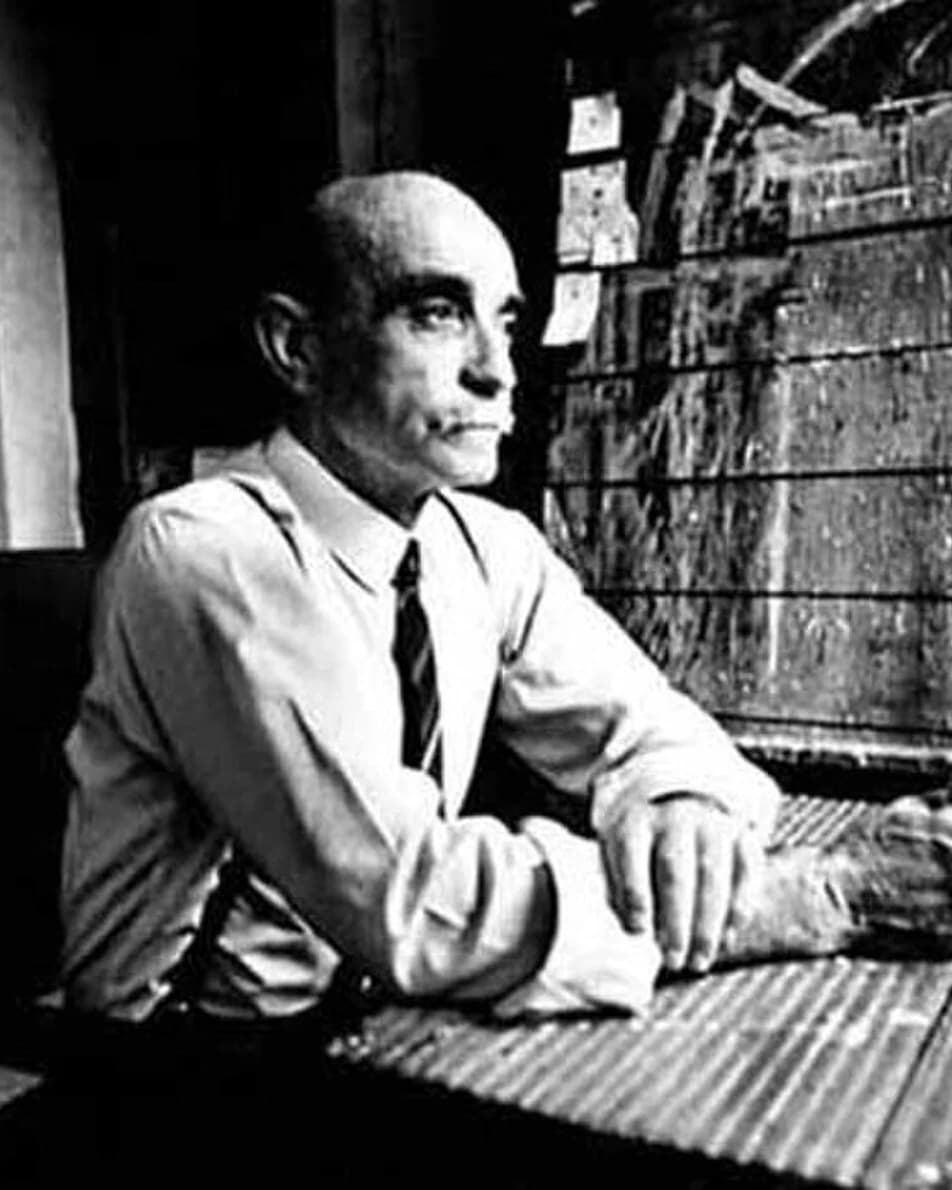
Image
Artist image
Lothar Wolleh; Wikimedia Commons; CC BY-SA 3.0.
