
0919–0967
Li Cheng
Li Cheng (919–967) lived at the close of the Five Dynasties period and in the first years of the Song, came from a scholarly family connected with the Tang imperial clan, and by some accounts kept away from official service. His landscapes, with their “level distance”, pale ink and mist, became a model for Guo Xi and many later masters. No originals seem to survive: copies of the 12th to 17th centuries are thought to come closest to them.
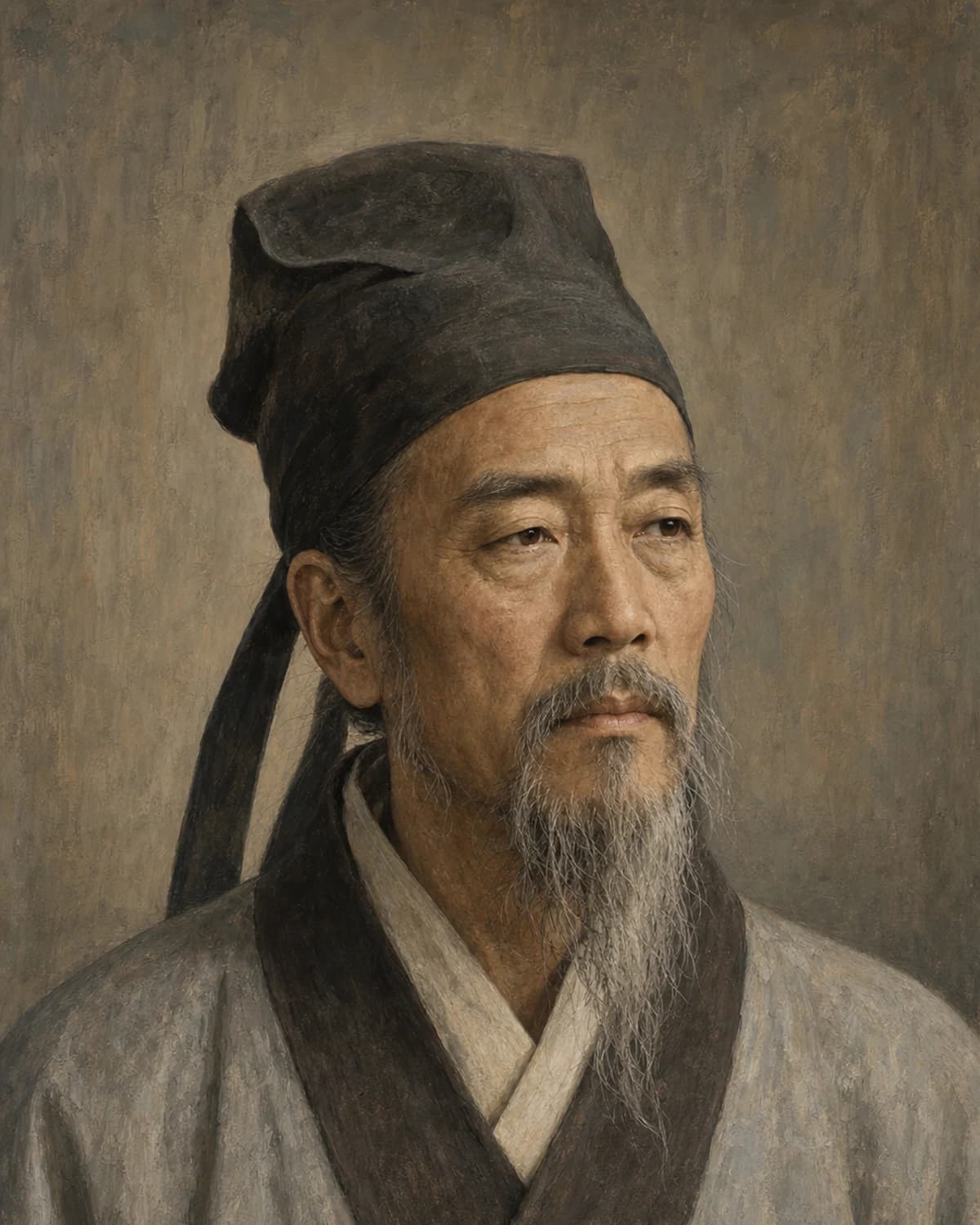
Biography
Li Cheng’s paintings had already become rare a hundred years after his death. Tradition explains it like this: the family belonged to the Tang imperial clan, and to have an ancestor regarded as “merely a painter” was a disgrace. Li Cheng’s grandson, who served as governor of Kaifeng in the Jingyou era (1034–1037), is said to have bought up his works and destroyed them, on the grounds that his grandfather had not wanted them in unworthy hands. Even so, the catalogue of the imperial collection, the “Xuanhe huapu”, compiled in the 12th century, lists one hundred and fifty-nine works by Li Cheng.
To my mind, this story explains the rarity of his scrolls a little too conveniently to be accepted without reservations.
Li Cheng was born in 919; his courtesy name was Xianxi. His forebears were Confucian scholars and officials; his grandfather lived through the Huang Chao Rebellion of the 870s, and in the turbulent last years of the Tang the family fled its old home. He lived in Qingzhou (now part of Weifang, in Shandong province); according to other accounts, first in the old Tang capital of Chang’an, then in Yingqiu, and in his last years in the Song capital of Kaifeng. The sources also disagree about his attitude to office. By one account, he passed the state examination for the highest degree, the jinshi, but did not become an official and turned down the nobles who sought his work. A certain Sun Anzhi is said to have offered him a prestigious post in exchange for a painting, been refused, and then bribed an acquaintance of Li Cheng to steal one; the artist never forgave him. By another account, under the Later Zhou Li Cheng joined the supporters of the future Song dynasty, was invited to the capital after its accession, entered the Hanlin Academy and received an honorary title.
He learned by copying Jing Hao and Guan Tong, and then turned to nature itself, most often to the landscapes of Shandong. He painted with heavily diluted ink; it was said of his manner that he treated ink like gold, and his landscapes seem veiled in the mist of a dream. He joined the majestic mountains of the northern masters to the pale ink and light mists of the southern painters of Jiangnan, and founded the style of “misty trees in a level distance”. With Fan Kuan and Guan Tong he was named one of the three rival masters of landscape, and his contemporaries ranked him above all the landscape painters of the past. The human figures in his landscapes were often painted by Wang Xiao; the scroll “Reading the Stele” was made jointly with him.
Two of his devices were controversial. Guo Xi later taught that space in a landscape is conveyed by “three distances”: high, deep and level. Li Cheng’s predecessors built vertical scrolls in which tall mountains take the main place, whereas in “Travelers in a Wintry Forest” he opened up a “level distance” into the depth of the picture. Not everyone accepted this, but Guo Ruoxu, Mi Fu and Guo Xi valued the innovation. The second device was a low viewpoint, close to the natural gaze of a person, in place of the earlier view from above. The scholar Shen Kuo reproached him for it: a painter, in his opinion, should show a subject from all sides and from different distances. Li Cheng may have been the first to build corner and diagonal compositions, in which the empty space of the scroll works on equal terms with what is depicted.
Because of the many followers, copyists and forgers who appeared even in early times, it is hard to tell his hand from others’. Copies of the 12th to 17th centuries are now thought to come closest to the originals: “Travelers in a Wintry Forest” in the Metropolitan Museum of Art, “Buddhist Temple in the Mountains” in the Nelson-Atkins Museum in Kansas City, “Reading the Stele” in the museum in Osaka, and “Winter Landscape” in the Palace Museum (Gugong). His best-known follower was Guo Xi, who lived in the 11th century.
Li Cheng also wrote a short treatise, “The Secret of Landscape” (“Shanshui jue”), one juan long, in parallel prose with lines of four and six characters. In it he develops the principles of Wang Wei and discusses painting from composition to the brushstroke; some of his words later became established terms of Chinese aesthetics. It was translated into Russian by E. V. Zavadskaya. Li Cheng himself regarded poetry and prose as secondary pursuits, though he was known as a poet and as an expert in history, chess and the qin. His son Li Jue, an expert in the Confucian canon, became a member of the Hanlin Academy and lectured on the classics at the request of the Emperor Taizu.
The 11th-century historian of painting Guo Ruoxu wrote that Li Cheng seldom responded to invitations from the noble and the rich and preferred to wander, studying nature. In his last years he travelled a great deal, and he died in 967 while on a journey, in Huaiyang.
Related context
Associations
Works connected through artistic movements, cultural context and period. Priced works available in this market appear first.
Profile notes
Profile and sources
Image
Artist image
На основе открытого изображения: Vitsuha; Wikimedia Commons; CC0.
