
1862–1951
Leopoldo Romañach
Leopoldo Romañach (1862–1951) was orphaned at five and grew up in Spain, then returned to Cuba and studied in Havana and in Rome. For many years he taught colour theory at the San Alejandro academy, where Amelia Peláez and Víctor Manuel were among his students. He took part in the decoration of the Presidential Palace and the Capitol in Havana.
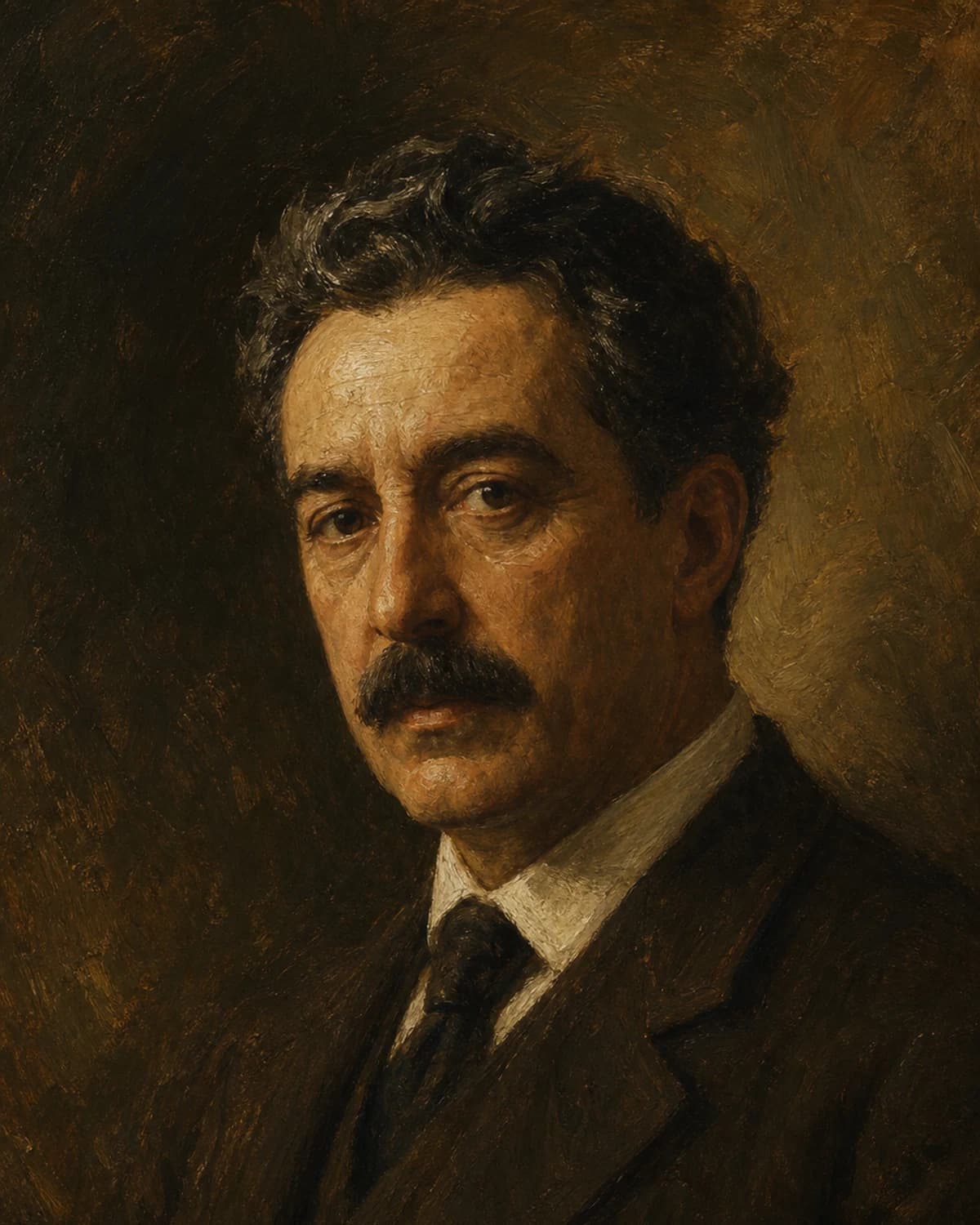
Biography
Leopoldo Romañach began drawing the Cuban landscape as a child, in Spain, where he was taken after the death of his parents.
He was born on 7 October 1862 in the hamlet of Sierra Morena, in the Corralillo district of central Cuba, then part of the Spanish Empire. At five he was orphaned and sent to Spain. His father had wanted him to go into trade, but the boy drew Cuban scenes from memory, against those plans. He returned to Cuba at fourteen, and soon afterwards was sent to the United States to study English and commerce. He gave up his studies because of his passion for painting and went home, reportedly with little to show for it.
From here his path parts from his family’s plans. He persuaded Miguel Melero Rodríguez, director of the San Alejandro academy in Havana, to let him attend classes in colour. By some accounts he studied at the academy in 1885–1886. Then, in Caibarién, Francisco Ducassi, believing in his vocation, helped him obtain a scholarship to study in Rome. At the School of Fine Arts in Rome his teachers were Enrique Serra, Francisco Pradilla and the school’s director, Filippo Prosperi. The Roman period is dated to 1890–1895.
After returning to Cuba, Romañach was given the chair of colour theory at the San Alejandro academy. Later he went to Paris to study the new painting theories of Impressionism and applied them in his teaching, changing the academy’s customary methods. He directed the academy in 1934–1935, and was later named professor emeritus of his chair and honorary director of the academy.
His work is usually divided into three periods. The early pieces, “Nido de miseria” (Nest of Misery), “La convaleciente” (The Convalescent) and “La abandonada” (The Abandoned Woman), are marked by a dramatic, pitying view of life, tied to the social conditions of the time. In the second period the new techniques of painting are more noticeable, three-colour technique and Impressionism: “La promesa” (The Promise), “La última prenda” (The Last Pledge), “La muchacha del abanico” (The Girl with the Fan), “La vuelta al trabajo” (The Return to Work) and “El ex voto” (The Votive Offering). Later he abandoned sad subjects. To this time belong “Hizo modelos”, “Primavera” (Spring), “Campesina” (Peasant Woman), “En un rincón del estudio” (In a Corner of the Studio), “Cabezas” (Heads), “Desnudo” (Nude) and his last painting, “Impresionismo”. Among his genre pictures are also named “The Old Man with an Orange” and “The Man with a Flask”. It seems to me that this division is hard to describe accurately without the canvases themselves, and it is easy to see in it a scheme devised later.
He also decorated public buildings in Havana. His work is found in the former Presidential Palace, now the Museum of the Revolution, and in the Capitol.
Awards came from several countries: a bronze medal at the Exposition Universelle in Paris (1900), a gold medal at the exhibition in St. Louis (1904), a silver one in Buffalo (1904), a gold one in Charleston, and first prizes in Cuba (1912), in Panama (1915) and in Seville (1929). He was a member of the International Artistic Circle in Rome and a full member of the National Academy of Arts and Letters of Cuba. In 1950 the Republic of Cuba awarded him the Great Cross of the National Order of Merit of Carlos Manuel de Céspedes.
Among his students are named Pastor Argudín Pedroso, Amelia Peláez, Lesbia Vent Dumois, Jesús Castellanos, Víctor Manuel García Valdés and Mariano Rodríguez. The Provincial School of Plastic Arts in Santa Clara bears Romañach’s name.
He died in Havana on 10 September 1951.
Related context
Associations
Works connected through artistic movements, cultural context and period. Priced works available in this market appear first.








Profile notes
Profile and sources
Image
Artist image
На основе открытого изображения: Leopoldo Romañach; Wikimedia Commons; Public domain.
