
15.04.1452–02.05.1519
Leonardo da Vinci
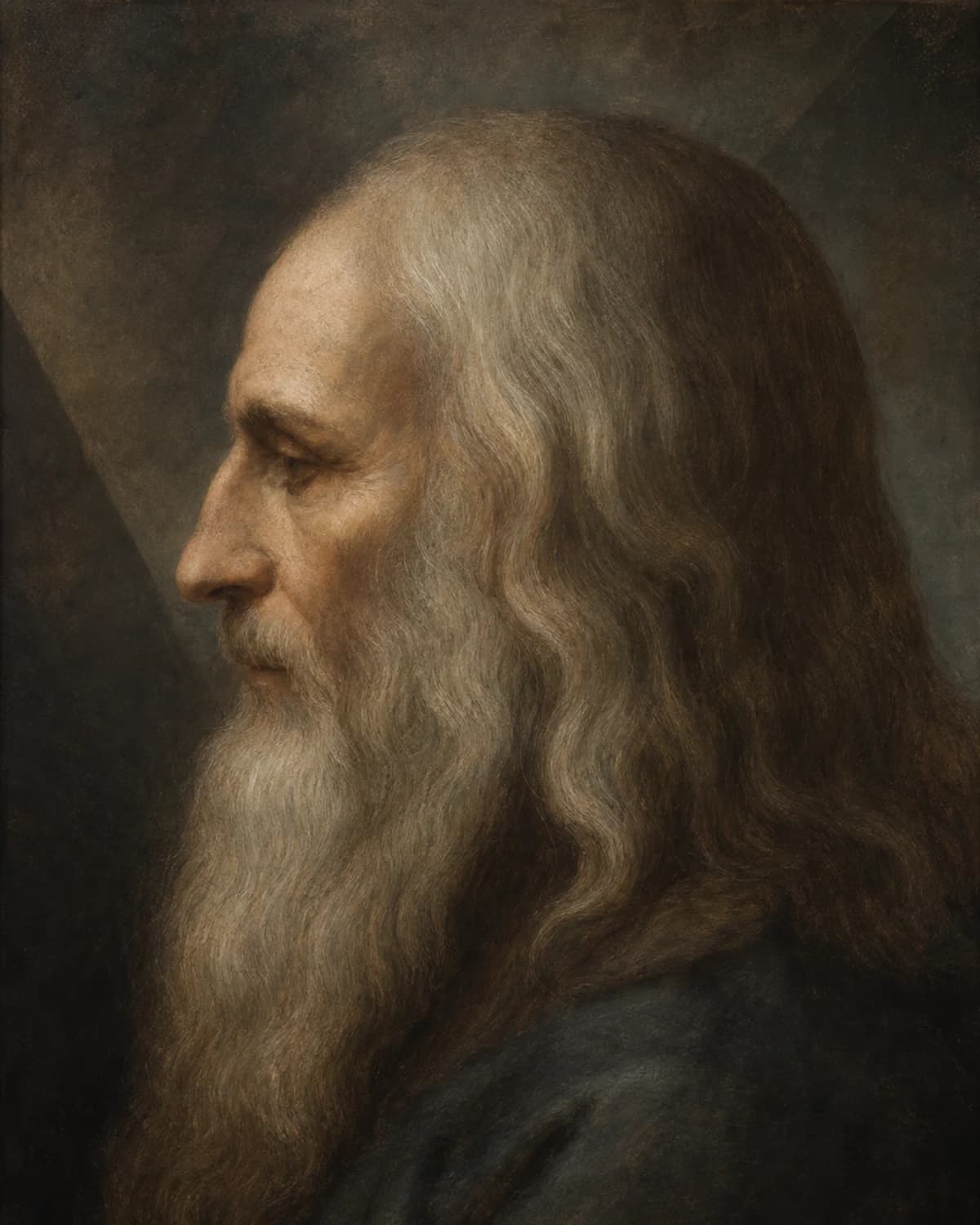
Leonardo da Vinci (1452–1519) trained in Florence under Andrea del Verrocchio, served the Milanese duke Ludovico Sforza for almost twenty years and died in France as the guest of King Francis I. Fewer than twenty-five paintings by him survive, among them “The Last Supper” and the “Mona Lisa”, but some thirteen thousand pages of notes and drawings remain: anatomy, mechanics, the flight of birds, water.
Biography
Among his notes on the flight of birds, in the Codex Atlanticus, Leonardo set down his earliest memory. He is lying in his cradle, a kite comes down to him and opens his mouth with its tail. Whether this really happened or was invented later is still argued over. To my mind the note itself says more than any answer: even his own infancy he remembers as the observation of a bird.
He wrote very little about himself at all.
Leonardo was born on 15 April 1452 in Vinci, a small town about 35 kilometres from Florence, or somewhere close by. Local tradition names the hamlet of Anchiano, but there is no conclusive proof. His father, Ser Piero, was a prosperous notary; his mother, Caterina, came from a humble family; they were not married, and the following year each of them married someone else. The boy seems to have grown up at first with his mother, and from 1457 he was certainly living in the house of his grandfather Antonio; he is thought to have been close to his uncle Francesco. He was taught little: reading and writing in Italian, and arithmetic.
In the mid-1460s the family moved to Florence, and at about fourteen Leonardo entered the workshop of Andrea del Verrocchio, first as an errand boy, then as an apprentice. The training was broad: technical drawing, chemistry, metalwork, mechanics, carpentry, and only after that drawing, painting and modelling. According to Vasari, in Verrocchio’s “Baptism of Christ” (about 1472–1475) Leonardo painted the angel holding Christ’s garments so well that his master is supposed to have given up the brush for good. Most likely this is a legend, but Leonardo’s part in the picture can be seen in the landscape and in the figure of Christ, painted in oil over tempera. In 1472 he was admitted to the Guild of St Luke.
His own Florentine commissions, an altarpiece for the Chapel of St Bernard in the Palazzo della Signoria (1478) and the “Adoration of the Magi” for the monks of San Donato a Scopeto (1481), were left unfinished. Around 1482 Leonardo left for Milan. Before going he wrote Ludovico Sforza a letter setting out in detail what he could do as an engineer and maker of weapons, and mentioning only in passing that he could also paint. He took with him a silver lyre in the shape of a horse’s head.
The Milan years (1482–1499) produced the “Virgin of the Rocks” and “The Last Supper” in the refectory of the convent of Santa Maria delle Grazie. The wall shows the moment just after Christ has said that one of the disciples will betray him. The writer Matteo Bandello watched Leonardo at work: there were days when he painted from dawn to dusk without stopping to eat, and then went three or four days without touching a brush. The prior kept hurrying him, the matter reached the duke, and Leonardo, if Vasari is to be believed, said that the face of Judas could be painted from the prior. Instead of fresco he painted in tempera on a gesso ground, and within a hundred years the mural was being described as completely ruined. For Sforza he designed festivities and prepared a huge bronze equestrian monument to Francesco Sforza. The clay model of the horse was finished, but in November 1494 the metal went into cannon against the French king Charles VIII. Around 1498, in the Sala delle Asse of the Sforza Castle, he painted the ceiling so that the room became an arbour of sixteen interlaced mulberry trees. In 1490 the assistant Salaì joined the household; within a year Leonardo wrote of him: “thief, liar, obstinate, glutton”, yet he kept him by his side for another thirty years.
When the French overthrew Ludovico in 1500, Leonardo left for Venice with Salaì and the mathematician Luca Pacioli, and there he drew up plans for defence against attack from the sea. In Florence the friars of Santissima Annunziata gave him a workshop, and, according to Vasari, people came in crowds to see his cartoon of “St Anne”. In 1502 he served Cesare Borgia as a military engineer and drew a plan of Imola for him. From 1503 he worked on the portrait of Lisa del Giocondo and did not part with it for the rest of his life. In January 1504 he sat on the committee that decided where Michelangelo’s “David” should stand, and afterwards he painted “The Battle of Anghiari” in the Palazzo Vecchio while Michelangelo prepared “The Battle of Cascina” opposite. Leonardo’s mural soon deteriorated, and it is now known from a copy by Rubens.
From 1506 he was in Milan again, now in the service of the French governor Charles d’Amboise; there the pupil Francesco Melzi came to him. In 1513 Leonardo went to Rome, lived in the Belvedere of the Vatican and dissected corpses, and, as Vasari tells it, fixed onto a lizard scales dipped in mercury. A commission from Pope Leo X came to nothing when the artist busied himself inventing a new varnish.
In 1516 Francis I invited him to France and settled him in the manor house of Clos Lucé near the royal château of Amboise. Leonardo drew up for him a plan for a palace-town at Romorantin and made a mechanical lion: at a festivity the lion walked up to the king and, when struck with a wand, opened its breast to show it full of lilies. By 1517 his right hand had almost stopped working. He wrote, as it happens, with his left hand and in mirror script, from right to left; most of the roughly thirteen thousand pages of his notes, from shopping lists to designs for wings, are written that way. I would look at these sheets alongside the paintings: text and drawing are often mixed together on one and the same page, and neither can be read without the other.
Leonardo died at Clos Lucé on 2 May 1519. As his will required, sixty poor men carrying candles followed the coffin. His principal heir was Melzi, who received the paintings, the instruments, the library and the manuscripts. On 12 August Leonardo was buried in the collegiate church of Saint-Florentin in Amboise. In 1802 the church, wrecked during the Revolution, was pulled down, and some of the graves were lost. In 1863 Arsène Houssaye found a skeleton there, together with fragments of an inscription bearing the letters “EO”, “AR”, “DUS”, “VINC”. In 1874 the bones were reburied in the Chapel of Saint-Hubert at the Château d’Amboise, and the plaque above them honestly says that the remains are only presumed to be Leonardo’s.
Artist works
Works by the artist
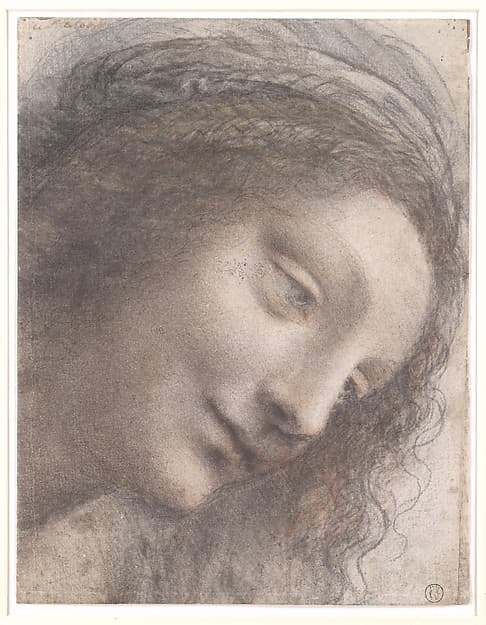
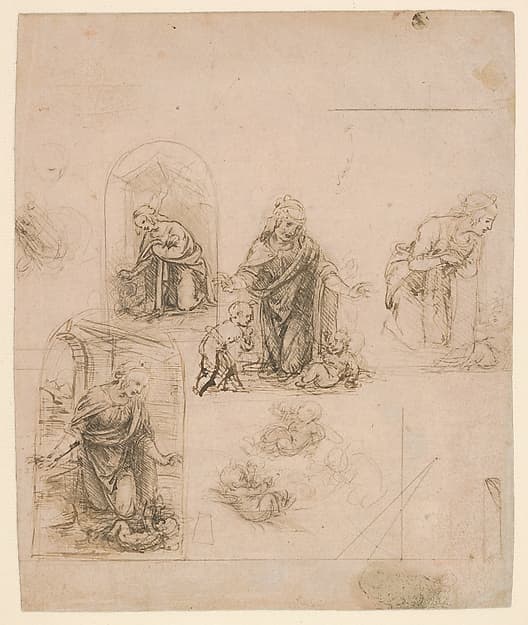
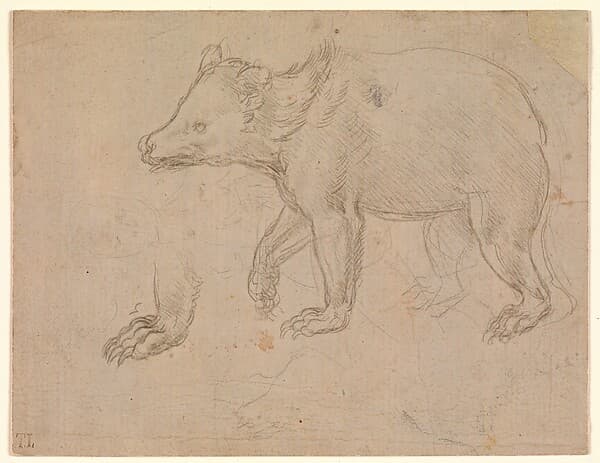
Works by Leonardo da Vinci available in this edition of NEOARCA.
Related context
Associations
Works connected through artistic movements, cultural context and period. Priced works available in this market appear first.
Profile notes
Profile and sources
Image
Artist image
На основе открытого изображения: Attributed to Francesco Melzi; Wikimedia Commons; Public domain.
