
03.09.1920–25.07.2013
León Ferrari
León Ferrari (1920–2013), an Argentine electrical engineer, took up art seriously only in 1954, and his fame came from a Christ crucified on an American fighter plane (1965), a protest against the Vietnam War. He wrote “illegible” letters and made wire sculptures and collages of newspaper cuttings. From 1976 to 1991 he lived in exile in São Paulo, and in 2007 he received the Golden Lion of the Venice Biennale.
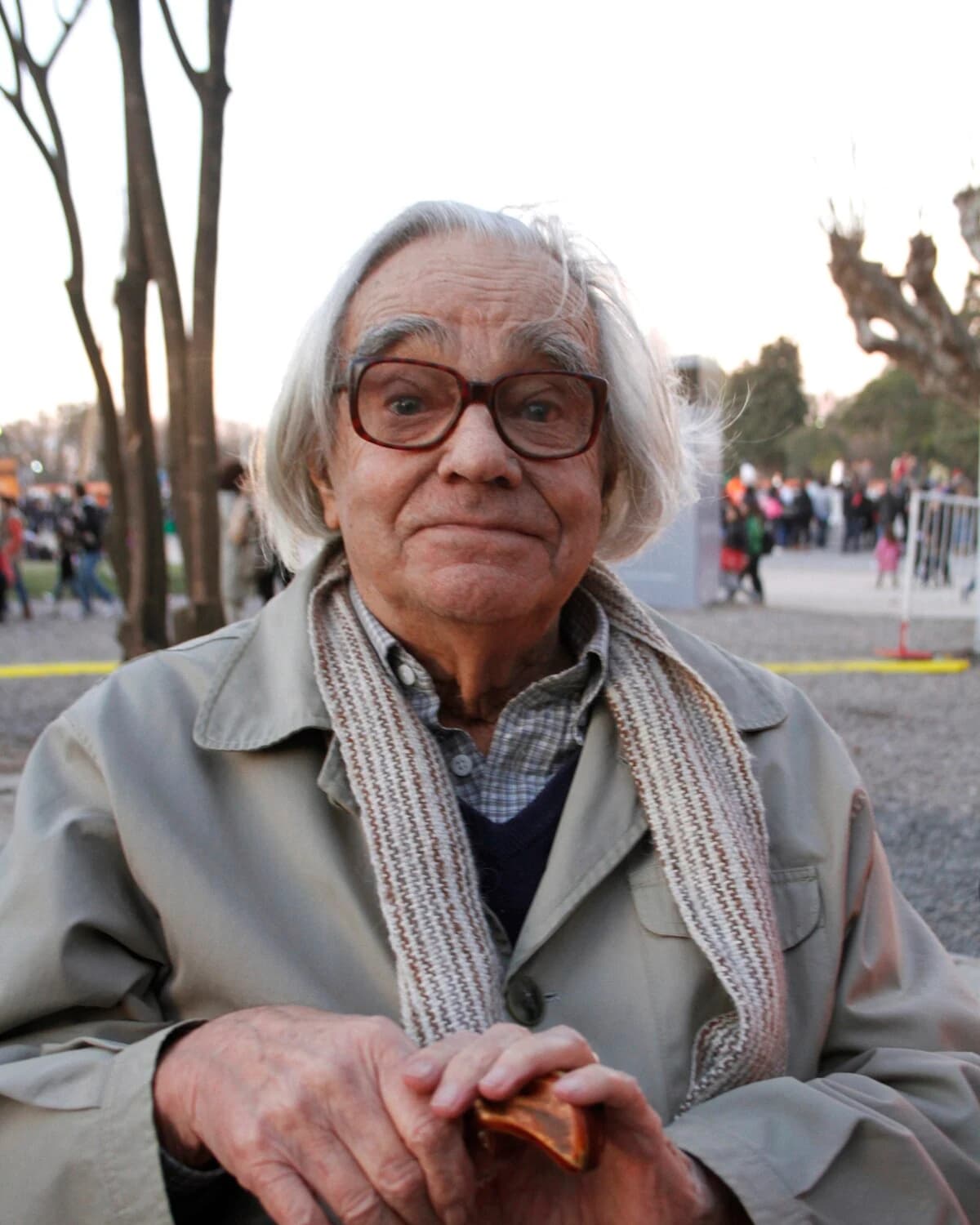
Biography
In 1965 León Ferrari submitted four works on religious themes for the National Prize of the Torcuato Di Tella Institute in Buenos Aires. The main one, “Western and Christian Civilization”, was a nearly life-size figure of Christ crucified on a model of an American fighter plane, its nose pointing downwards. The director of the institute’s Centre of Visual Arts, Jorge Romero Brest, demanded that it be withdrawn, or the artist would not be admitted to the competition, and Ferrari gave way. The other works, box-like showcases, were shown all the same: in one a bomber hung over a Vietnamese school, in another fourteen aircraft added up to “fourteen votes in the OAS”. The critics attacked him anyway for his assaults on Christianity, and he answered them with “Written Painting”, a letter written by hand like a drawing.
He was forty-five. He had become an artist some ten years before, almost by chance.
Ferrari was born on 3 September 1920 in Buenos Aires. His father, Augusto César Ferrari, a native of San Possidonio in Italy, was a well-known painter. The son qualified as an electrical engineer at the University of Buenos Aires and worked in his profession into his thirties, while from 1946 he painted portraits and flowers for himself. In 1952 the family moved to Italy, and there in 1954 he took up clay almost by chance. Lucio Fontana invited him to the 10th Milan Triennale, his first solo exhibition was held in Milan in 1955, and that same year Ferrari returned to Buenos Aires. He carved wood, modelled in plaster and cement, and from 1959 bent wire; he showed his first wire sculpture in 1961.
In March 1962 he began to draw, and from then on words and handwriting became his main material. At first these were “deformed writings”, lines of strokes that looked like text but could not be read. “Letter to a General” (1963), a large sheet covered in black ink in a sweeping calligraphic hand, is impossible to read; Ferrari later explained that one cannot write a logical letter to a general and that illegibility also protects against censorship. To my mind this work explains him better than any manifesto. Into other sheets he wrote perfectly legible essays, letters and poems on politics. From 1964 came collages of photographs and reproductions of religious images, objects and plastic. In 1968 Ferrari took part in the collective action “Tucumán Arde” (“Tucumán Is Burning”), in which artists exhibited photographs, articles and short films about poverty in the province of Tucumán. In 1965 he wrote that if anyone proved to him that this was not art, he would not change course; he would simply cross out the word “art” and call what he made politics.
From the early 1970s Ferrari hardly exhibited for several years, and in 1976, because of threats from the military dictatorship, he took his family to São Paulo. His son Ariel stayed in Argentina. In February 1977 he was abducted by the forces of the dictatorship, and in 1978 the family learned that he had been found dead on 26 February 1977; in all likelihood he was murdered. In Brazil Ferrari worked with mail art, photocopies and lithography and wrote books. In the series “Heliografías” (1980–1987) he printed by diazotype plans of absurd cities, interchanges, neighbourhoods and furniture arrangements in which tiny figures walk round a closed loop; “Bairro” (1980) is one of them. Wire came back too: the steel sphere “Planeta” (1979), about 130 centimetres across, would not go through the gallery door, and the door had to be broken. His wire sculptures hummed in the wind, and in 1981 he staged “Fourteen Nights of Performance” in São Paulo, playing sculptures with built-in instruments. In 1983 the São Paulo Association of Art Critics named his exhibition the best of the year. From 1985 he placed reproductions of Michelangelo’s “Last Judgement” under cages of birds and left them to the birds’ droppings; the São Paulo Museum of Modern Art was the first to show such a work.
In 1991 Ferrari returned to Argentina for good. In 1995 he received a Guggenheim Fellowship and made illustrations for an edition of the “Nunca más” report on the disappeared for the newspaper Página/12, setting the Argentine military beside the Nazis; politicians protested against these sheets. In 1997 he founded a club of the impious, heretics, blasphemers, atheists and infidels and sent John Paul II a letter asking him to abolish the doctrine of the Last Judgement. The 2004 retrospective at the Centro Cultural Recoleta provoked protests by believers: 70,000 people came, and several works were destroyed. When the Archbishop of Buenos Aires, Cardinal Jorge Bergoglio, the future Pope Francis, declared the exhibition blasphemous, a judge closed it; the city authorities appealed, the exhibition reopened, and Ferrari publicly thanked the cardinal for the publicity.
In 2006 the Pinacoteca do Estado de São Paulo showed a retrospective of his work, and in 2007 he took part in Documenta 12 in Kassel and received the Golden Lion of the 52nd Venice Biennale, where “Western and Christian Civilization” was on show. In 2008 he set up the Augusto and León Ferrari Foundation. In 2009 the Museum of Modern Art in New York showed the exhibition “Tangled Alphabets”, in which his works hung alongside those of Mira Schendel; it then went to the Reina Sofía in Madrid. In 2012 the Konex Foundation gave him its highest award as the leading visual artist in Argentina of the decade. That same year, following his idea, fourteen glass panels bearing the full text of Rodolfo Walsh’s “Open Letter to the Military Junta” were installed by the former Navy Mechanics School, now the Space for Memory and Human Rights.
León Ferrari died in Buenos Aires on 25 July 2013, at the age of ninety-two. He is buried in La Chacarita Cemetery.
Profile notes
Profile and sources
Image
Artist image
Tecnópolis Argentina; Wikimedia Commons; CC BY 2.0.
