
26.12.1955–present
Lemi Ghariokwu
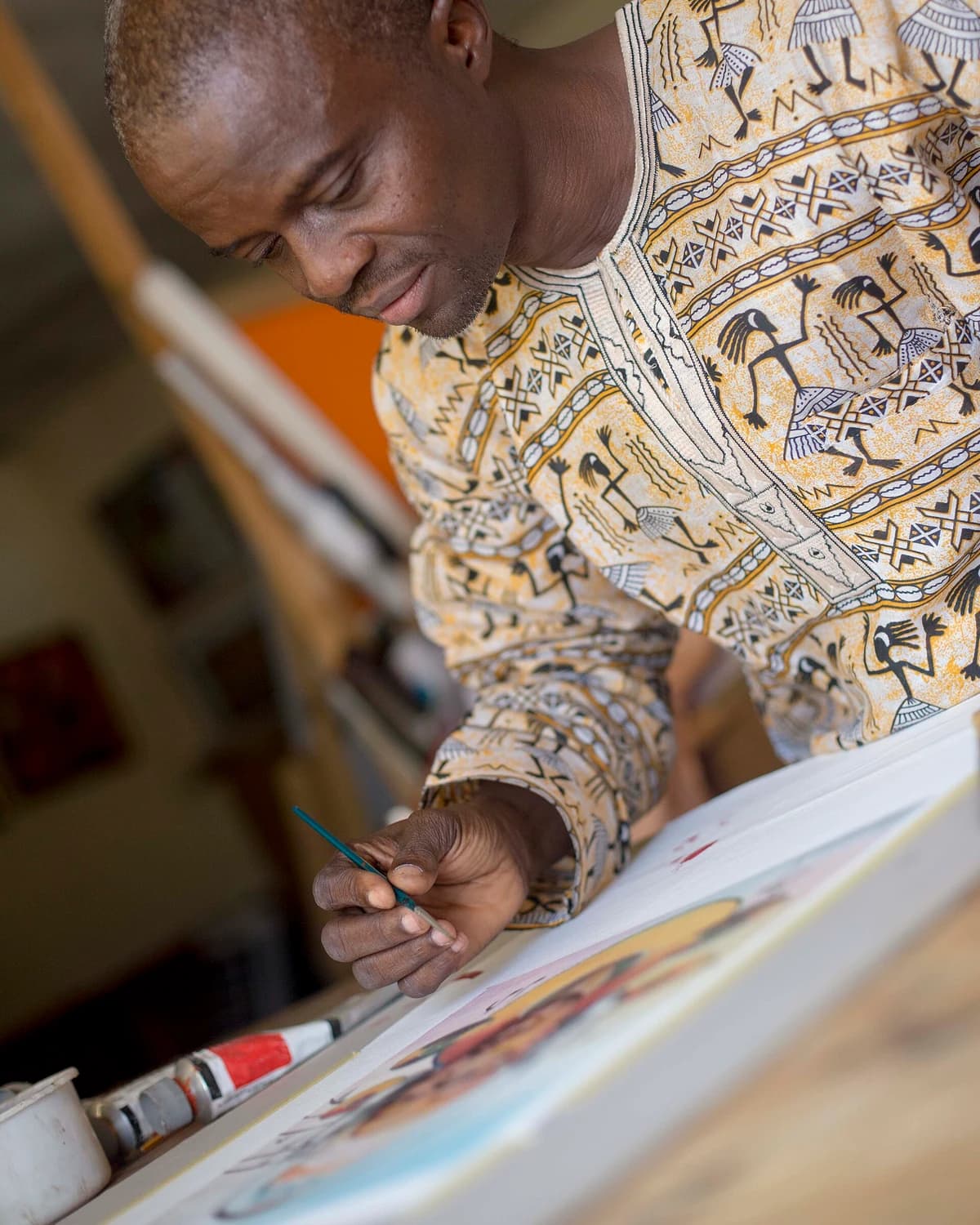
Lemi Ghariokwu (born 1955), a self-taught Nigerian artist from Lagos, met Fela Kuti at eighteen and drew 26 covers for his albums. In all he has more than two thousand covers to his name for Nigerian and foreign musicians, from Bob Marley to Miriam Makeba. His painting “Anoda Sistem” (2002) is in the Museum of Modern Art in New York.
Biography
In 1974 Babatunde Harrison, a journalist with the “Sunday Punch”, walked into a pub in Lagos and saw a picture a young artist had made for the owner. Harrison asked to see more, and among the drawings was an illustration of Fela Kuti’s song “Roforofo Fight”. He took the artist to Fela. Fela liked the work and offered to pay for it, but the artist refused the money, and that was the beginning of his way into the “Kalakuta Republic”, the musician’s commune.
Lemi was eighteen.
He was born on 26 December 1955 in Agege, Lagos, as Emmanuel Sunday, and has lived in Lagos all his life. His father wanted him to become a mechanical engineer, so he attended the technical secondary school of Yaba College of Technology, where he studied technical and science subjects. There his schooling ended. He taught himself to paint, working out a manner of his own, read a great deal, listened to reggae and took an interest in metaphysics.
He and Fela Kuti worked well together. The musician gave him complete freedom: Lemi decided for himself what to show and how, and on some covers he placed his own photograph and comments. His method was to listen to a record, think it over and answer the music with painting, lettering and text, hence the wealth of detail on his covers. The images often echo the songs and their politics, and sometimes argue with them; his colours are bright and his typefaces are his own. For Fela he made 26 covers. Besides Fela, Lemi designed records for Osita Osadebe, James Iroha, Bob Marley, Kris Okotie, Lucky Dube, Miriam Makeba, Gilles Peterson and about a hundred other musicians around the world. From the early 1980s he was for eleven years the consulting cover designer for Polygram in Nigeria, worked as long again with artists of the Kennis Music label, among them 2Face, Lagbaja and Sound Sultan, made covers for EMI and CBS, and drew logos for magazines. He has more than two thousand covers to his name. How many of them were made for Nigeria and how many for foreign companies I have not been able to establish. Recent works include the covers of Brymo’s album “Oṣó” (2018) and Falz’s “Moral Instruction” (2019), and in 2024 the visuals for the project “70 Years of Music in Nigeria”.
The West took notice of him in the early 2000s. In 2003 his work was included in the exhibition “Black President: The Art and Legacy of Fela Anikulapo Kuti” at the New Museum of Contemporary Art in New York. His first solo exhibition in Britain took place in 2004 at the Spitz Gallery in London, and the music magazine of “The Observer” called him the “King of Covers” at the time. The president of MTV, Mark Rosenthal, commissioned from him the painting “Everybody’s Gotta Be Somebody”, about which Aaron Konisberg made a documentary film. The painting “Anoda Sistem”, made in 2002, entered the permanent collection of the Museum of Modern Art in New York. In 2006 his political cartoons of 1975–2006 were shown in Brooklyn together with work by two other Nigerians. In 2007 the curator Bisi Silva organised his solo exhibition “Democrazy” at the Centre for Contemporary Art in Lagos, and in 2008 the publisher Phaidon included twenty of his works in the book “Area 2”, on a hundred graphic artists from around the world. He designed the cover of a new edition of the biography of Fela written by Carlos Moore, and in 2010, commissioned by the producers of the Broadway musical “Fela!”, he decorated an advertising bus.
Lemi has received a Nigerian music award for the record sleeve of the year, a Fame Music award and the title of favourite sleeve designer. Part of his archive is held by the British company Punch Records, which has invited researchers to work with the material.
Profile notes
Profile and sources
Image
Artist image
Weekhai; Wikimedia Commons; CC BY-SA 4.0.
