
24.06.1936–present
Lee Ufan
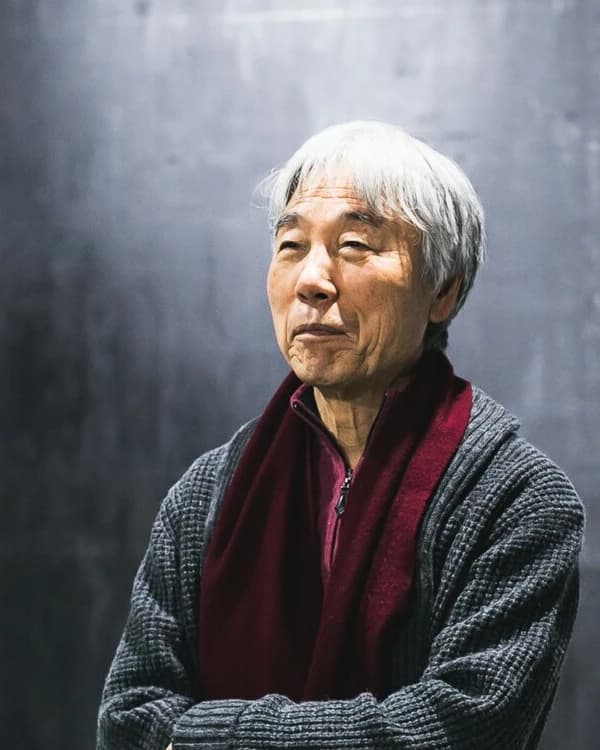
Lee Ufan (born 1936), a native of Haman County in South Korea, has lived and worked in Japan since 1956, and since the 1980s in France as well. He was the chief theorist of the Japanese group Mono-ha, and is known for the stones set beside steel plates in his “Relatum” series and for paintings of one or two brushstrokes. Museums of his work have opened on the island of Naoshima (2010) and in Arles (2022).
Biography
In 1968 Lee Ufan laid a square sheet of glass on a steel plate and dropped a stone onto it from a small height. Cracks spread across the glass. The pattern of the cracks was decided by gravity rather than by the artist’s hand, and that was the whole point: the work had come into being, yet the author’s gesture had vanished from it. Later he gathered works of this kind under the general title “Relatum”, meaning “that which is brought into relation”. In 2011, for the Guggenheim Museum in New York, he repeated a similar action of 1969: a large stone falls onto glass plates and shatters them.
He was born in 1936 in Haman County, South Gyeongsang Province, when Korea was a Japanese colony. He was brought up by his parents and a Confucian grandfather, and, as was the custom in old families, the boy was taught calligraphy, ink painting and the Chinese classics at home; he also studied painting as a high-school student in Seoul. In 1956 Lee entered the fine arts department of Seoul National University, but two months later he went to Japan to stay with an uncle and remained there. In 1961 he graduated from the philosophy faculty of Nihon University in Tokyo; what absorbed him most at the time was Heidegger.
He began painting alongside his philosophy, in a restrained traditional Japanese manner, far from the turbulent abstraction of the Gutai group. In the 1960s he taught at the independent school B-Semi, run by the artist Kobayashi Akio, and asked his students to think about the movement of the hand, about the way paper crumples and clay twists. His first solo exhibition was held at the Sato Gallery in Tokyo in March 1967. In March 1969 he won a competition for new critics announced by the publisher Bijutsu Shuppansha, and in May he received a prize at the Ninth Contemporary Art Exhibition of Japan for “Words and Things”: three huge sheets of paper laid out flat, a direct reference to Michel Foucault’s book “Les Mots et les choses”. That same year, 1969, saw the essay “From Object to Being”, in which he wrote of wanting to show the world as it is, and of “encounter” (deai), the moment when a person enters into relation with things. In this logic a work comes to life only when the viewer engages with it attentively and at length.
A year later came the collection “In Search of Encounter”, published in the magazine “Bijutsu Techō” together with the round-table discussion “Mono Opens a New World”, which Lee chaired with Sekine Nobuo and young artists. These texts are considered the theoretical foundation of Mono-ha, the “School of Things”, and the group became widely known in that same year, 1970, through the exhibition “Aspects of New Japanese Art” at the National Museum of Modern Art in Tokyo. He later explained the group’s central idea with the example of a stone: nobody made the stone, it may be as old as the Earth, and the question was what would happen to art if the unmade were let into it. Lee himself places Mono-ha alongside the European Arte Povera and American Minimalism of the same years.
Since 1972 he has called all his sculptures “Relatum”. The materials stay the same, stones and sheets of iron, and in the Mono-ha years also cotton wool, glass and wood. At the 1971 Paris Biennale, where he was chosen as one of Korea’s representatives, three stones pressed down on a rubber mat and stretched it. He also represented Korea at the São Paulo Biennial in 1969 and 1973, and in 1977 took part in documenta 6 in Kassel.
Painting returned with the series “From Point” and “From Line” (1972–1984), first shown in 1973 at Tokyo Gallery. He took the technique from Japanese nihonga painting: ground mineral pigment bound with animal glue. The brush touches the canvas, the paint goes down in a thick ridge and grows gradually paler until it runs out. The artist calls this fading “yohaku”, the art of emptiness. The critic Fujieda Teruo saw these paintings above all as action and process, while Minemura Toshiaki suggested looking at them as an image of time, closer to a video recording. I lean towards the second reading. From 1991 came the “Correspondence” series, where one or two grey-blue strokes remain on a large white surface, and from the mid-2000s the “Dialogue” series: a broad flat brush and a single square stroke, which is in fact laid down in several layers.
From 1973 to 2007 Lee taught at Tama Art University in Tokyo, where he is now professor emeritus. In 1997 he taught as a visiting professor at the École Nationale Supérieure des Beaux-Arts in Paris, and his exhibition at the Jeu de Paume in Paris took place at the same time. Then came a retrospective in Bonn (2001), the Praemium Imperiale for painting (2001), and the exhibition “Resonance” at the Palazzo Palumbo Fossati in Venice during the 2007 Biennale. In 2010 the Lee Ufan Museum opened on the island of Naoshima, in a building by Tadao Ando.
The retrospective “Marking Infinity” at the Guggenheim (2011) brought together more than ninety works from the 1960s onwards. In 2014 he became the seventh contemporary artist invited to Versailles, in 2016 he showed his project “The Cane of Titan” in the Great Courtyard of the Winter Palace, and in 2019 he filled the entire plaza in front of the Hirshhorn Museum in Washington with ten “Relatum” sculptures. In 2022 his second museum opened in Arles, in the sixteenth-century Hôtel Vernon, remodelled by the same Ando. A year later the Hamburger Bahnhof in Berlin staged a large retrospective, hanging his paintings next to Rembrandt’s self-portrait of 1634.
In the summer of 2024 his sculptures stood in the garden of the Rijksmuseum in Amsterdam.
Profile notes
Profile and sources
Image
Artist image
Andrew Tupalev; Wikimedia Commons; CC BY-SA 4.0.
