
08.01.1836–25.06.1912
Lawrence Alma-Tadema
A Frisian from Dronryp who trained in Antwerp, Alma-Tadema moved to London in 1870 and became one of the most popular Victorian painters. He painted scenes of ancient Rome and Egypt with such archaeological exactness that critics found them close to museum catalogues. He put opus numbers on 408 of his pictures, beginning with a portrait of his sister from 1851.
Biography
The first picture to which Alma-Tadema gave an opus number was a portrait of his sister Artje, painted in 1851, when he was fifteen. The last, “Preparations in the Coliseum”, carries the number 408. He introduced the numbering in 1872 and went back to number his early works as well, which made it easier to tell originals from forgeries.
Lawrence Alma-Tadema was born on 8 January 1836 in the village of Dronryp in Friesland, the sixth child of the village notary, Pieter Tadema. Tadema is an old Frisian surname, and the names Lourens and Alma came to him from his godfather. In 1838 the family moved to Leeuwarden, and in 1840, when the boy was four, his father died. His mother loved art and added drawing lessons to the children’s upbringing; Lourens studied with a local teacher hired for his older half-brothers. He was being prepared for a career in law and was sent to the grammar school, but in 1851 he fell gravely ill, and the doctors, expecting the worst, let him draw and paint as much as he liked. He recovered and decided to become an artist.
In 1852 he entered the Royal Academy of Fine Arts in Antwerp and studied there for four years, winning several prizes; his chief teacher was Gustaf Wappers. Before leaving the academy he became assistant to Professor Louis Jan de Taeye, in whose lectures he had come to love history and historical costume. He then worked with Hendrik Leys, whose studio was regarded as one of the best in Belgium. There, in 1861, he painted “The Education of the Children of Clovis”, shown at an exhibition in Antwerp: the picture was a success, and it was bought and presented to King Leopold. Leys, by the artist’s own account, praised the work but compared its marble to cheese. Alma-Tadema took this seriously and later became known as the painter who rendered marble and variegated granite better than anyone. He often destroyed his early works: of several watercolours on the theme of “Faust”, only one survives.
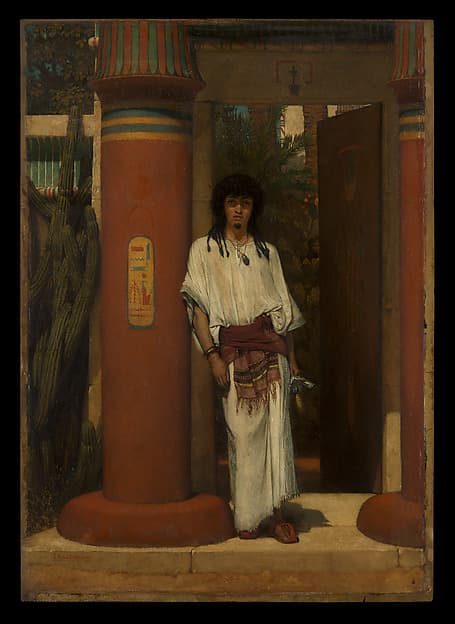
From 1862 he worked on his own. The Merovingian subjects that had absorbed him until the mid-1860s found little wide international demand, and he turned to ancient Egypt, at first working from museum objects: he did not visit Egypt until the winter of 1902–1903. In 1863 his mother died, and on 24 September he married Marie-Pauline Gressin-Dumoulin de Boisgirard, the daughter of a French journalist living near Brussels. They spent their honeymoon in Italy, in Florence, Rome, Naples and Pompeii, and after that he painted mainly scenes of antiquity. His daughters Laurence and Anna grew up, one becoming a writer, the other a painter. Their son died in infancy.
In the summer of 1864 he met the influential art dealer Ernest Gambart, who commissioned twenty-four pictures from him and arranged an exhibition in London. In 1865 Alma-Tadema moved to Brussels and received the Belgian Order of Leopold. Pauline died in 1869, and for almost four months he could not work. The doctors in Brussels could not diagnose his own ailment, and on Gambart’s advice he went to London in December. There, in the house of the painter Ford Madox Brown, he met Laura Theresa Epps; they married in July 1871. Laura became a painter herself and posed for many of his canvases, for example “The Women of Amphissa”.
He settled in England for good in 1870, at the beginning of September, with his daughters and his sister, and changed his name to an English form. He attached Alma to his surname so that he would stand near the start of the alphabetical lists in exhibition catalogues, under the first letter of the alphabet. In 1873 Queen Victoria granted him British status. In 1874 the explosion of a barge loaded with gunpowder on the Regent’s Canal wrecked his London house; his daughters were thrown out of the windows together with their beds but were not seriously hurt, and not one picture was damaged. In 1879 he became a full member of the Royal Academy of Arts, and in 1882 a retrospective was held at the Grosvenor Gallery.
In 1883 he bought a house that had belonged to Jacques Tissot and rebuilt it to his own design: sixty-six rooms, three studios, collections of Japanese and Chinese art. In those same years he went to the excavations at Pompeii every day, and critics reproached him because his pictures resembled museum catalogues. His best-known picture, “The Roses of Heliogabalus” (1888), shows the emperor smothering his guests under rose petals; the flowers were sent to him from France in winter. Critics received it coolly, but it was bought by the engineer George Aird. To my mind, what is most interesting about it is the sheer pedantry: he painted roses and only roses, although the ancient text names other flowers too.
Later he turned to history less and less: “Spring” appeared (he worked on it for more than four years), as did “Unconscious Rivals”, “Silver Favourites” and women on marble terraces above the sea. He designed stage productions (mostly Shakespeare, at the Lyceum Theatre) and devised furniture and costumes. In 1899 he was knighted, the eighth foreign artist to receive that honour, and in 1904 he received the Order of Merit. His last major work was “Caracalla and Geta” (1907).
Laura died on 15 August 1909.
In the summer of 1912 Alma-Tadema went with his daughter Anna to Wiesbaden for treatment and died there on 25 June; by other accounts, on 28 June. He was buried in the crypt of St Paul’s Cathedral in London. A few months later the Royal Academy held a memorial exhibition, but soon his work went out of fashion, and interest in it returned only from the 1960s. In 1975 a plaque was placed on the house at 44 Grove End Road in St John’s Wood.
Artist works
Works by the artist
Works by Lawrence Alma-Tadema available in this edition of NEOARCA.
Profile notes