
1954–present
Larry Abramson
Larry Abramson (born 1954), an Israeli painter from South Africa, worked for ten years as a printer at the Jerusalem Print Workshop, rewrote Malevich’s “Black Square” in his own way in the 1980s and, in the series “tsooba” (1993–1994), painted thirty-eight landscapes of a single hill with ruins and as many impressions of them on newspaper. He has taught at the Bezalel Academy since 1984; in 2010 the Tel Aviv Museum showed his retrospective.
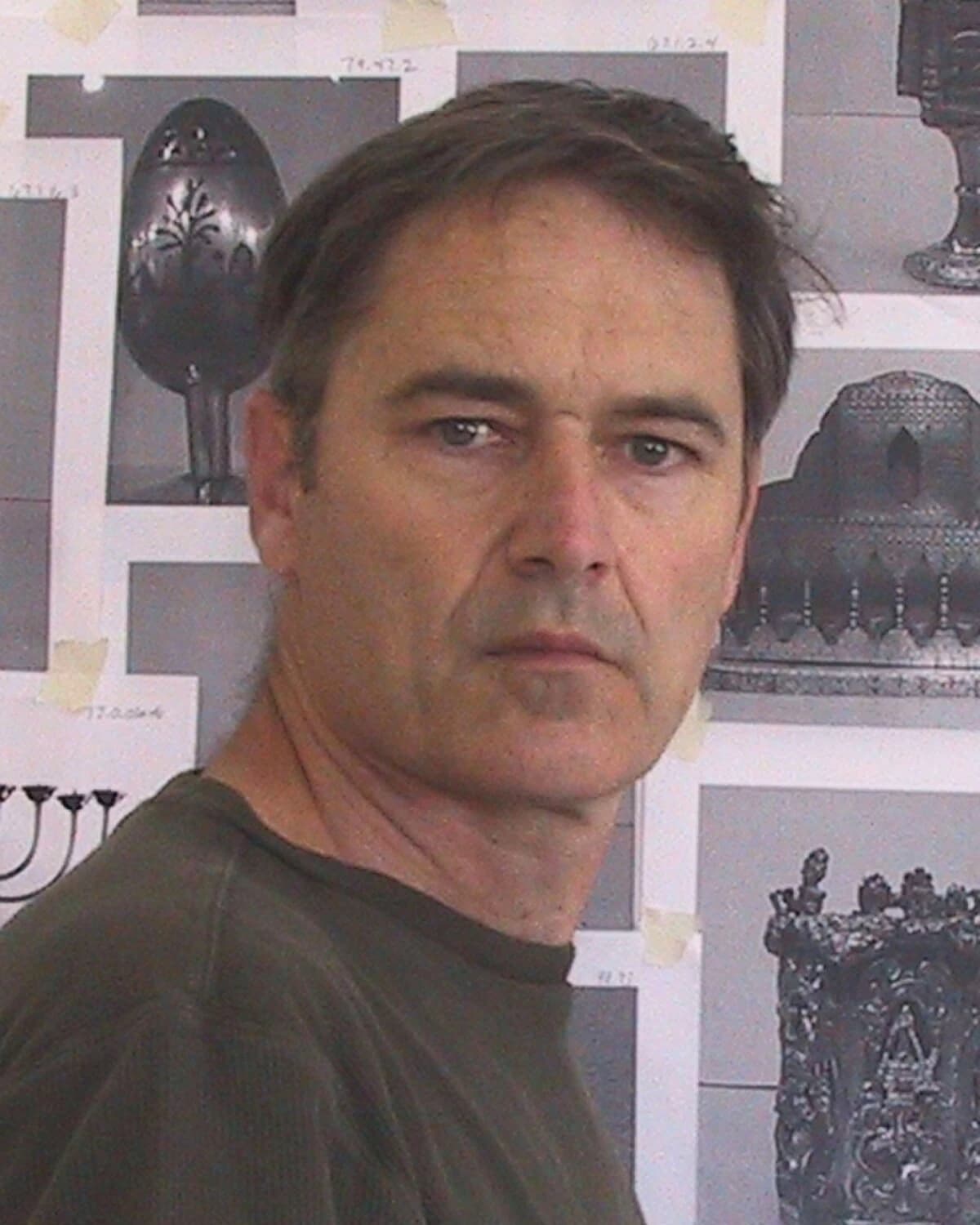
Biography
Larry Abramson’s series “tsooba” (1993–1994) consists of thirty-eight landscapes in oil, thirty-eight impressions of those canvases on newspaper, and still lifes of plants gathered at the same spot. The spot is a hill of ruins near Kibbutz Tzova outside Jerusalem; ten years earlier Joseph Zaritsky had painted it, and in his pictures the ruins of the abandoned Arab village dissolved into abstraction. Abramson painted the view in detail and realistically, and then erased it himself by pressing it against newspaper.
That was his way of arguing with a teacher without naming him.
Abramson was born in 1954 in South Africa; in 1961 the family moved to Israel and settled in Jerusalem, where he finished the Hebrew University Secondary School. In 1973–1974 he took the foundation course at the Chelsea College of Art and Design in London, and on his return became printer and curator of exhibitions at the Jerusalem Print Workshop, where he worked until 1986. His first solo exhibition was held in 1975. In the 1980s he worked with the symbols of European modernism, above all Malevich’s “Black Square”, setting abstraction against figurative drawing; the Israel Museum holds “Column VII” (1988), “Hevel” (1989–1990), “Return of the Black Square IV” (1990) and a sheet from the series “Beams” (1992). In 1984 he joined the teaching staff of the art department of the Bezalel Academy, in 1992 he became head of the department, and in 1996 he founded and headed Bezalel’s master’s programme for young artists. In 2000 and 2003 the San Francisco Art Institute invited him as a guest lecturer, and in 2002 he joined the team planning a new art department at the Shenkar College in Ramat Gan.
In May 2002 he published in the journal Studio an article, “We Are All Felix Nussbaum”, on how history can be painted after the Holocaust. Its sequel was the exhibition “The Pile” (2005): charcoal drawings of heaps of construction debris, shown at the Felix Nussbaum Haus in Osnabrück and at the Chaim Atar Museum of Art at Kibbutz Ein Harod. In 2007 the Gordon Gallery in Tel Aviv exhibited his new paintings; later works include “Panic III” (2009) and “Israel-Palestine I” (2010). A large retrospective was held at the Tel Aviv Museum of Art in 2010. His awards include the Beatrice S. Kolliner Award for a Young Israeli Artist (Israel Museum, 1979), the Jacques Ohana Prize (1991) and the Mendel and Eva Pundik Prize (2007) of the Tel Aviv Museum, the Sharett Award (1993) and the Minister of Education and Culture Prize (1998).
Profile notes
Profile and sources
Image
Artist image
תולוניוס מרקס; Wikimedia Commons; CC BY-SA 3.0.
