
24.10.1878–15.02.1939
Kuzma Petrov-Vodkin
Kuzma Petrov-Vodkin (1878–1939), the son of a Khvalynsk shoemaker, built his painting on his own “spherical perspective” and the three primary colours; his main pictures are “Bathing of a Red Horse”, “Petrograd Madonna” and “Death of a Commissar”. He studied under Serov, worked in Paris and North Africa, taught for fourteen years in Petrograd and Leningrad, and wrote plays and autobiographical prose.
Biography
On 2 March 1910 the newspaper Birzhevye Vedomosti printed Ilya Repin’s letter “To the Critics of Art”. The occasion was “The Dream”, a picture shown at the exhibition of the Union of Russian Artists. Repin saw in it decadence and a challenge to realism, called its author an “illiterate slave” and an “ignoramus” imitating Matisse and Gauguin, and for good measure attributed to Petrov-Vodkin works by other young Muscovites. A few days later Alexandre Benois and Léon Bakst came to the picture’s defence, and the dispute dragged on for months.
The artist himself took a calmer view of “The Dream”. In a letter he explained that he believed “in the birth of myself, in the simplification of language”.
Kuzma (in documents also Kozma) Sergeyevich Petrov-Vodkin was born on 24 October (5 November) 1878 in Khvalynsk, Saratov province, into a shoemaker’s family; the second half of the surname came from his grandfather’s nickname. His mother, Anna Panteleyevna, a former serf, worked as a servant for rich merchants; his correspondence with her, as his biographers write, took the place of a diary. At twelve he watched two local icon painters at work and tried painting icons himself. In 1893, after finishing the town school, he worked for a summer in the ship-repair yards, failed the entrance exams for the railway school in Samara and ended up in F. E. Burov’s painting classes. There, in all that time, they never once drew from life. Around then the young man took Maxim Gorky a poem on Tolstoyan themes and got a rebuff which, in his words, had a sobering effect.
Chance decided everything. In the summer of 1895 the St Petersburg architect Roman Meltzer came to Khvalynsk; he was designing a mansion for the merchant’s wife and patron Yulia Kazarina. Kuzma’s mother, a maid in the household of Kazarina’s sister, showed him her son’s drawings. Meltzer advised him to go and study in the capital, and Kazarina paid the young man a small allowance for almost ten years. From 1895 he studied at the Stieglitz School of Technical Drawing, from 1897 at the Moscow School of Painting, Sculpture and Architecture under Valentin Serov and Nikolai Kasatkin. In 1902, with his fellow students Pavel Kuznetsov and Pyotr Utkin, he painted a church in Saratov; in 1904 the district court found these murals uncanonical, and they were destroyed. Around the same time he made the five-metre majolica panel “Virgin and Child” for the church at the Vreden Orthopaedic Institute in St Petersburg and went to London, where the design was translated into majolica at the Doulton ceramics works. He graduated from the School in 1904.
Then came Italy (1905–1906), Paris and the Académie Colarossi, and in the spring of 1907 Algeria and Tunisia. “I have almost forgotten my grey colours,” he wrote of Africa. In Paris, at the boarding house her mother kept in Fontenay-aux-Roses, he met Margarita Jovanović, the future Maria Fyodorovna Petrova-Vodkina; they were married in 1910 in Khvalynsk. His first solo exhibition was held in November 1909 in the editorial offices of the magazine Apollon. Later he admitted that in Paris and Africa he had remained an “unformed” artist and that his real work began in Russia.
After “The Dream” came “Boys” (1911), where he himself allowed for the influence of Matisse’s “Dance”, and in 1912 “Bathing of a Red Horse”. Together with “Mother” (1913) and “Girls on the Volga” (1915), these canvases are connected with the Russian icon, rediscovered at that time. He painted churches in Ovruch and Kronstadt, designed “The Maid of Orleans” at Nezlobin’s theatre and taught at Zvantseva’s school in St Petersburg. Gradually his theory took shape: a curved, “spherical” space seen as if from a height, and three primary colours, red, blue and yellow. In 1916 he was called up into the Izmailovsky Life Guards Regiment, where he painted “On the Line of Fire”.
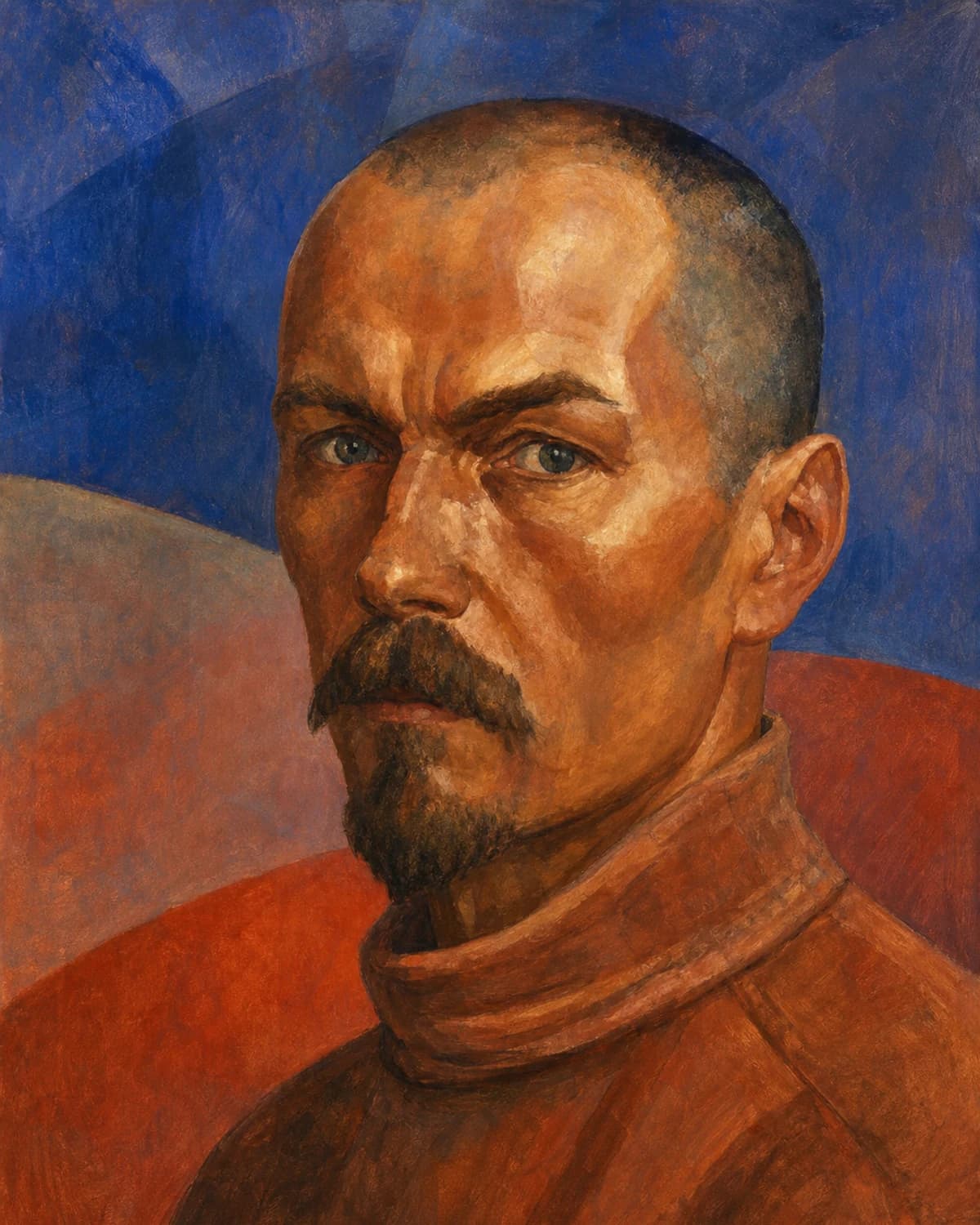
From 1918 Petrov-Vodkin was a professor at the former school of the Academy of Arts, which was then renamed many times over, and he worked there until 1932. He complained to his mother of “damned professorship” in place of painting, and yet these years produced the self-portrait and the still lifes of 1918, “Petrograd Madonna” (1920) and the portrait of Anna Akhmatova (1922). In 1921 he went on an expedition to Samarkand and published the book “Samarkandia”. In October 1922 his daughter Yelena was born. In 1924–1925 the family lived in France. “Death of a Commissar” (1928), painted in the same spherical perspective, summed up the decade.
From 1929 illness kept him away from painting for a long time, and he turned to prose: “Khlynovsk” (1930) and “Euclid’s Space” (1932). In 1933 Gorky savaged the second book, and Petrov-Vodkin replied in a letter to Andrei Bely that the article put him in mind of “cracking sunflower seeds to the accordion” and only egged him on. To my mind his whole character is in that phrase. In 1930 he was named Honoured Art Worker of the RSFSR, and in August 1932 he became the first chairman of the Leningrad branch of the Union of Soviet Artists. When things eased a little, he painted again: “1919. Alarm” (1934), “Housewarming” (1937). His portrait-picture “A. S. Pushkin in Boldino” was rejected by the jury of the 1937 Pushkin exhibition, and the artist cut the canvas to pieces.
Petrov-Vodkin died in Leningrad on 15 February 1939. He is buried at the Literatorskie Mostki of the Volkovo Cemetery.
Related context
Associations
Works connected through artistic movements, cultural context and period. Priced works available in this market appear first.








Profile notes
Profile and sources
Image
Artist image
На основе открытого изображения: Kuzma Petrov-Vodkin; Wikimedia Commons; Public domain.
