
12.10.1875–11.04.1958
Konstantin Yuon
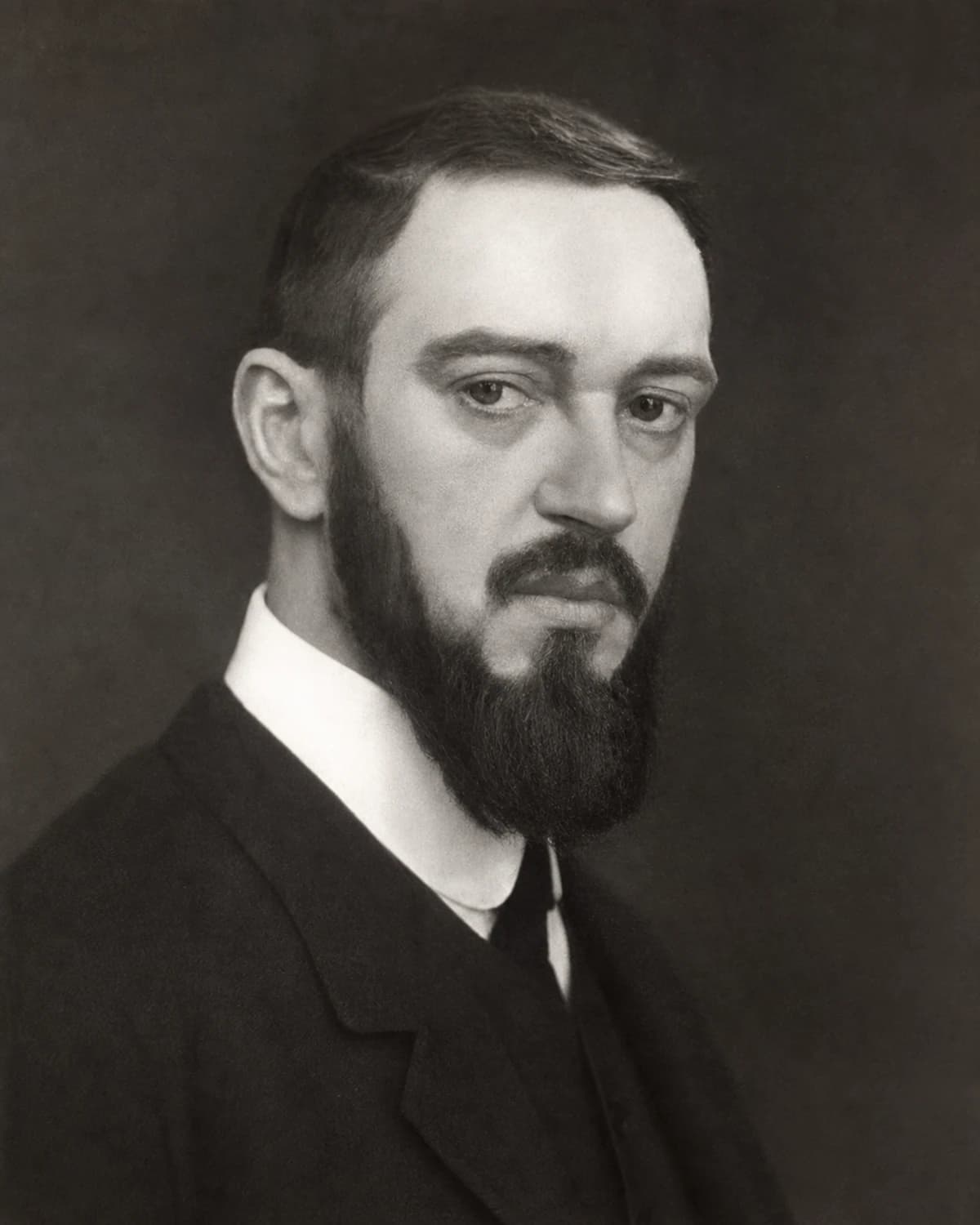
Konstantin Yuon (1875–1958) began as a painter of old Russian towns bathed in sun or snow, from Sergiev Posad to Uglich, and in 1900 opened a private studio in Moscow where Favorsky, Mukhina and Falk studied. He designed productions ranging from Diaghilev’s “Boris Godunov” in Paris to plays at the Maly Theatre, and in the Soviet years became a People’s Artist of the USSR and a full member of the Academy of Arts.
Biography
In Yuon’s picture the domes of the Dormition Cathedral of the Trinity Lavra of St Sergius are seen from above, from the bell tower. It is a clear summer evening, the setting sun blazes on the golden patterned crosses, swallows dart around them, and below, as far as the horizon, lies a peaceful land. The picture is called “Domes and Swallows”, and it was painted in 1921.
The same year saw “New Planet”, in which the revolution is shown as the outcome of a cosmic catastrophe. In Soviet times it was read as showing the “cosmos-creating” significance of the October Revolution; today it is put on the cover of Ivan Shmelyov’s “The Sun of the Dead”, a book about the Red Terror in the Crimea. The interpretations diverge to the point of complete opposition, and, to my mind, the picture itself allows both.
Konstantin Yuon was born on 12 (24) October 1875 in Moscow, into a family of Swiss-German origin. His father, Theodor Juon, worked for an insurance company and in time became its director; his mother was an amateur musician. His elder brother Pavel became a composer and a professor at the Berlin Conservatory. From 1892 to 1898 Konstantin studied at the Moscow School of Painting, Sculpture and Architecture, where his teachers included Konstantin Savitsky and Abram Arkhipov, and after graduating he spent two years in Valentin Serov’s studio. On trips to Western Europe, especially to Paris, he saw the cityscapes of Pissarro and other Impressionists, but did not change his own manner.
In 1900 Yuon opened his own studio of painting and drawing in Moscow and ran it until 1917 together with Ivan Dudin. Among those who passed through it were Vladimir Favorsky, Vera Mukhina, the Vesnin brothers, Robert Falk, Alexander Kuprin, Vasily Vatagin and Nikolai Kolli. In 1903 he became one of the founders of the Union of Russian Artists, and he exhibited with the World of Art. His main subject before the revolution was Russian towns: Moscow, Sergiev Posad, Rostov, Uglich, Torzhok, Pskov, Nizhny Novgorod. He painted them filled with light, with broad perspectives, churches, women in folk costume and a host of small signs of provincial life. “To the Trinity” (1903) and “Tverskoy Boulevard” (1909) are counted among his Impressionist works. There was another line too: in 1908–1912 he made a cycle of engravings, “Creation of the World”, on subjects from the Book of Genesis. In its Symbolism it is closest to the later “New Planet”.
From 1907 Yuon worked for the theatre. In 1912–1913 he designed Mussorgsky’s “Boris Godunov” for Diaghilev’s company at the Théâtre des Champs-Élysées in Paris. Later came “The Government Inspector” at the Moscow Art Theatre (1921), “Yegor Bulychov and Others” at the same theatre (1934), “Khovanshchina” at the Bolshoi (1940), and several Ostrovsky plays at the Maly Theatre, from “A Heart Is Not a Stone” (1923) to “Enough Stupidity in Every Wise Man” (1951). In 1945–1947 he was the Maly Theatre’s chief designer. He also worked in film, on “Ivan Nikulin: Russian Sailor” (1944), and even on an animated film, “Kashtanka” (1952).
After the revolution Yuon stayed in Moscow. In 1923 he painted “Parade of the Red Army” and “People”, another “cosmic” picture about the creation of a new world, and in 1925 he joined the Association of Artists of Revolutionary Russia. The 1920s brought “Young People near Moscow” (1926), “The First Women Collective Farmers. In the Sun’s Rays” (1928) and “End of Winter. Midday” (1929). His late works, “Storming the Kremlin in 1917” (1947) and “Parade on Red Square in Moscow on 7 November 1941” (1949), are painted in the strict spirit of Socialist Realism. The honours were many: a Stalin Prize of the first degree (1943), a doctorate in art history (1941), one of the first full memberships of the USSR Academy of Arts (1947), the title of People’s Artist of the USSR (1950). In 1948–1950 he headed the Institute of the Theory and History of Fine Arts, in 1952–1955 he taught at the Surikov Institute and also at the Repin Institute in Leningrad, and from 1957 he was First Secretary of the board of the Union of Artists of the USSR.
Konstantin Yuon died on 11 April 1958 in Moscow and was buried in the Novodevichy Cemetery. That same year his book “Moscow in My Work” came out, and a year later the two volumes of his essays “On Art”.
Related context
Associations
Works connected through artistic movements, cultural context and period. Priced works available in this market appear first.








Profile notes
Profile and sources
Image
Artist image
На основе открытого изображения: Konstantin Yuon; Wikimedia Commons; Public domain.
