
30.11.1869–06.05.1939
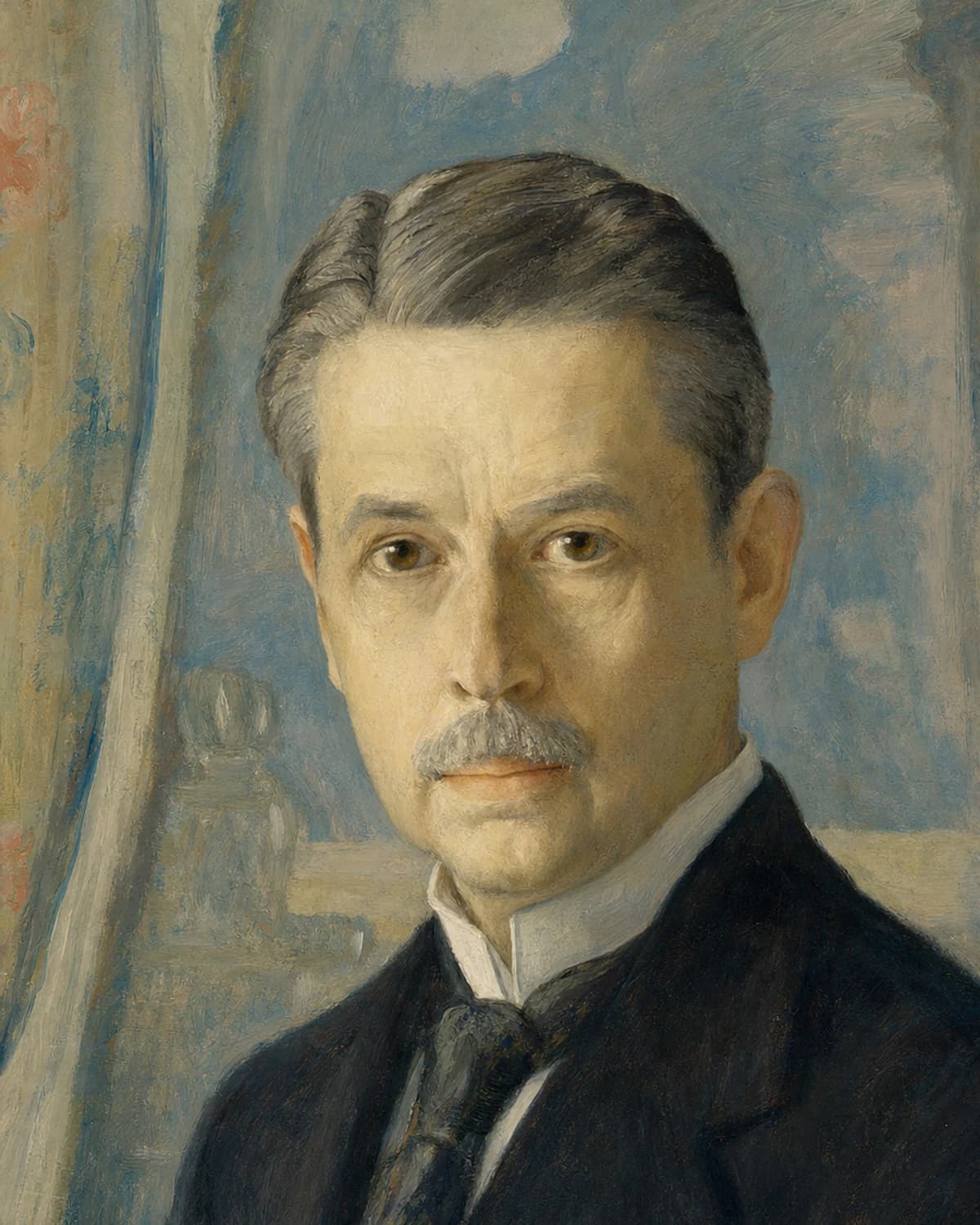
Konstantin Somov
Konstantin Somov (1869–1939) was one of the founders of the World of Art and painted the past as a masquerade: gallant scenes, harlequinades, and “Lady in Blue” in the manner of eighteenth-century portraitists. He also illustrated Pushkin and Gogol, designed covers for Silver Age poets and made porcelain figurines. In 1923 he went to America with an exhibition and never returned to Russia; from 1925 he lived in Paris.
Biography
For three years, from 1897 to 1900, Konstantin Somov worked on “Lady in Blue”, a portrait of the artist Elizaveta Martynova. A young woman in an old-fashioned blue dress stands holding a book against a park landscape, as though she had stepped out of an eighteenth-century canvas. This manner was later called retrospectivism, and Somov one of its leaders.
He was born on 18 (30) November 1869 in St Petersburg. His father, Andrei Ivanovich Somov, was then employed at the Academy of Sciences and later became a curator at the Hermitage; his mother, Nadezhda Konstantinovna, was a fine musician. The family collected old prints, drawings and paintings, and the son decided early that he would be an artist. In 1879–1888 he attended Karl May’s gymnasium together with Alexandre Benois, Walter Nouvel and Dmitry Filosofov, with whom he later founded the World of Art.
From 1888 to 1897 Somov studied at the Academy of Arts, in his last years in Ilya Repin’s studio, and there he met Sergei Diaghilev and Léon Bakst. He travelled to Italy in 1890 and 1894. In the summer of 1896 he and Benois stayed at a dacha in Martyshkino near Oranienbaum, and the landscapes he painted there brought him his first recognition. He spent two winters, 1897 and 1898, in Paris, studying at the Académie Colarossi, and later remembered them as the happiest days of his life.
From 1898 he belonged to the World of Art, designing its magazine and the publication Artistic Treasures of Russia. As a book artist he illustrated Pushkin’s “Count Nulin” (1899) and Gogol’s “The Nose” and “Nevsky Prospect” (1901), drew the covers of Balmont’s “The Firebird” and of a collection by Vyacheslav Ivanov, and the title page of Blok’s “Theatre”. He sought out old techniques and, for example, glued vellum paper onto soft fabric so that the pencil would move across it differently. His favourite masters of the past were Watteau, Fragonard and Boucher; among moderns he was drawn to the Pre-Raphaelites, Beardsley and Whistler; his favourite poet was Verlaine. In 1905 the Imperial Porcelain Factory cast the figurines “The Lovers” and “Lady with a Mask” from his models. His first solo exhibition, in St Petersburg in 1903, brought together 162 works; that same year 95 pieces were shown in Hamburg and Berlin, in 1906 thirty-two works hung at the Salon d’Automne in Paris, and in 1907 the first book about him, by Oskar Bie, appeared in Germany.
By the 1910s Somov was a fashionable painter, the author of harlequinades and gallant scenes in the rococo spirit. Mikhail Kuzmin sensed anxiety behind the festivity and wrote that Somov held up a terrible mirror to the laughing holiday. Benois called him one of the most delicate poets of modern painting. In 1913 Somov became an academician.
He regarded himself with irony and said he would like to become Ingres, or, failing that, at least the little toe on his foot.
From 1907 to 1919 he made more than a hundred and twenty ink drawings for “Le Livre de la Marquise”, an anthology of eighteenth-century French gallant and erotic prose and verse. The fullest edition appeared in 1918 from Golike and Vilborg in Petrograd in a run of 800 copies, and Somov designed the whole book and chose the French texts himself. In 1917–1918 he was artistic consultant to the Porcelain Factory, in 1918 he became a professor at the Petrograd Free Art Studios and taught at Elizaveta Zvantseva’s school, and in 1919 the Tretyakov Gallery held his jubilee exhibition. From 1910 Methodiy Lukyanov lived with him, running his household, helping to organise exhibitions and sitting for him many times; a large portrait of Lukyanov from 1918 is in the Russian Museum.
In 1923 Somov went to America as commissioner of the Russian Exhibition, which opened in New York in January 1924 with 38 of his works. There he painted portraits of Sergei Rachmaninoff and his daughter. He refused to return, calling Soviet Russia completely alien to his art. From 1925 he lived in France; in 1928 he bought a flat on the Boulevard Exelmans in Paris, and a farm appeared in the Normandy village of Granvilliers. For the Trianon publishing house he illustrated “Manon Lescaut” and “Daphnis and Chloe” in 1929–1931; in 1927 he painted the landscape “The Rainbow”, and in 1933 a portrait of a young boxer known as “The Boxer”. His last work was four portraits of the heroine of “Les Liaisons dangereuses”, made in November and December 1934 for his friend and executor Mikhail Braikevich. It seems to me that nothing more Somov-like than this last commission could be imagined.
Konstantin Somov died in Paris on 6 May 1939 and was buried in the cemetery of Sainte-Geneviève-des-Bois. His diaries for 1917–1927 were published in Moscow in 2017–2019, and for the 150th anniversary of his birth the Russian Museum assembled an exhibition of more than a hundred of his works.
Related context
Associations
Works connected through artistic movements, cultural context and period. Priced works available in this market appear first.








Profile notes
Profile and sources
Image
Artist image
На основе открытого изображения: Konstantin Somov; Wikimedia Commons; Public domain.
